Northerners invite PM to ‘toxic meal’ at Parliament
Display dramatises worsening effects of river pollution from mining in Myanmar
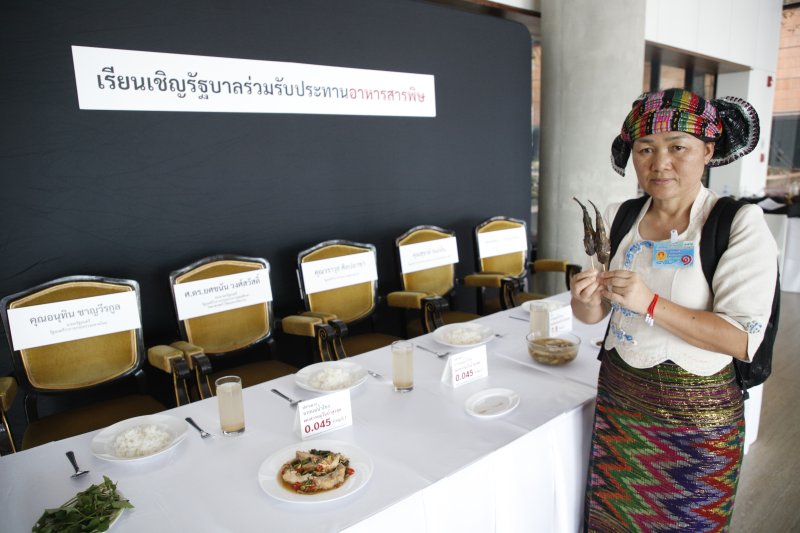
Residents affected by cross-border river contamination in northern Thailand staged a symbolic “toxic meal” at Parliament on Wednesday, inviting the prime minister and four ministers to eat fish dishes sourced from the Sai and Mekong rivers.
Those invited were Prime Minister Anutin Charnvirakul, Deputy Prime Minister Yodchanan Wongsawat, Industry Minister Varawut Silpa-archa, Natural Resources and Environment Minister Suchart Chomklin and Public Health Minister Pattana Promphat.
People’s Party MPs, led by party leader Natthaphong Ruengpanyawut, joined the event.
Sangrawee Suweerakan, a resident of tambon Tha Ton in Chiang Mai, said communities along six rivers had been affected for two years, since mining in Myanmar began changing the water.
Areas free of contamination have been lumped together with affected ones, leaving farmers unable to export their produce, she said. Residents now have to buy all their drinking and household water, while hotels and restaurants have closed due to declining visitor numbers, Ms Sangrawee added.
Fellow resident Jiraphat Kanthiyajai said rice mills have refused to buy local rice and farmers have been barred from growing crops.
“They didn’t come with weapons to shoot us, but they released toxic chemicals that destroy our children,” she said.
Three demands
Kriangkrai Chichuang, a representative of the affected communities, read a statement making three demands:
- bilateral and multilateral diplomacy with neighbouring countries to end upstream mine pollution and set up accountability mechanisms,
- cooperation with international bodies to monitor water quality and assess ecological impact, and
- urgent relief measures for people who have lost their livelihoods.
Most of the mining takes place in areas of Myanmar where the military, which has been fighting on numerous fronts with armed ethnic groups, has no control.
Mr Yodchanan, who leads a task force created last week to address the issue, said Thailand would ask Myanmar to halt unregulated mining in Shan State for six months so that Thailand and China can develop a plan to curb arsenic pollution in rivers.
Mr Natthaphong urged the government to adopt a risk map identifying farming areas that are not affected by pollution, so that farmers are protected from middlemen trying to push prices down.
Arsenic levels up 50%
He said tests of 322 people by state agencies showed accumulated arsenic levels in their bodies had risen by more than 50% between 2025 and 2026.
He called for the Thai-Myanmar Joint Working Group on Water Quality Management in Boundary and Transboundary Rivers to cover all six rivers, set up monitoring points at mine heads and tails, and make testing details public.
Mr Natthaphong said mining was spreading into Laos and could eventually affect the Mekong basin in the Northeast. He urged the government to use forums such as the Mekong-Lancang Cooperation to press China, saying Thailand risked serving as a transit route for ore, particularly rare earths, while bearing the cost of cleaning up toxins.
He also called on Thailand to refuse imports of ore from mines that fail to control pollution and to make public details of the working group’s meetings.
KioskNews shows a cleaned-up reading view extracted from the publisher’s page — the original always lives on their site, not ours.