5 EU nations planning to follow U.S. with deportations to third countries
Five European Union countries are pushing ahead with plans to start deporting asylum seekers whose applications are rejected to third countries outside the bloc, potentially in Africa, after the EU approved new rules this week that clear the way for the practice.
Greece, Germany, Austria, Denmark and the Netherlands have agreed on a common framework to establish "return hubs" outside the EU to which people who have exhausted their legal options to remain in Europe could be transferred if they cannot be sent back to their own countries of origin.
"When it comes to return hubs, it's progressing very well," Danish Interior Minister Morten Bødskov told reporters Thursday, according to AFP. "We are moving in the right direction."
He previously said Denmark expected "to be ready to transfer the first irregular migrants to a partner country outside the EU within 2027."
Greek Migration Minister Thanos Plevris told Politico that Greece expects to have a pilot project in place in the first half of next year.
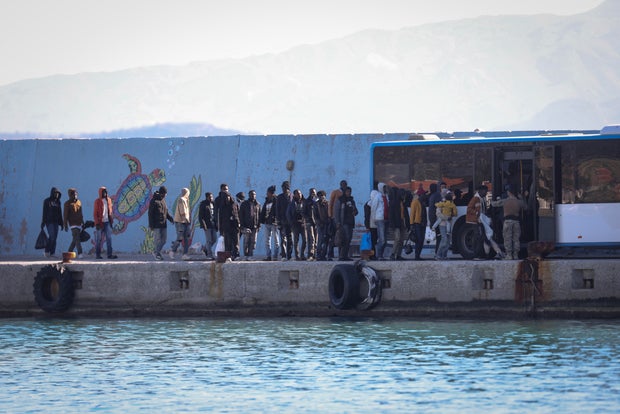
No potential destinations for EU return hubs have been confirmed, although Rwanda has been reported as a possible partner in the project. A Greek government statement on the plans said the hubs would be established in safe third countries, "particularly on the African continent."
The EU itself has presented the idea of return hubs as a potential deterrent to irregular immigration. A discussion paper published by the EU's governing European Council in October 2025 said the hubs could "incentivize voluntary returns," because migrants who fail to comply with a deportation order could face transfer to a hub instead.
It said the policy could also discourage people without a valid asylum claim from making dangerous journeys to Europe.
The rules adopted this week by the EU establish a bloc-wide legal framework for returns and allow member states to conclude bilateral or unilateral agreements with countries outside the bloc, but with stipulations.
Under the rules, "any such agreement or arrangement may only be concluded with a non-EU country that respects international human rights standards and principles of international law, including the principle of non-refoulement," which guarantees that no individual can be sent back to a country where they would face torture, cruel, inhuman or degrading treatment, punishment or other irreparable harm.
EU follows U.S. and U.K. examples
The Trump administration has enthusiastically embraced the use of third-country deportations to remove undocumented migrants from the United States. More than 100 deportees were sent to eight African countries over a 10-day period in August, according to internal U.S. government documents obtained by CBS News.
The deportees were sent to destinations including the African nations of Liberia, Rwanda, Eswatini and Sierra Leone.
Plevris, Greece's migration minister, has praised the Trump administration's approach.
"I am a fan of President Trump," he told Breitbart in August. "But if you ask me what was the best thing he did, it was change the migration policy of the USA, because now we have a new migration policy also in Europe."
Other European governments have experimented with deportations to third nations before, however, with mixed results.
"No shortcut around the difficult parts of migration policy"
Britain's former Conservative Party government sought to send asylum seekers who arrived through irregular routes to Rwanda to have their claims processed there. The U.K. Supreme Court ruled the scheme unlawful in 2023, before it ever got going, over the risk that refugees could ultimately be returned to countries where they faced persecution.
The following year, the policy was formally abandoned by the new Labour Party government after the Conservatives were voted out of power. The British Home Office said £715 million (almost $950 million) had been spent on the Rwanda program by June 2024, and no asylum seekers were forcibly relocated. Four people traveled voluntarily to Rwanda under the program.
"One lesson may be that European governments should expect litigation, even where the third country looks considerably less controversial than Rwanda," Peter Walsh, a senior researcher at the University of Oxford's Migration Observatory, told CBS News on Friday.
"These policies are often justified as deterrence measures, and that assumes a sufficiently large share of people believe there is a realistic chance they will actually be transferred," Walsh said. "If only a very small proportion can be moved, the deterrent may be much less credible."
"The broader lesson from Rwanda is that externalization is not a shortcut around the difficult parts of migration policy," he said. "It may relocate some of those difficulties geographically, but governments still have to deal with courts, individual rights, administrative capacity, countries that may not cooperate with returns, and substantial costs"
The push for return hubs is part of a broader effort by European nations to tighten their immigration policies amid intense pressure on governments to increase the number of people without a legal right to remain who are actually removed.
Jacob Reynolds, policy director at the Freedom and Sovereignty Initiative Europe, a right-wing think tank based in Brussels, called the EU decision to embrace these hubs a "welcome step towards gaining control of our borders and removing those who have no right to be here."
But he added that "outsourcing the problem of illegal migration to third countries — as the EU has long done — risks avoiding the broader problem: the lack of control over EU countries' borders."
He called for "much more fundamental action" to address "the generous regimes available to asylum seekers in Europe," and said until that happened, "the problem will not be solved."
In:
KioskNews shows a cleaned-up reading view extracted from the publisher’s page — the original always lives on their site, not ours.