CCP and China becoming one and the same: experts
By Hsu Yung-ching / Staff Reporter


The Chinese Communist Party’s (CCP) tighter control has made it difficult to separate China from the party, a former Taiwanese defense academic said on Saturday, urging the public to recognize their growing overlap.
Former Fu Hsing Kang College at National Defense University dean Yu Tsung-Chi (余宗基) made the remarks at a forum in Taipei titled “Anti-Communism 2.0: Rethinking Communism in the 21st Century — Completely Eradicating Communism” hosted by the Formosa Republican Association.
Yu said that in the 1958 book The Naked Communist, W. Cleon Skousen wrote that people can persuade Chinese to change China if they distinguish the country from the CCP. A similar belief was also held by US officials during the first term of US President Donald Trump, Yu added.
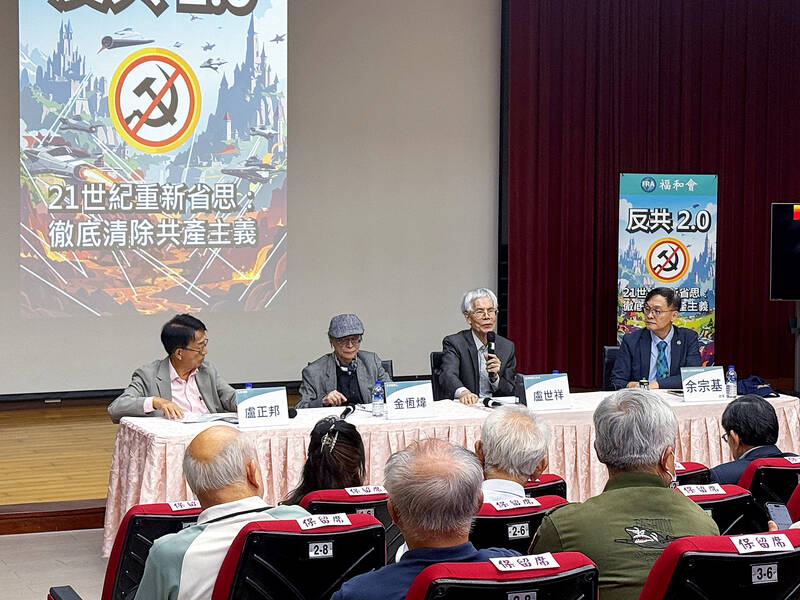
From left, lawyer Lu Cheng-pang, political commentator Chin Heng-wei, journalist Sean Lu of the Taipei Times and former dean of Fu Hsing Kang College at National Defense University Yu Tsung-Chi take part in a panel disucssion during a forum hosted by the Formosa Republican Association in Taipei on Saturday.
Photo: Hsu Yung-ching, Taipei Times
However, with the advancement in technology and CCP enforcing stricter domestic control by enacting Ethnic Unity and Progress Promotion Law and revising the National Defense Education Law, the party effectively makes the country one where nearly everyone is mobilized for national defense, Yu said.
Any hope of dividing and sabotaging Chinese nationalism is an illusion, he said.
“We should gradually equate China with CCP,” Yu said. “Rather than hoping for change to happen with the CCP, we should be prepared for war by building the capacity and resolve to deter China.”
Political commentator Chin Heng-wei (金恆煒), who also attended the forum, similarly refuted the argument that CCP is not China.
China has never experienced democracy, and even if the CCP and Chinese President Xi Jinping (習近平) were to fall, any new force that emerged would be unlikely to steer the country toward democracy, as “power corrupts, and power breeds authoritarianism,” he said.
Taiwanese human rights activist Lee Ming-che (李明哲), who was imprisoned in China for five years after being convicted of “subverting state power,” was in the audience at the forum. He said that democratization in China does not guarantee Taiwan’s safety.
“Taiwan is not obligated to support China’s transition to democracy. China under the communists’ rule still considers taking Taiwan by force. If China becomes a democratic country, people there could organize a referendum on whether China should overtake Taiwan by force,” Lee said.
Seasoned journalist and Taipei Times adviser Sean Lu (盧世祥) told the forum that the US’ National Security Strategy released last year shows that Washington has come to recognize the nature of China and no longer believes Beijing can be integrated into the rules-based international order.
Taiwan should avoid repeating the mistakes of its “boldly going west” policy that advocated for unfettered investment in China, he said, adding that China’s economy has already fallen into deflation.
Escaping deflation is no easy task, Lu said, adding that China also faces challenges including the middle-income trap and the disappearance of its demographic dividend.
Lu added that this does not mean opposing any exchanges between Taiwan and China, but Taiwan should instead focus on its role in global supply chains and deepen its connections with the rest of the world, he said.
Meanwhile, Yu said that during the US’ 250th anniversary celebrations, Trump devoted 12 minutes of a 30-minute speech in July to discussing the threat posed by communism. Yu quoted Trump as warning that communism was making a comeback and threatening the US, and that it had not only deepened divisions within US society but posed a threat greater than those of World War I and World War II combined.
Yu also cited Taiwan’s national security agencies as saying that nearly 40 schools in Taiwan have “communist groups” on campus. This underscored the need to speak out and remind the public of the threat posed by communism, he said.
Taiwan must not allow communism to threaten the country, he added.
Yu went said that more than 2 million Taiwanese traveled in China during the first six months of this year, showing that many have dropped their guard against communism.
“The extent of the harm we suffer would depend on the degree of our ignorance,” he said, adding that politics should be listed as a required course, in which communism should be listed as a key subject on the curriculum. He said Taiwan should also follow the international trend of tightening laws and impose harsher penalties for assisting China’s transnational repression, as the threat facing Taiwan is inevitably more serious than that faced by other countries.
KioskNews shows a cleaned-up reading view extracted from the publisher’s page — the original always lives on their site, not ours.