Flags, fists and an extra 5 minutes: Manila reveals a confident but tired Trump
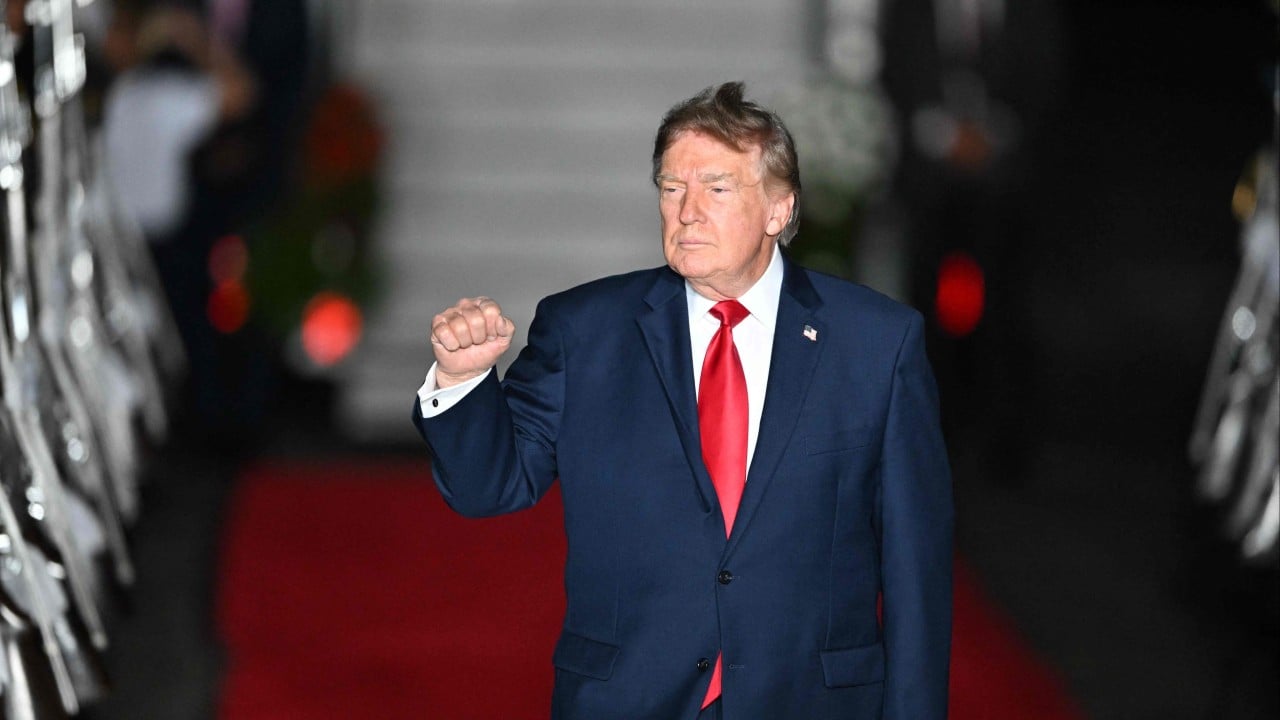
The fist came before the flags. As US President Donald Trump stepped off Air Force One in Manila on Tuesday evening, he raised a clenched fist towards the cameras, accepted miniature American and Philippine flags from a child and waved them down the red carpet.
Roughly 20 hours later, as he departed Manila for Shenzhen in southern China, Trump again raised his fist towards the cameras.
Experts said the sequence which opened his first foreign trip since Republicans lost both chambers of Congress in the midterm elections read as a deliberate signal that Trump intended to continue projecting strength and command on the international stage.
According to some observers, the president looked tired after the long flight from Washington. Others assumed he was simply saving his energy for China, the main event of the Asia trip.
Barely an hour later, the same pattern was observed at the Quadrilateral Security Dialogue (Quad) photo opportunity with Indian Prime Minister Narendra Modi, Japan’s Sanae Takaichi and Australia’s Anthony Albanese.
Standing with the three leaders, Trump turned what was meant to be a brief group shot into a five-minute press opportunity. While the others waited largely silent, he fielded questions on domestic issues and the Nvidia controversy.
“Shall we move,” the Indian leader asked at one point and tried to edge the group forward. Trump stayed put, kept answering and then pointed to his counterparts, calling Modi “a very tough man” and Takaichi “even tougher”.
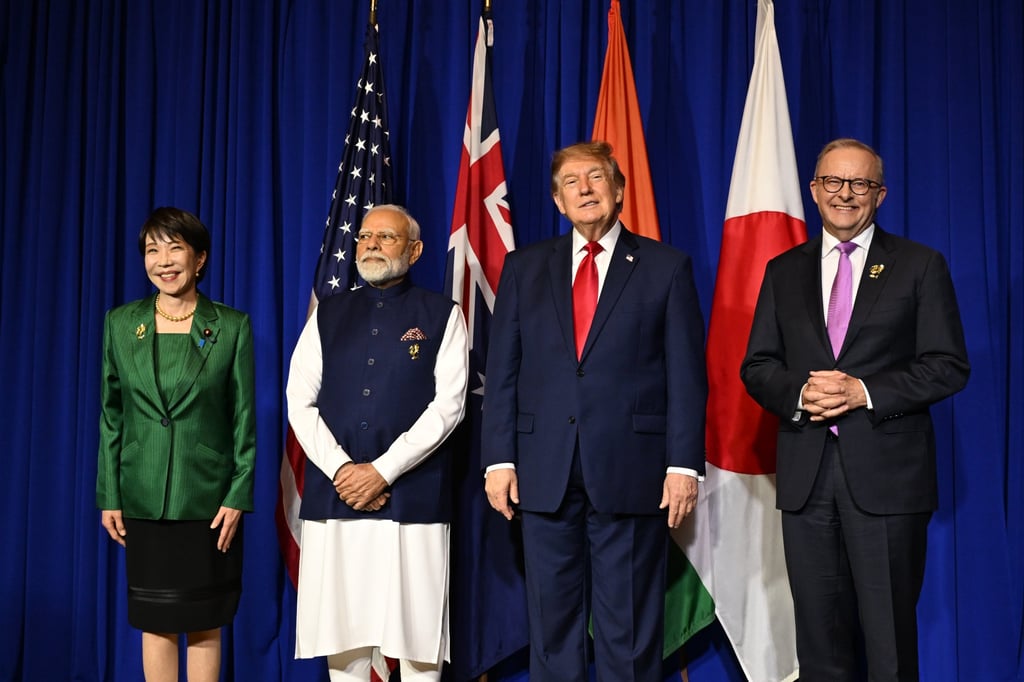
The moment quickly drew online attention as an awkward extension of what was meant to be a brief moment for the cameras, with the other leaders left looking non-committal as they stood beside the US president.
Former Indian foreign secretary Kanwal Sibal called the scene “most disrespectful towards the other three leaders”, saying they “stood there like props” while Modi maintained a “stern” expression.
The Sydney Morning Herald described Modi gesturing as if to ask what was happening, Albanese frowning and fidgeting with his suit button, and Takaichi holding a tight, poker-faced smile as Trump “held court”.
Some social media commenters said Trump looked pale and tired as he waved the flags on the tarmac after the long flight. Others focused on the Quad photo-op, describing it as Trump turning the moment into a personal monologue while the other leaders stood by.
Observers noted a more subdued demeanour from the moment Trump stepped off the plane. “All of a sudden, it seems like a long time,” he remarked at an Asean dinner later that evening.
The energy behind the performance appeared thinner than usual even as he continued to project control, they said.
According to Aubrey Immelman, associate professor of psychology at the College of Saint Benedict and St. John’s University, Trump looked “somewhat disengaged” in the two sets of images.
Immelman said it appeared to him that Trump was just “going through the motions” and really was focused on the “main event” – his trilateral with Chinese President Xi Jinping and Russia’s Vladimir Putin in Shenzhen on Thursday.
There was also an alternative explanation, he noted: “a combination of the 80-year-old Trump not being well rested and suffering from jet lag after the long flight from Washington to Manila.”
189:49
Live: Leaders speak at Apec summit
Immelman, who has published extensive assessments of Trump’s personality and leadership style, also observed that the other Quad leaders “looked pretty unexpressive and non-committal themselves”.
He added that he “didn’t see much display of interpersonal warmth, but maybe that’s only because it was really just a photo op”.
Despite Trump’s statements that the US would catch up with China on critical minerals and that there was “no better partner for Asean than the US”, Immelman found him “more low-key and less boastful than we’ve seen him on his home turf in recent times, where he would typically rattle off a long list of his achievements in office”.
He concluded that this too “[could] be accounted for by the simple fact that Trump was tired and that he was saving his energy for China”.
According to observers, Manila offered only a partial picture of Trump’s post-midterms demeanour on the world stage. The clearer test will come in Shenzhen, where he will take part in the Apec leaders’ summit as well as sit down for three-way talks with Xi and Putin.
Christopher Ulrich, a body language expert and political analyst who has advised senior US officials, described the broader trip as staged political theatre of the type that has become familiar.
The domestic timing is hard to ignore. Trump reaches Shenzhen at a moment when his standing at home is under open question and the summit offers him a high-profile world stage.
“We’ll see whether and how that shows up in his dynamics with Putin and Xi,” Ulrich said.
“Some news reports of his engagements at the Manila summit suggest he’s been relaxed and getting on well, so that may serve as a possible baseline to look at for Shenzhen. Yet we won’t know until we see their interactions,” he said.
“Then compare how he engages with Xi and Putin against how he handles allies like Japan and Australia. With allies, we’ve seen the pat on the arm and the first-name warmth.”
Ulrich added that changes in body language with Xi and Putin will be closely watched, as will who opens any joint remarks, how the leaders are positioned and who has the last word.
KioskNews shows a cleaned-up reading view extracted from the publisher’s page — the original always lives on their site, not ours.