The Danish prime minister’s coarse language about migrants has no place in the EU | Shada Islam

With the notable exception of Spain’s Pedro Sánchez, who may soon be out of office, EU leaders appear most united when promoting one clear aim: reinforcing the already heavily guarded borders of Fortress Europe against unwanted migrants.
Policymakers who once criticised Donald Trump’s immigration policies as inhumane now enact measures that increasingly resemble Washington’s ugly playbook of ICE home raids, family separations, deportations and offshore detention deals.
Denmark’s prime minister, Mette Frederiksen, who calls herself a social democrat, now alludes to the “great replacement” migration conspiracy theory in rejecting multiculturalism. On a podcast last week, she said: “We are a Danish society, and we form an ethnically Danish indigenous tribe.” For good measure, she added: “We do not have religious equality. We are a Christian country. We shall continue to be so.”
Just a day earlier, the Danish PM joined leaders of four other EU countries – Austria, Germany, Greece and the Netherlands –in unveiling the first ever European “return hub” in Rwanda for people whose asylum claims are rejected in the EU. Frederiksen called the deportation deal “gamechanging”. Given Rwanda’s dismal human rights record, the pact – under which the first transfers of about 100 people are due in 2027 – is more accurately described by rights groups as “disgraceful”.
But such criticism can be brushed aside when even Denmark’s supreme court appears to support the government’s anti-migrant stance. The court ruled this week that the eviction of “non-western” tenants from a social housing estate in Copenhagen under the country’s controversial “ghetto law” is not discriminatory.
Belgium, meanwhile, has approved legislation allowing police to forcibly enter properties to remove people deemed to be undocumented, an abhorrent measure that conflates lack of legal residence status with criminality.
The shock-and-awe manner of these announcements, and the coarse anti-migrant and anti-Muslim language that European leaders now use, are disturbing enough. What frightens me even more is their cumulative effect: the normalisation of hate, fear and discrimination, which makes the dehumanisation and exclusion of particular categories of people – migrants and by extension also Black, brown and Muslim European citizens – appear ordinary, orderly and even necessary.
The deportation scheme and police raid legislation may ultimately be challenged in courts and perhaps even overturned. But the purpose of the fanfare is to shift public norms, and widen the Overton window – make previously unacceptable ideas appear a legitimate part of public debate.
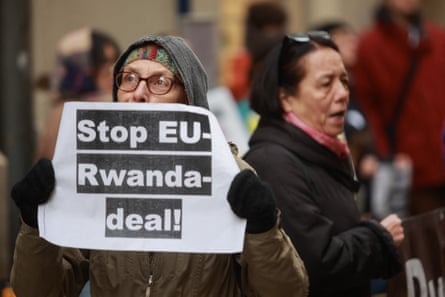
What we are witnessing, I believe, is pure spectacle, courtesy of politicians who face growing public anger over such things as inflation and housing, to give the illusion that they are “taking back control”. It’s the deliberate manufacturing of moral panic about migrants through choreographed, headline-grabbing announcements, coded language and dog whistles that invoke far-right tropes once considered beyond the pale in mainstream European politics.
The political theatre serves an even deeper purpose: it turns extreme ideas into everyday conversations. It creates fear, chills solidarity and deters people from offering shelter.
In his book Chain of Ideas, the American scholar Ibram X Kendi explains how the great replacement theory, which claims that Europe is being “invaded” by people from the global south, moved from a fringe conspiracy into Europe’s everyday consciousness. And here it is, seeping into the discourse of Denmark’s Frederiksen and embedded in the Rwanda plan.
When politicians face little or no pushback for violating longstanding taboos – and are instead invited on to TV chatshows and podcasts to repeat their toxic messages – both their words and actions can become even more inflammatory. And this, in turn, allows EU institutions to quietly start crossing their own red lines by using coded technocratic and neutral-sounding language about “risk management”, “burden sharing”, “returns” and finding “innovative solutions” to control migration.
Brussels could push back against the Rwanda plan but instead of doing that, Magnus Brunner, the most senior EU official on migration policy, has doubled down on the discredited strategy of “migration diplomacy”. In other words, yet more cash and other benefits offered to global-south governments that agree to stop migrants from reaching Europe.
after newsletter promotion
The latest headline-grabbing announcements also serve to divert and distract from Europe’s real problems. Student protests over education shortfalls, failing public services and unaffordable housing are sidelined – and blamed on foreigners.
Despite politicians’ alarmist drumbeat, however, the European parliament’s spring Eurobarometer shows that almost 50% of Europeans see inflation and the cost of living, not migration, as their principal concern. And despite the sense of permanent crisis conveyed by EU leaders, latest data by Frontex, the EU’s increasingly powerful border-control agency, shows the number of “irregular” border crossings into the EU fell by 29% in the first 10 months of this year.
In fact, many of the countries with the toughest public discourse on migration, including Denmark, are quietly bringing in workers from India, the Philippines, Bangladesh and other states to fill labour shortages, often on short-term contracts that can leave workers vulnerable to exploitation.
Elections in the coming days and months could see the installation of even more hardline anti-migration governments across Europe, including in France, where Marine Le Pen, the unapologetically anti-Muslim and anti-migrant leader of the far-right National Rally, is hoping to become president next year.
I watch all this in sadness and fear but retain hope that Europe’s progressive politicians become more vocal in ensuring a more humane European migration policy and a more responsible and equitable policy towards racialised and Muslim citizens.
Europe’s history should have taught us the dangers of scapegoating, hate-mongering and dehumanising people. And yet here we are again, hurtling down a dangerously slippery slope.
-
Shada Islam is a Brussels-based commentator on EU affairs. She runs New Horizons project, a strategy, analysis and advisory company
KioskNews shows a cleaned-up reading view extracted from the publisher’s page — the original always lives on their site, not ours.