Trump tariff threat ‘unacceptable’, says Brazil, as China denounces levies as baseless
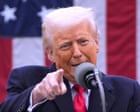
Brazil has said it will not bend to the new US tariff “threat” and China accused Washington of “political manipulation” in the wake of Donald Trump’s latest economic salvo against 14 major trading partners.
Brazil’s government said on Wednesday: “Brazil will not yield to this type of threat”, adding in its statement that the “unilateral decision constitutes an unacceptable action within the framework of the ongoing bilateral negotiating process”.
It voiced particular indignation at US proposals for higher import taxes for raw and refined sugar and a new 10% tariff on aircraft, a change that would hit Embraer, Brazil’s largest aircraft maker.
It added that Brazil would continue to negotiate “without ruling out the possibility of adopting retaliatory measures in response to the illegal and unjust imposition of tariffs on Brazilian products”.
Brazil was particularly singled out for in the announcement after trade talks stalled. The Trump administration claimed on Wednesday that the new tariffs would be consistent with trade deals that the US reached last year with dozens of countries.
The new tariffs are being imposed under a law which allowed the president to target countries the US had found to engage in unreasonable or discriminatory trade practices. Jamieson Greer, the US trade representative, told CNBC that many US trading partners had adopted “market distorting practices that tilt the trade balance in their favour while eroding America’s manufacturing base.”
The administration will seek feedback from affected industries and hold a hearing on 25 January, suggesting the final duties won’t take effect until February or March.
China is potentially facing one of the biggest hits. The US said China would face the highest capped rate of 20%, which in some cases will be stacked on top of other import taxes for a total rate of 45%. The US and China last year reached a trade truce but that is set to expire on 10 January 2027.
A spokesperson for China’s embassy in Washington rejected allegations that China was a source of excess capacity, but stopped short of threatening retaliation.
“The so-called issue of ‘industrial overcapacity’ does not really exist and should not be used as a pretext for political manipulation,” the spokesperson said, urging the two sides to jointly deliver on agreements secured between Donald Trump and Chinese leader Xi Jinping.
Earlier, China’s foreign ministry restated its opposition while calling for the US to resolve the issue through dialogue. “A tariff war or a trade war serves no party’s interests,” spokesperson Guo Jiakun said.
Greer told CNBC that the administration is proposing a “broad exemption” for $30bn worth of Chinese goods in line with the deal. “We’ve talked to our trading partners about this – they know what we’re proposing,” Greer told CNBC. “I think a lot of this is baked in.”
Some US analysts criticised the duties as too weak to change China’s trade practices.
China “is a bigger source of excess production than the rest of the world combined,” said Derek Scissors, senior fellow at the American Enterprise Institute. Yet Wednesday’s proposal “barely raises existing tariffs on China and will make no difference to the country’s trade behaviour.”
Vietnam’s trade ministry said it was working with the US to complete its trade deal as soon as possible and would coordinate with relevant US agencies.
It added it was “preparing and submitting rebuttal comments on the preliminary findings as well as on inaccurate submissions and allegations made by interested parties.”
In response to the US announcement, the Indian government denied it had any structural excess capacity in any sector, adding that it remained committed to an early conclusion of a trade deal between the two countries. Greer has said the tariff on Indian imports would be capped at 17% if a trade deal was struck.
Taiwan was also singled out for new tariffs, but Taipei on Thursday said it was confident it would keep its existing 15% tariff rate.
Taipei and Washington signed trade deals in January and February of this year, which secured preferential treatment for semiconductors and other tech product which account for over 70% of Taiwan’s exports to the US.
Other countries and regions affected by the new tariffs include Bangladesh, Cambodia, the European Union, Indonesia, Japan, South Korea, Malaysia, Singapore, Switzerland, and Thailand.
Tokyo’s top government spokesman, Minoru Kihara, said it was “regrettable that a proposed measure targeting Japan has been announced”.
Trump’s latest round of tariffs may be here to stay despite the Democrats’ electoral sweep in the US midterms. Some Democrats will likely support some of the tariffs, particularly on China. And Trump can veto any legislation that seeks to overturn the import taxes.
However Democratic Senator Ron Wyden of Oregon, who will take over the finance committee next year, said he would “use every tool at my disposal to end Trump’s tariffs chaos.”
“This is another blatant attempt by Donald Trump to reconstruct his illegal global tariffs,” Wyden added. “Global overcapacity is a serious problem, but Trump’s unilateral price-hiking tariffs are not the solution.”
With Associated Press and Reuters
Year-end fundraiser
$0 of $2,000,000 goal
A moment full of possibility – and risk
We hope you appreciated this article. Before you close this tab, can we ask you to support the Guardian at this crucial time for democracy in the US? With Black Friday approaching, our most impactful monthly support option is just $7.50 a month for six months.
In the last two years alone, Donald Trump has eroded many of the pillars of US democracy – slashing funds for universities, undermining science, shutting down arts institutions, and attacking the free press as an “enemy of the American people” and “a threat to our national security”. While he and his allies have enriched themselves and spread lies, federal forces have harassed and imprisoned innocent people and violated the constitutional rights of many Americans.
Now, in a sweeping change election, the American people have spoken: Donald Trump, Pete Hegseth, RFK Jr, Elon Musk and the tech oligarchs may finally be held to account. A majority of American voters have demanded an end to the costly and immoral wars, the flagrant profiteering, and the corrosive attacks on communities and democratic institutions.
It’s a moment full of possibility, with more stories than we can possibly cover. New leaders are emerging from Texas and Michigan to Iowa and South Carolina – and heading to Washington to fight for affordability, against wealth inequality, and for human survival in the face of AI and the climate crisis.
These new leaders will be facing a cornered Trump and his hardline chief of staff, Stephen Miller, who have nothing left to lose. The next few years are critical for the future of the country. Journalism that covers the epic clash between these forces has a vital role to play right now.
Investigative journalism provides a fact-based paper trail for an emboldened Congress to follow. Members of Congress – and the American public – often rely on our in-depth reporting to inform the tough questions, to connect the dots and to pursue accountability for wrongdoing.
At the Guardian, our newsroom is devoted to uncovering the truth and conveying it to as many people as possible. We’re not alone in this mission, but this kind of journalism faces unprecedented hurdles: big tech threatening our financial stability and stealing our work for AI, billionaire owners telling journalists what to publish, and a hostile executive branch intent on suppressing our reporting.
The Guardian is free to dig deep without fear because we’re funded by our readers. Our readers hold us to account, and we hold the powerful to account.
However, this only works when enough of our readers contribute. Against the advice of most industry analysts, we’ve refused to put up a paywall – we believe good journalism should be freely available to all people, regardless of ability to pay. If you’re counting on our reporting, and you can’t afford to pay, please stop reading this message and go back to our articles.
If you can afford to contribute, please know that your support is not only helping yourself – from voters in Kansas to immigrants in Minnesota and families in Gaza, your generosity is bringing factual news to people around the globe.
Today is among our most important fundraising days of the year. To sustain our unique financial model, our goal is to raise $2,000,000 before the new Congress is seated on 3 January. More than 19,000 people have contributed already. All gifts are gratefully received, but for the next several days only, our most impactful monthly support option is $7.50 a month for the first six months. If you can afford 37 seconds, please join our ranks – and show your support for the rekindling of democracy in the US and around the world.
KioskNews shows a cleaned-up reading view extracted from the publisher’s page — the original always lives on their site, not ours.