Chethan Kumar in Parallax: Exploring new frontiers, confronting old gaps
Where You Stand Changes What You See
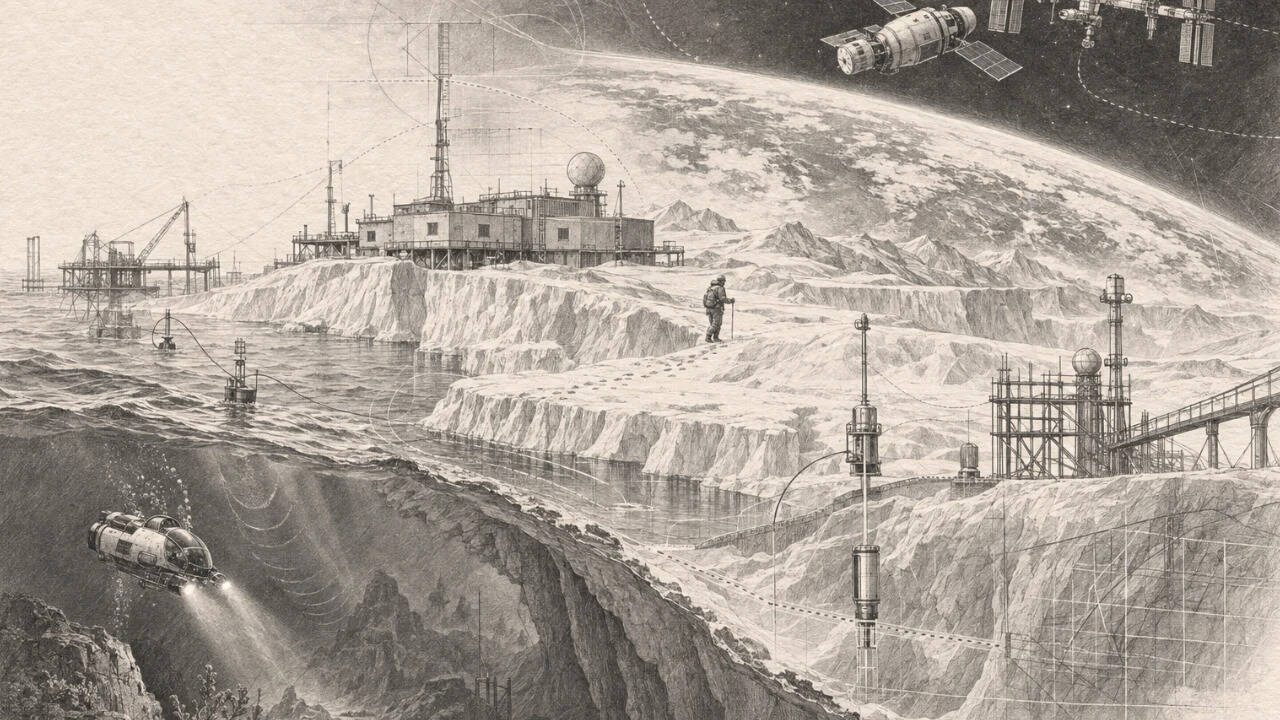
The deepest parts of the ocean, the frozen expanses of Antarctica and the vastness of space may seem like unrelated frontiers. Yet, for countries seeking to expand their scientific and technological capabilities, they are increasingly connected.
All three demand sophisticated engineering, specialised materials, advanced sensors, robotics, sustained investment and the ability to operate in environments where even routine tasks can be challenging.India is extending its presence across these frontiers. It is developing a human submersible capable of reaching 6,000 metres below the ocean surface, planning a replacement research station in Antarctica and pursuing an increasingly ambitious space programme. These are significant undertakings, showing the country’s growing scientific capabilities. But they also raise a larger question: how well equipped is India to sustain its presence in these challenging environments?Consider the deep ocean. The govt’s Deep Ocean Mission, launched in 2021, seeks to develop capabilities in underwater exploration, deep-sea mining, ocean observation and marine biology.
Its most visible component is MATSYA-6000, a human-occupied submersible being developed by the National Institute of Ocean Technology (NIOT), designed to carry three aquanauts to depths of 6,000 metres.There has been tangible progress. The submersible’s system engineering has been completed, several major subsystems have been realised, and wet harbour trials were conducted at Kattupalli, near Chennai, in Jan–Feb 2025.
In Aug 2025, two Indian aquanauts gained operational experience through an Indo-French expedition aboard the French submersible Nautile, descending to 4,025 metres and 5,002 metres in the Atlantic.These are important steps. But demonstrating individual systems and completing harbour trials are different from establishing a fully operational human deep-sea exploration capability. The next stage requires progressively deeper trials, validation of life-support and communications systems under operational conditions, specialised support vessels, trained personnel and the ability to conduct repeated missions safely.

Chethan Kumar, in Parallax.
Official communications have indicated that shallow-water demonstrations up to 500 metres were expected by the end of 2025, but the timeline has since shifted, with further shallow-water trials expected in 2026. The schedule for the first crewed 500-metre dive and, more importantly, for a full 6,000-metre dive remains subject to testing, certification and operational readiness. A working capability will depend not merely on reaching a record depth once, but on proving that the vehicle, its crew and its support systems can operate reliably and repeatedly.There is also a larger question about what India intends to do with this capability. Exploring polymetallic nodules and other seabed resources may offer economic opportunities, but the deep ocean remains among the least understood ecosystems on Earth. The scientific and environmental implications of disturbing these environments need to be understood alongside the technological possibilities. Exploration cannot be viewed only through the lens of resource extraction.The polar regions present a different set of challenges. India has maintained a scientific presence in Antarctica for decades, operating the Maitri and Bharati research stations. Its Arctic research station, Himadri, at Ny-Ålesund in Svalbard, has also enabled Indian scientists to study a region whose changing climate has consequences far beyond the Arctic.India is now planning Maitri-II to replace the ageing Maitri station, which was commissioned in 1989 and has far outlived its original expected service life.
The proposed facility is expected to support year-round research in glaciology, atmospheric science, biology, earth sciences and climate studies. It is a necessary investment, but a slow one: completion has been pushed to 2032 from an earlier target of January 2029.
The govt has approved Rs 29.2 crore for pre-investment activities, while broader estimates of the eventual project cost have been reported at around Rs 2,000 crore.A parliamentary standing committee examining India’s presence in the Arctic and Antarctic regions has pointed to several constraints. India does not have its own ice-class polar research vessel and depends on chartered foreign ships for logistics and research.The committee has also flagged inadequate budgetary allocations, shortages of scientific and technical personnel and logistical difficulties. Among its recommendations are expediting a dedicated polar research vessel and increasing the outlay for polar research.
A vessel has in fact been planned, with the Department of Expenditure granting in-principle approval for a revised acquisition cost estimate of about Rs 2,329.40 crore.
The gap, then, is less about intent than about the pace of delivery.These are not merely operational inconveniences. In polar science, the ability to reach a research site, transport equipment, maintain a station and sustain observations through extreme winters is fundamental to the quality and continuity of research.
A research station alone cannot guarantee a strong scientific presence if the infrastructure supporting it remains inadequate.Space offers a more established example of India’s ability to develop indigenous capabilities. Isro’s launch vehicles, satellite programmes and planetary missions have given the country a substantial scientific and technological foundation. Chandrayaan, Aditya-L1 and the Mars Orbiter Mission have expanded India’s capabilities in planetary exploration and space science.
The Space Docking Experiment has also demonstrated an important technology required for more complex future missions.But the next phase will demand capabilities beyond those required for conventional satellite launches, and here too timelines have proved hard to hold. Gaganyaan, India’s human spaceflight mission, was originally planned for 2022 and has slipped repeatedly since.Human spaceflight, a proposed Indian space station, lunar exploration and more ambitious deep-space missions will require advances in life-support systems, space medicine, robotics, materials, propulsion and long-duration mission operations.
They will also need sustained funding and a much larger research and industrial ecosystem.There is a common thread running through these programmes. Deep-sea exploration, polar research and space missions increasingly depend on overlapping technologies. Robotics, autonomous systems, advanced materials, remote sensing, communications, navigation and environmental monitoring have applications across all three.
Investments in one domain can strengthen capabilities in another. Progress, however, depends on whether these technologies can be developed, tested and deployed reliably, rather than remaining confined to individual projects.Technological self-reliance is important, but it should not be confused with scientific isolation. India’s experience with the Nautile expedition, international space collaborations and polar research partnerships demonstrates the value of working with countries that have longer experience in these fields.
The more relevant question is whether such partnerships help Indian institutions acquire expertise, develop infrastructure and contribute meaningfully to global research.
Collaboration should strengthen domestic capabilities, not become a substitute for building them.There is also a need to examine what these investments deliver beyond the missions themselves. Understanding ocean circulation can improve climate predictions and coastal preparedness.
Antarctic ice-core research can help reconstruct the planet’s climate history. Space-based observations can improve weather forecasting, disaster management and environmental monitoring. These are not distant scientific ambitions; they have direct consequences for a country facing growing environmental and climate-related challenges.
The challenge, then, is not to establish a presence in every frontier simply for the sake of being there.
It is to build the capacity to ask better scientific questions, conduct sustained research and translate discoveries into knowledge and public benefit. That requires continuity in funding, strong research institutions, skilled personnel, dependable infrastructure and the patience to allow scientific capabilities to mature.India has made genuine progress in extending its scientific reach. But a successful submersible trial, a new research station or an ambitious space mission is a beginning, not the final measure of achievement. The real test lies in the quality of research that follows, the continuity of investment and the strength of institutions. For India, the next phase must be less about demonstrating that it can reach these frontiers and more about building the scientific depth to sustain a meaningful presence in them.--PostscriptParallax is about changing the way we see things. Perhaps India’s scientific ambitions need a similar shift in perspective: from measuring how far the country has reached to examining how well equipped it is to stay there.
KioskNews shows a cleaned-up reading view extracted from the publisher’s page — the original always lives on their site, not ours.