Meet Anthropic's 7 billionaire founders: from elite universities to $1.5 trillion AI empire
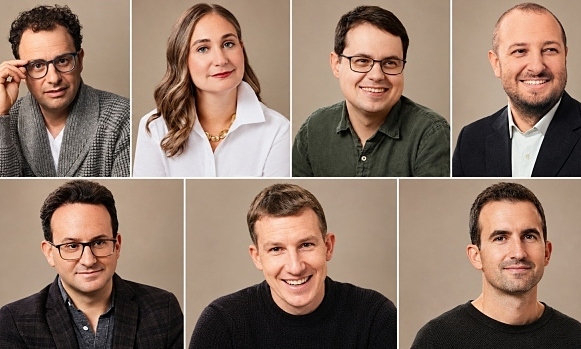
Most of Anthropic's seven billionaire founders graduated from prestigious universities such as Stanford, Harvard and MIT, majoring in mathematics, physics, computer science and engineering.
All seven founders, former OpenAI employees who left to establish Anthropic in 2021, now hold stakes estimated at around US$20 billion each, based on the company's US$1.5 trillion fully diluted valuation at its IPO, which was priced on Nov. 18.
Dario Amodei
Dario Amodei, 43, is CEO of Anthropic, the parent company of the AI chatbot Claude.
He initially studied physics at the California Institute of Technology (Caltech) before transferring to Stanford University, where he earned his bachelor's degree in 2006.
He received a Hertz Fellowship in 2007 to pursue a PhD in biophysics and computational neuroscience at Princeton University, followed by postdoctoral research at Stanford Medical School. At the time, he hoped to improve cancer diagnosis and treatment, he told The New York Times in February.
In 2014, Amodei joined Chinese internet giant Baidu as a researcher before moving to Google and then OpenAI two years later. At OpenAI, he served as vice president of research, leading the development of large language models such as GPT-2 and GPT-3.
Daniela Amodei
Daniela Amodei, 39, is president and co-founder of Anthropic, where she oversees work across research, engineering, product, governance and commercial operations, and manages the executive team. She is the younger sister of Anthropic CEO Dario Amodei.
Daniela graduated from the University of California, Santa Cruz in 2009 with a bachelor's degree in literature and a minor in politics. She previously worked in international development and government, including managing communications for Democratic Congressman Matt Cartwright's office in Washington.
In 2013, Daniela joined payments company Stripe, where she initially worked in recruiting before rising to head of risk operations. She joined OpenAI in October 2018 and held several positions, including engineering manager, vice president of people and vice president of safety and policy, before leaving in December 2020 to co-found Anthropic with her brother and former OpenAI colleagues.
Jared Kaplan
Jared Kaplan, 42, is Anthropic's chief science officer and a co-founder of the AI company. He helped pioneer Constitutional AI, a method for training AI models to follow a written set of principles and values.
He attended the Illinois Mathematics and Science Academy in Illinois. His interest in physics was partly inspired by his mother, a science fiction writer. He earned bachelor's degrees in physics and mathematics from Stanford University in 2005 before completing a PhD in physics at Harvard University in 2009.
Like Dario Amodei, Kaplan received a Hertz Fellowship while pursuing graduate studies. Kaplan was a 2005 fellow, while Amodei received his fellowship in 2007.
After earning his doctorate, Kaplan conducted postdoctoral research at the SLAC National Accelerator Laboratory from 2009 to 2012. He joined Johns Hopkins University as an assistant professor in 2012 and became an associate professor in 2018.
In 2019, he began working with OpenAI as a research consultant while maintaining his academic career. His research contributed to the development of GPT-3 and helped establish the scaling laws used to understand how AI models improve as they grow.
 |
|
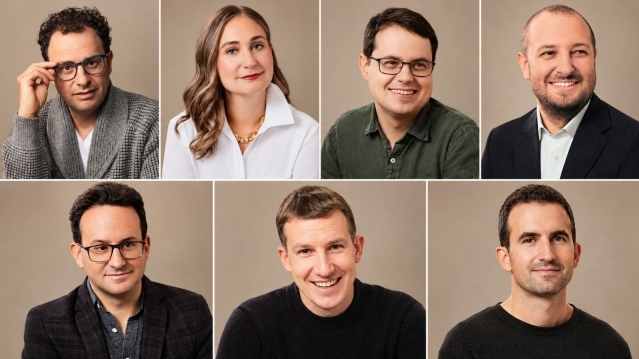
(Clockwise from top left) Anthropic founders Dario Amodei, Daniela Amodei, Christopher Olah, Sam McCandlish, Jared Kaplan, Jack Clark and Tom Brown. Photos by Anthropic |
Sam McCandlish
Sam McCandlish, 36, is Anthropic’s chief architect, focusing on large-scale AI model training, including pretraining, research productivity and reinforcement-learning infrastructure. He previously served as the company’s chief technology officer before moving into the chief architect role in October 2025.
McCandlish studied mathematics and physics at Brandeis University, where he earned a bachelor's degree and a master's degree in physics, before completing a PhD in theoretical physics at Stanford University in 2017.
He conducted postdoctoral research at Boston University before joining OpenAI in 2018, initially working on AI safety. At OpenAI, he contributed to research on machine-learning scaling and was involved in work associated with GPT-3 and the Codex programming tool. He later helped build and lead a team focused on the science and scaling of machine learning before co-founding Anthropic in 2021.
Tom Brown
Tom Brown, 39, is Anthropic's co-founder and chief compute officer, overseeing the technical organization responsible for securing, scaling and managing the computing resources used to develop and run AI models.
Raised in San Francisco, Brown studied computer science and cognitive science at the Massachusetts Institute of Technology (MIT), where he earned a bachelor's degree and a master's degree in engineering.
After working at and co-founding several startups, he joined OpenAI in 2016 as one of its first 20 employees. He spent about 16 months at Google Brain before returning to OpenAI in December 2018 as a research engineering lead, where he led the engineering of GPT-3.
Jack Clark
Jack Clark, 38, currently serves as Anthropic's head of public benefit, leading the Anthropic Institute, an internal research group examining the societal implications of advanced AI, including its effects on employment, the economy, security and governance. He previously led the company's policy work.
Born in Brighton, England, Clark studied English literature and creative writing at the University of East Anglia before becoming a technology journalist. He worked for The Register and Bloomberg, covering developments in artificial intelligence, computing and emerging technologies.
Clark joined OpenAI in October 2016, initially overseeing strategy and communications before becoming the company's policy director in October 2018.
He co-founded Anthropic in 2021 with former OpenAI colleagues, including Dario and Daniela Amodei. He also continues to publish Import AI, a weekly newsletter covering developments in artificial intelligence.
Christopher Olah
Christopher Olah, 34, is the lead of Anthropic's interpretability research, overseeing research into how artificial intelligence models work internally. According to his personal website, his work focuses on reverse-engineering artificial neural networks into algorithms that humans can understand.
Olah grew up in Toronto, Canada, and attended the private Abelard School. In 2012, he received a $100,000 Thiel Fellowship, which supports young people pursuing independent research or entrepreneurial projects. He subsequently pursued research into 3D printing and machine learning.
He joined Google Brain as an intern in 2014 and 2015 before becoming a research associate in October 2015 and a research scientist in October 2016. His work there focused on neural networks and techniques for visualizing their internal representations.
In 2017, Olah co-founded Distill, an online scientific journal dedicated to making machine-learning research more accessible through interactive explanations and visualizations.
He joined OpenAI in October 2018, where he led the Clarity team researching neural-network interpretability. In 2021, he co-founded Anthropic with former OpenAI colleagues, including Dario Amodei, and became the company's interpretability research lead.
KioskNews shows a cleaned-up reading view extracted from the publisher’s page — the original always lives on their site, not ours.