Wife’s epilepsy alone does not prove cruelty, Gauhati High Court dismisses husband’s plea

A wife’s epilepsy cannot, by itself, be treated as proof of cruelty towards her husband or a mental disorder, the Gauhati High Court has observed while dismissing a husband’s plea seeking her original medical records in a pending divorce case. The court said that merely because a person has epilepsy does not mean that they are cruel, adding that allegations of matrimonial cruelty must be established through specific instances.
Justices Michael Zothankhuma and Sanjeev Kumar Sharma were hearing the husband’s challenge to two orders passed by a family court in his divorce proceedings.
“The fact remains that epilepsy is a neurological disorder. It is not a mental or psychopathic disorder. It should also be noted that just because a person has epilepsy does not mean that the person is cruel. Cruelty and mental cruelty would have to be decided on the basis of specific instances to be proved by the person making the allegation, against the person who committed acts of cruelty,” the court said on November 13.
The dispute concerns a couple who married on July 15, 2021. The husband alleged that he learnt in December 2022 that his wife had epilepsy and was under constant medical attention. He claimed that her behaviour towards him amounted to mental cruelty and sought dissolution of their marriage.
Man alleged mental cruelty after learning of wife’s epilepsy
The husband approached the family court seeking divorce under the Hindu Marriage Act, which provides for divorce on grounds of cruelty and incurable unsoundness of mind or a mental disorder of such a nature and extent that the petitioner cannot reasonably be expected to live with the respondent.
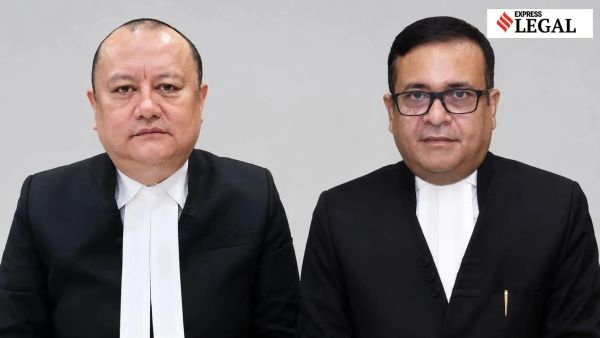 Justices Michael Zothankhuma and Sanjeev Kumar Sharma observed that epilepsy is a neurological disorder and not a mental or psychopathic disorder. (Image enhanced using AI)
According to his submissions before the high court, the man came to know about his wife’s epilepsy in December 2022. He also stated that she had travelled to Kochi for treatment and was under constant medical attention. The husband alleged that she behaved very badly with him and that this amounted to mental cruelty.
He sought to establish his allegations by relying on his wife’s medical records, including documents relating to her epilepsy and treatment. His divorce petition, registered in 2024, remained pending before the family court and had reached the stage of recording evidence. During the proceedings, the husband sought directions requiring his wife to produce the original marriage certificate as well as her original medical documents relating to epilepsy.
Story continues below this ad
On August 2, 2025, the family court directed the wife to produce the original marriage certificate, which she submitted on June 12. However, it declined the husband’s request for her original medical records, noting that he had already submitted copies and could summon her doctors or other persons involved in her treatment.
The court said producing the originals was unnecessary at that stage and that rejecting the application would not prejudice his case. It directed him to lead his evidence on July 27. The husband later approached the high court, challenging both orders, arguing that the complete medical records were necessary to establish his allegations of mental cruelty and mental disorder.
Cruelty must be proved through specific instances
Finding no reason to interfere with the family court’s decisions, the high court said that the family court had already granted the husband‘s request and that his wife had complied with the direction by producing the original document. Therefore, there was no reason to challenge the August 2, 2025 order.
On the medical records, the high court noted that the husband already possessed photocopies of the documents. It agreed with the family court that obtaining the originals was not necessary at that stage, particularly when he had the option of summoning the persons involved in his wife‘s treatment.
Story continues below this ad
The court also noted that the husband had not claimed that the contents of the medical documents available with him were false. It clarified that the family court had not permanently rejected the husband’s request for the original medical records.
KioskNews shows a cleaned-up reading view extracted from the publisher’s page — the original always lives on their site, not ours.