Providing breathable attire, ice packs to protect outdoor workers from heat mandatory from Dec 1
SINGAPORE – From Dec 1, 2026, employers must ensure their outdoor workers wear breathable, sweat-wicking uniforms that provide better ventilation, under a new rule to protect employees from hotter days ahead.
Employers must also ensure that ice packs or water sprays are available on site in case of a heat illness scare, and make cool water available at worksites. They must also ensure all outdoor employees are trained to understand the suite of heat stress measures to keep them safe.
Existing measures include ensuring workers are regularly hydrated, and that new workers are gradually acclimatised to heat before being sent to work.
Flouting these four new rules will result in penalties such as stop-work orders and fines.
These measures were previously listed as recommendations under the Manpower Ministry’s (MOM) heat stress framework, which was introduced in late 2023.
The new rules were announced by Minister of State for Manpower Dinesh Vasu Dash on Aug 28 during a visit to the construction site of the PSA Supply Chain Hub @ Tuas.
This brings the total number of compulsory heat stress measures to 11, up from seven currently.
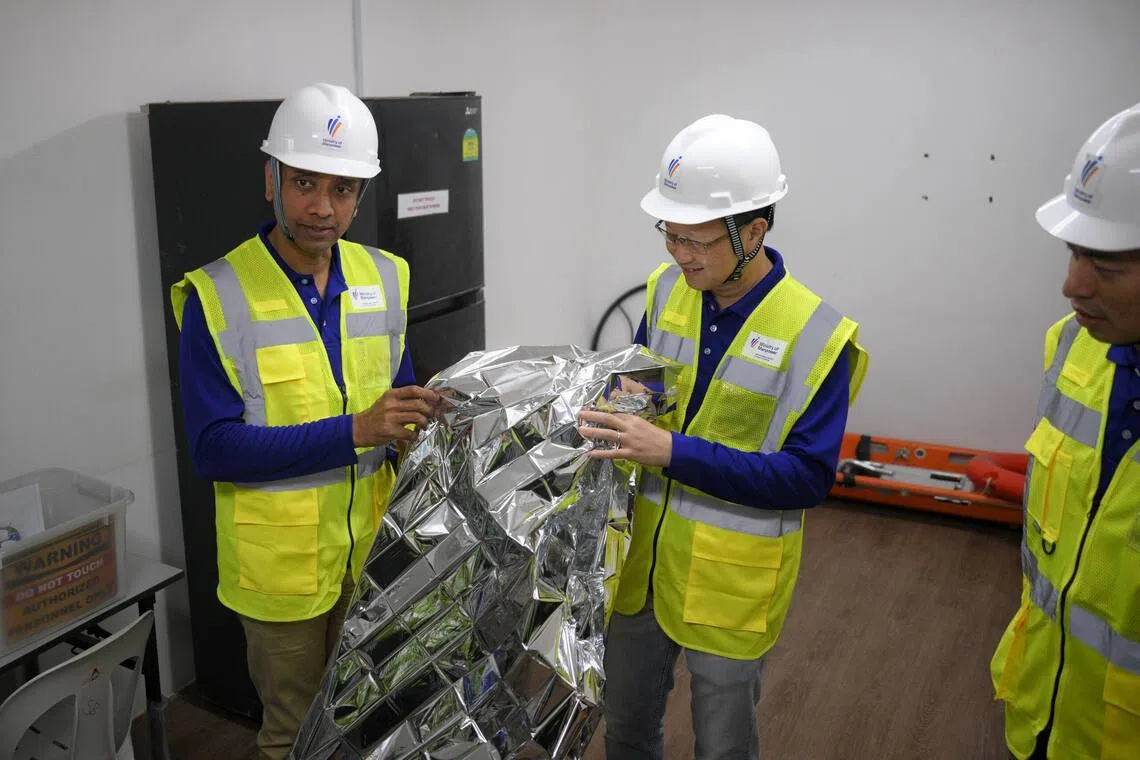
Minister of State for Manpower Dinesh Vasu Dash inspecting a thermal blanket during a visit to the construction site of the PSA Supply Chain Hub @ Tuas on Aug 28.
ST PHOTO: MARK CHEONG
The announcement comes as Singapore is currently experiencing rising heat risks and hotter months ahead, due to a rapidly intensifying and warming El Nino climate phenomenon. The highest temperatures this month is expected to hit 35 deg C.
Other existing mandatory requirements that employers have to follow include providing employees with a shaded rest area. New workers, and those who have been on leave for at least a week, must also be put under a heat acclimatisation regime.
This entails workers gradually increasing their daily heat exposure over at least seven days.
MOM’s framework classifies the measures based on three heat stress levels, which are determined by wet bulb globe temperatures (WBGT). This is a measure of heat stress which takes in temperature, humidity levels, wind speed and solar radiation.
The four new measures apply across all three heat stress levels under MOM’s framework - when the WBGT is under 31 deg C, when the WBGT ranges between 31 and 33 deg C, and when WBGT are 33 deg C and above.
But other existing measures are differentiated based on heat stress levels. For example, when WBGT temperatures are between 32 deg C and 33 deg C, employers must ensure that their workers doing strenuous work are given hourly rest breaks of at least 10 minutes.
During periods of higher heat stress, when the WBGT is 33 deg C and above, employees doing strenuous work are urged to rest for 15 minutes every hour.
Since 2024, it has been mandatory for WBGT meters to be installed at all worksites with a contract sum of at least $5 million, shipyards and the process manufacturing sector.
On Aug 28, MOM also introduced a new voluntary measure encouraging employers to provide shaded rest areas that are cooled, or well-ventilated and well-insulated. This includes a sheltered area with fans, and an insulated roof with wooden panels.
In end-May, the National Environment Agency warned that El Nino’s temperature impacts are the highest when the El Nino event weakens, which could be March to May 2027 – coinciding with the hottest period of the year. The onset of this year’s El Nino event was around June.
At the tail end of the last super El Nino event in 2016, average temperatures in March to May that year was 29.2 deg C, one deg C above the long-term average. Singapore also faced its last heatwave in April 2016.
Scientists have been warning that the 2026 El Nino could be the strongest since at least the 1950s.
Employers have until Nov 30 to implement the four new measures which have already been “widely adopted” despite being voluntary now, said MOM on Aug 28.
The enhancements were developed in consultation with the industry, tripartite partners and government agencies, said MOM.
Between 2021 and 2025, MOM recorded 24 heat-related cases and zero fatalities. Among the 24 cases, 22 were related to outdoor work, and fewer than half involved hospitalisation, said MOM in a parliamentary reply in February.
MOM took action against 151 employers in 2024 and 62 in 2025 for flouting heat-safety rules. The penalties included stop-work orders notices of non-compliance and fines.
Dinesh said: “For employers, these are important measures because it allows our employees to be productive. We have more workers who will be ready and fit to be able to work. Therefore, less downtime as a result of our workers not being around.”
KioskNews shows a cleaned-up reading view extracted from the publisher’s page — the original always lives on their site, not ours.