Devil in the detail: 100 years on, FW Murnau’s Faust scrapbook reveals the secrets of his silent masterpiece
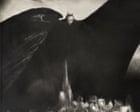
FW Murnau was one of the greatest of all silent film-makers, with a rare genius for making beautiful images on screen. His peers liked to say he “had a camera instead of a head”. The director of such stunning films as vampire tale Nosferatu (1922) and marital romance Sunrise: A Song of Two Humans (1927) died at the age of 42 in 1931, meaning that his career barely scraped into the talkie era. Still, Murnau’s tremendous run of silent pictures included some beautiful, often disturbing classics, in which he sent his camera roaming through changing vistas of shadows and light, and plumbed the depths of the human soul. Nowhere more so than in his tour-de-force Faust, released 100 years ago this month, based on Goethe’s play about a deal with the devil. And the making of Faust is depicted in a stunning new book, which is both a document of, and in a sense an artefact from, the production of this classic film.
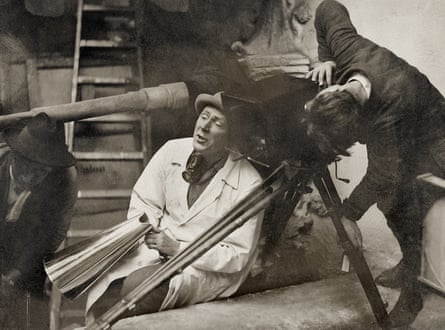
Murnau was also one of the most mysterious of directors: secretive about his methods, with an intense devotion to his work. Early collaborator Edgar G Ulmer called him “a great purist who worked under a sort of hypnosis”. Murnau banned producers from his sets, and executives from watching his rushes. Bar a few exceptions, he did not allow on-set photography to reveal the secrets of his camerawork and special effects. This mystique created room for speculation as to whether Murnau, or his talented crew, were responsible for the success of his films. The Faust Bible: The Making of FW Murnau’s Masterpiece publishes unseen images from the shoot of one of his best films, and gives a rare insight into the collaborative way it was made.
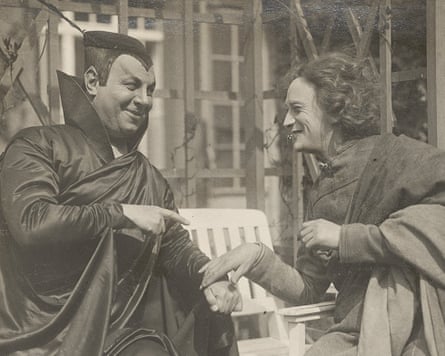
Faust was Murnau’s final German film before he went to Hollywood, and at the time it was the most expensive, complex film that the Ufa studio had ever produced. It is an adaptation of Goethe’s tragedy about the scholar Faust (played by Swedish actor Gösta Ekman) who sells his soul to the devil, represented by the grinning, black-clad demon Mephistopheles (German star Emil Jannings). A commercial flop on its release, Faust is now acclaimed as one of the greats. French New Wave director Éric Rohmer, a Murnau devotee, wrote his doctoral dissertation on the film. The Faust Bible reveals how Murnau and his crew achieved some of the incredible shots and special effects in this film, but it is also an enhanced facsimile of an artefact from the film’s production, which has survived against all odds to spill its secrets.
In the film, Faust owns a hefty, leather-bound Bible, which he throws on the fire in a moment of despair. But the prop was to become something more. Art directors Robert Herlth and Walter Röhrig pulled the book from the ashes and pasted designs, stills and behind-the-scenes photographs on to its blank pages so they could present the souvenir as a gift to the director at the end of the shoot. Murnau left it behind in his flat in Berlin when he went to Hollywood, not knowing he would never return to retrieve it. After his death, Murnau’s brother stashed his belongings in various city-centre basements, which were susceptible to flooding, and worse, once the bombs began falling on Berlin during the second world war.
Film scholar and archivist Lotte Eisner came to Berlin looking for Murnau’s archives in the 1950s, but found no sign of the Bible. It was not until the 1960s that a German curator from the city’s Akademie der Künste, Engelbert von Mallinckrodt, told Henri Langlois at the Cinématheque Française that he had bought some of Murnau’s photo albums for a small sum from a restaurateur called Rolf Conscienze, who had film industry connections. It turned out that these albums included the Bible – though no one knows how they ended up with Conscienze. Then, to deepen the mystery, Mallinckrodt vanished, and his flatmate became the book’s custodian for several decades: it was wrapped in brown paper sitting on top of a cupboard. Eisner searched for the Faust Bible her whole life but she was never to see it. She died in 1983.
Now the book is in the safekeeping of the Cinémathèque Française, which bought it in 2017, and there it remains, a memento of the once-contested collaborative nature of Murnau’s methods. I went to see it this summer, and it is appropriately grand in scale, an unusually majestic scrapbook. Restored by the cinema’s director of heritage Laurent Mannoni and his team, the book looks good for an abandoned, 100-year-old prop. The water-damage has been smoothed out, leaving only a few scuffs, and the shadows where some enterprising thief has prised the metal crucifix and corner pieces from the leather.
Inside, sketches for individual scenes are arranged opposite matching stills from the film. Turning these hallowed pages, you can see how the compositions of figures and objects by the designers known as “film architects” – the forced perspectives, contrasting arrangements of light and dark, sweeping shadows, steam and flames – were re-created on film by Murnau and his talented cinematographer Carl Hoffmann. The director encouraged his designer to draw not just the spaces, but the actors too, creating something closer to a storyboard image than a set design.
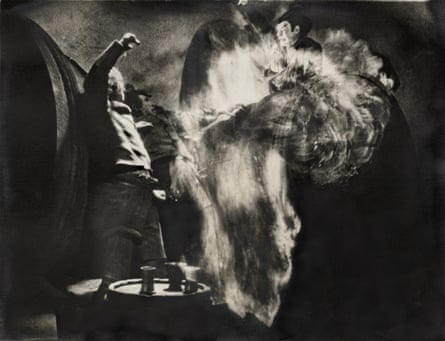
“The sketch became the equivalent of a contract,” Herlth later wrote. “[Murnau] insisted that every stroke of the pen should be faithfully rendered in the execution.” This meant not only building sets according to the designs but Murnau and Hoffmann making extensive adjustments to the lighting to produce the velvety shadows that the director demanded. Hoffmann then navigated these settings with bold, fluid camera movements in a technique called entfesselte Kamera (unchained camera), originated by cinematographer Karl Freund when working with Murnau on The Last Laugh (1924). Murnau was not short of visual references. He had a strong interest in the occult, and his background was in art history. Albrecht Dürer’s Four Horsemen of the Apocalypse woodcut was a direct influence on the film’s opening scene.
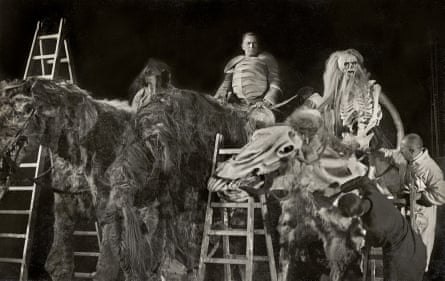
Herlth recalled the experience of working with Murnau as good-humoured, if challenging, as the director was cheerful but always ambitious to create shots and camera effects that had not been achieved before. The crew spent long days and nights discussing and experimenting with new ideas. “Each day on the set was a fresh opportunity to surpass ourselves in inventiveness and ingenuity,” he said.
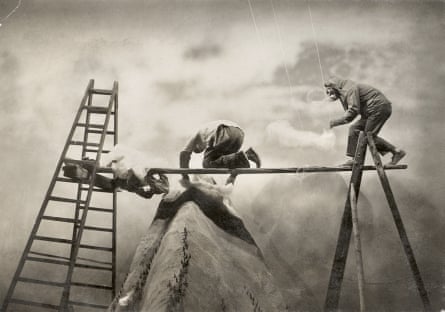
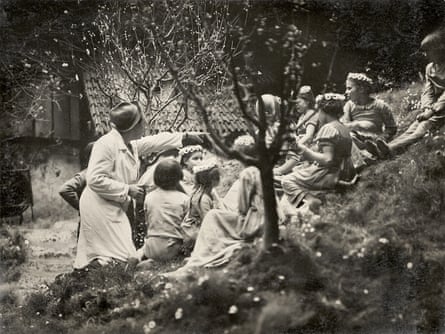
Leafing further through the Bible, the chiaroscuro sketches and stills give way to playful collages, images of the cast and crew having fun on set, the legendarily tall Murnau hunched over as he instructs Jannings how to leer malevolently. And there are pages that speak to that boundless technical ingenuity. One of the most celebrated moments in the film is the Weltflug (“flight around the world”) sequence, in which Mephistopheles flies Faust through the sky on his cloak, the world lurching below them. The Bible retains the diagrams that explain just how they achieved this uncanny flight simulation. The secret was a low wooden trolley moving along a plaster ramp, an idea that came to Herlth and Röhrig when they saw a truck being unloaded in the street.
The facsimile edition reprints the Weltflug diagrams on gatefold pages so you can study century-old secrets of film technique at your leisure. It also comprehensively reprints all the Bible’s images, with explanatory captions, enlargements, and quotations from the screenplay, which was written in epigrammatic, almost poetic prose. There are also essays and additional drawings from the Cinémathèque’s archives.
KioskNews shows a cleaned-up reading view extracted from the publisher’s page — the original always lives on their site, not ours.