Nvidia’s Jensen Huang scandal casts shadow over South Korea’s chip ‘bromance’

South Korea is facing growing concerns over the fallout from Nvidia CEO Jensen Huang’s alleged affair with a woman suspected of being a Chinese spy, amid fears that the scandal could disrupt global AI supply chains and trigger tighter US export controls on Seoul’s semiconductor champions.
The highly publicised “bromance” between Huang and South Korea’s top technology leaders – notably Samsung Electronics executive chairman Lee Jae-yong and SK Group chairman Chey Tae-won – has played a crucial role in accelerating deals and joint infrastructure development, analysts say.
During high-profile visits to Seoul, the flamboyant Nvidia boss has routinely bypassed corporate boardrooms, preferring informal, photogenic dinners over Korean comfort food and drinks to cement multibillion-dollar partnerships.
02:42
Nvidia CEO Jensen Huang meets with Samsung, Hyundai chiefs over beer and fried chicken
But those warm business ties now face uncertainty following revelations surrounding the single most important buyer of South Korean advanced memory chips.
“This is an out-of-the-blue incident that exposes the vulnerability of South Korea’s semiconductor industry to global political and regulatory risks,” said Hur Jung, an economics professor at Sogang University.
Hur said the scandal could cause short-term delays in Nvidia’s investments and disrupt global supply chains as Huang might have to attend hearings and respond to questioning by authorities, leaving him less time to meet Korean business partners.
“More significantly, this is likely to trigger tougher US restrictions on exports of semiconductors and related manufacturing equipment to China, affecting Samsung and SK Hynix’s semiconductor factories there,” he added.
US President Donald Trump said on Monday that he had spoken with Huang, who denied knowing that the woman was an alleged intelligence asset. Media reports have identified her as Alice Huang, a former executive at Singapore-based data centre operator Megaspeed International. Jensen Huang recently admitted to being unfaithful to his wife, but Trump told reporters the Nvidia CEO had “absolutely no idea” the person was a suspected spy.
Trump said he was “amazed” by the allegations, noting he had only recently been briefed on claims surrounding her suspected ties to Chinese espionage networks.
Nvidia’s board of directors has reportedly formed a special independent committee to investigate the matter. The company said it had no reason to believe that national security or corporate secrets had been compromised, and that Huang remained at the helm.
US and Singaporean authorities have been investigating Megaspeed over suspicions that it served as an illicit conduit to divert restricted Nvidia graphics processing units (GPUs) and server clusters to Chinese entities in breach of US export controls.
Megaspeed reportedly bought billions of dollars’ worth of Nvidia hardware over the past two years, with US intelligence memos outlining suspicions that Alice Huang cultivated a close relationship with the Nvidia CEO to gain non-public information about US AI hardware, trade policies and corporate strategy.

Kim Gwang-suk, head of economic research at the Korea Economic and Industrial Research Institute, warned that congressional investigations or leadership instability at Nvidia would send shock waves through the global chip sector.
“Regardless of whether these allegations are groundless, one thing is clear: US technology restrictions targeting China could become more stringent,” Kim said. “Washington could step up measures to curb not only the supply of US-made GPUs, but also Korean memory semiconductors to China.”
Kim added that any slowdown in global data centre construction resulting from the controversy could directly dampen demand for South Korean semiconductor exports.
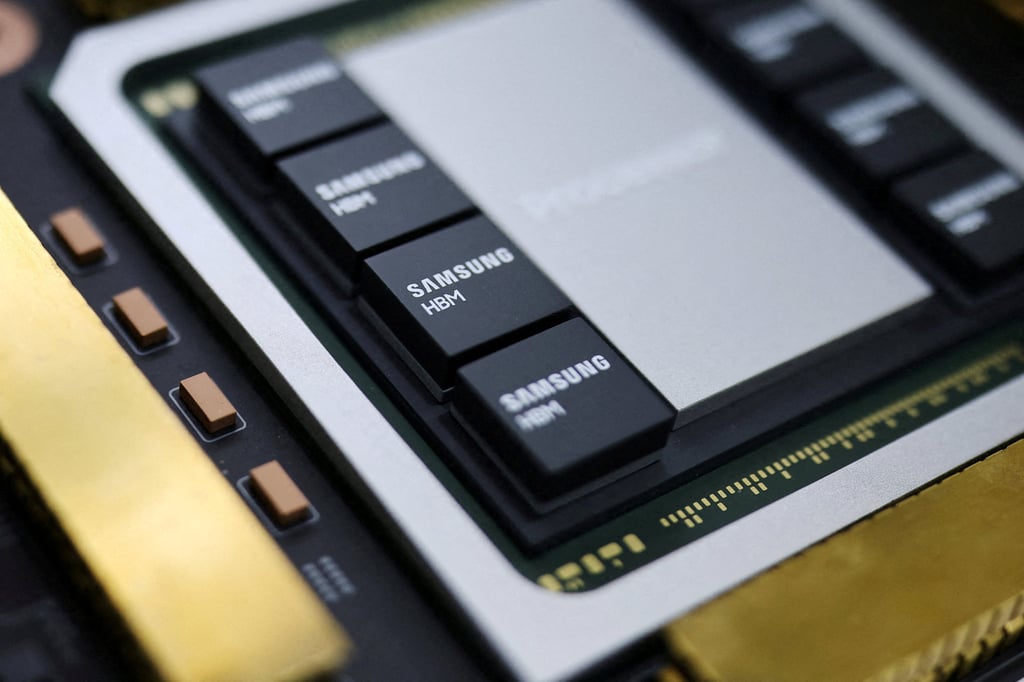
Samsung and SK Hynix collectively hold an estimated 82 to 83 per cent share of the global high-bandwidth memory (HBM) market. HBM chips are vital to training and running frontier AI models, working alongside GPUs to handle the enormous volumes of data required for intensive computing.
South Korean officials have moved quickly to reassure markets, insisting that contracted hardware deliveries are unaffected.
Ryu Je-myung, South Korea’s second vice-minister of science and ICT, told the National Assembly’s Budget Committee on Monday that GPU delivery schedules were on track. Ryu said 10,000 GPUs procured under the 2025 supplementary budget were already in use, while GPUs ordered under a 2026 allocation contract were expected to be deployed within the year.
The ministry said it was closely monitoring delivery timetables and pricing trends alongside Nvidia Korea to safeguard the country’s AI infrastructure expansion.
But a planned high-profile visit to Seoul by Madison Huang, a senior Nvidia executive and the CEO’s daughter, was abruptly cancelled over the weekend. She had been scheduled to meet government officials, including Science and ICT Minister Bae Kyung-hoon.
Despite the uncertainty, South Korean tech firms are continuing with their planned technology partnerships involving Nvidia.
On Monday, Nvidia, telecoms giant SK Telecom and domestic AI chip designer Rebellions signed a memorandum of understanding to build a joint computing system dubbed “NVLink Fusion Cooperation”.
The project uses Nvidia’s standard rack architecture to integrate Rebellions’ next-generation R200 neural processing unit (NPU) into a unified rack-scale inference platform using NVLink Fusion – an open platform that allows chips developed by other companies to work with Nvidia’s proprietary data-transfer technology.
The system is expected to be deployed across SK Telecom data centres following performance tests, representing Nvidia’s broader push to anchor its hardware ecosystem against custom application-specific integrated circuits (ASICs) developed by rivals such as Google.
But analysts warn that geopolitical exposure is Seoul’s main challenge.
Hwang Hee-sang, a semiconductor and IT industry research fellow at NH Financial Group, said Washington was likely to tighten restrictions on shipments of advanced semiconductor chips and manufacturing equipment to China, while also limiting Beijing’s access to computing resources at global data centres.
“This could deal a blow to Samsung and SK Hynix’s factories in China, which need advanced equipment to upgrade their production capabilities,” he said.
KioskNews shows a cleaned-up reading view extracted from the publisher’s page — the original always lives on their site, not ours.