My teen wants to play Grand Theft Auto 6. What do I need to know about the game?
Grand Theft Auto 6, more commonly known as GTA6, is released on Thursday. I can’t wait to play. Neither can my 13-year-old.
They’ve watched the trailers and the Netflix extended look. Their friends are talking about it. So are popular YouTube streamers. It’s easy to understand why they want to join in.
When I explain it’s rated R18+ in Australia, they have a ready reply.
But you’ll play it.
So what do parents and carers need to know?
What’s the game about?
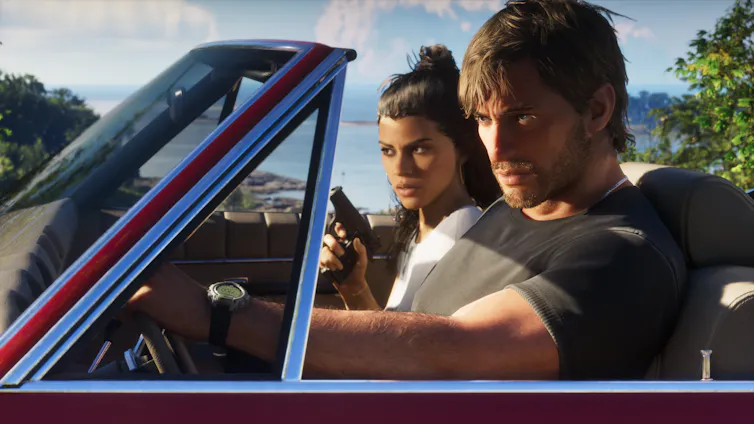
GTA6 follows the characters Jason and Lucia – a couple caught up in a criminal conspiracy. Think of a crime drama you can take part in. Game developer Rockstar’s character descriptions mention drug trafficking, prison and a strip club financed by drug money.
It’s an open-world game, meaning players can explore activities between story missions. For players, that freedom is part of the appeal. But current trailers and game play videos reveal little about the surrounding story lines.
Earlier games in the series show the range of adult content commonly featured. For example, GTA San Andreas, released in 2004, depicts paid sexual encounters and drug use. And GTA5, which came out in 2013, included a torture mission that made players carry out the violence.
While these examples don’t tell us exactly what happens in GTA6, they explain why we need to look beyond the trailers.
Can teens still get access?
We know in Australia R18+ games are legally restricted to adults.
For GTA6, the classification entry lists “high impact violence, sex scenes and drug use”. This gives parents something specific to discuss with their teenager if they express interest in playing.
In March, Australia’s new online safety codes came into effect. As part of these codes, online gaming platforms must now require players to provide age assurance to allow them to access R18+ content.
This means gaming companies PlayStation and Xbox (consoles GTA6 is available on) now require age checks for the game through their Australian stores.
Worried about your child playing anyway?
Checking who buys a game doesn’t decide who holds the controller afterwards. Teenagers could still play on an adult’s account.
You can create a separate user account for your teenager and set age restrictions through PlayStation Family or Xbox Family Settings.
If you’re planning to play the game yourself, you can protect adult accounts with a login passcode, too.
Be aware if you decide not to let your teen play, they might still encounter the game on an older sibling’s account or at a friend’s house.
Survey data, published in 2023, estimated around 70% of GTA gamers in Britain first played the game when they were under 18.

Do violent video games encourage teens’ bad behaviour?
While some studies have suggested there is a small link between violent gaming and later physical aggression in children and teenagers, the larger body of research doesn’t support such a correlation.
The American Psychological Association has acknowledged this, saying there’s not enough evidence to link violent games with violent behaviour in players.
However, parents should not ignore the game’s inclusion of strong impact nudity and sexual content. While a 2020 study found there wasn’t enough evidence to link sexualised content in games with increased sexist attitudes in players, previous GTA games have been criticised for being misogynistic and sexist.
Is watching different from playing?
Over the past decade, there has been a surge in watching other people play video games – much like you would watch TV or a film.
This online streaming of gameplay is often mixed with commentary, humour and editing.
A US study, published in March, examined livestreams on Twitch (an online platform popular for streaming gameplay). The study found aggressive speech from streamers was linked with more aggressive chat messages posted by viewers. But violent gameplay itself showed no significant association with aggressive chat messages.
However, the study did not establish causation or effects specifically on teenagers. The findings cannot tell us whether watching a game is safer than playing it. Both can potentially expose a teenager to an age-inappropriate content.
So what do I tell my teen?
When it comes to choosing games with your children, the eSafety Commissioner recommends:
checking game classifications and reviews
discussing boundaries, such as what types of content are OK and what aren’t (and why)
making rules about when a game can be played and in which rooms of the home
encouraging children to speak up when something makes them uncomfortable.
It’s also important to include watching gameplay videos and visits to friends’ houses as part of conversations about gaming.
If the answer ends up being “no”, experts say parents should acknowledge and validate teenagers’ feelings, especially if they react strongly to the decision.
So when it comes to my 13-year-old child, I am explaining how scenes in the game are not suitable for them without dismissing their interest in it. And if they encounter something inappropriate through a friend or an online video, I want them to feel they can tell me, even when I’ve said no to the game.
Read more: Grand Theft Auto 6 could make US$3–5 billion in the next week. Here’s how games make so much money
KioskNews shows a cleaned-up reading view extracted from the publisher’s page — the original always lives on their site, not ours.