SX2026: Balancing Thailand’s AI boom and green energy goals
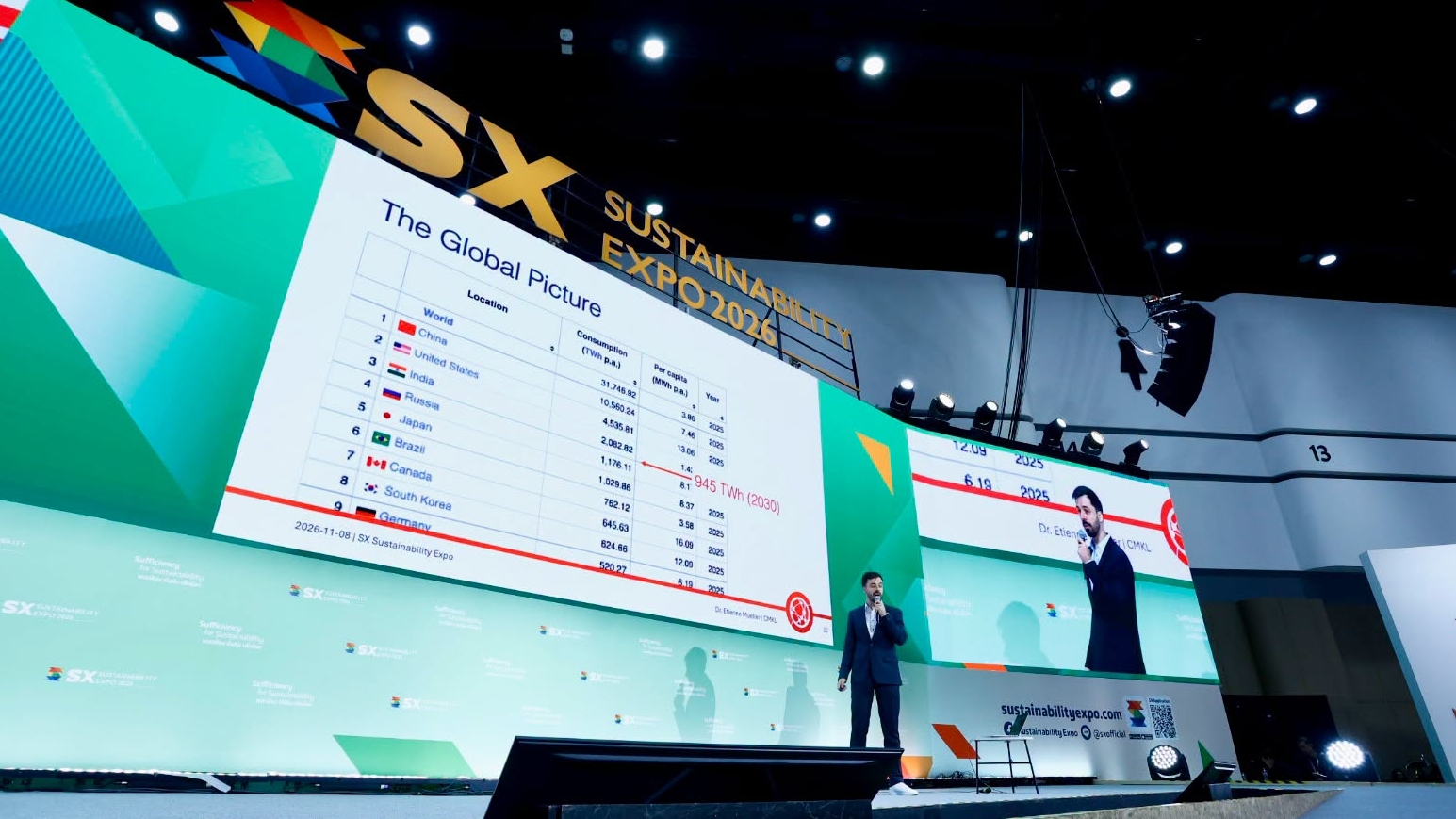
As global tech giants pour billions of dollars into Thailand’s burgeoning digital infrastructure, the kingdom faces a delicate balancing act between capitalizing on the artificial intelligence (AI) gold rush and mitigating its severe environmental toll.
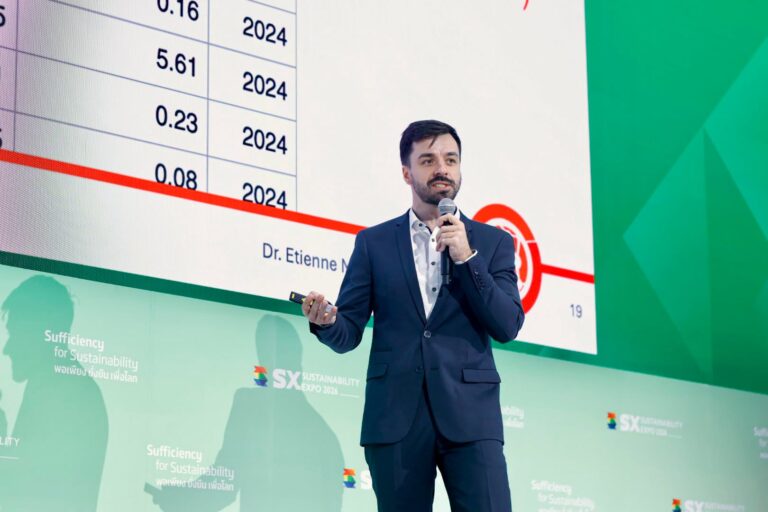
Speaking on the Talk Stage at Sustainability Expo 2026 (SX2026), Dr. Etienne Mueller, Assistant Professor at CMKL University, delivered a stark yet hopeful assessment of Thailand’s unique position as Southeast Asia’s emerging data center hub.
The Hidden Environmental Cost of AI
Dr. Mueller opened his address by contextualizing the massive resource consumption driving modern AI models. While efficiency for single queries has improved, user behavior has shifted toward complex reasoning loops and agentic AI, resulting in computational and energy demands remaining extraordinarily high.
Global data center energy consumption is projected to reach 565 terawatt-hours in 2026—overtaking the total annual electricity consumption of Germany—and is forecasted to hit nearly 1,000 terawatt-hours by 2030. Training state-of-the-art frontier models like Elon Musk’s Grok can generate upwards of 72,000 tons of CO2 emissions, consuming energy equivalent to driving a conventional vehicle to the sun and back multiple times.
With Western nations increasingly imposing moratoriums and regulatory caps on new data center construction due to power grid strains, hyper-scalers are rapidly shifting their investments toward Southeast Asia.
Thailand as the Next Frontier
Thailand has emerged as a primary beneficiary of this geopolitical and regulatory shift, aided by its neutral foreign policy, competitive costs, and geographic proximity to regional hubs like Singapore, where data center growth has faced tightening land and power restrictions.
According to Dr. Mueller, Thailand saw 88 AI and data center projects approved in the first half of 2026 alone, representing a combined investment value of US$27 billion (approx. 900 billion baht). Installed compute capacity currently stands at 216 megawatts, with nearly one gigawatt under active construction—a fourfold increase in the immediate pipeline. Analysts estimate the country will require three to five gigawatts by the end of the decade to support both domestic demand and global infrastructure.
Major international and local players, including TikTok, Galaxy, and Gulf Energy, are driving this rapid expansion across the country.
The ‘Green Squeeze’ Risk
However, this economic opportunity comes with substantial environmental trade-offs. Modern AI racks consume up to 80 kilowatts of power—a 16-fold increase over traditional data center racks. Projections suggest AI infrastructure could account for 6 terawatt-hours of electricity in Thailand by 2030, or roughly 2.5% of the total national power grid consumption.
Dr. Mueller warned of the risk of a “green squeeze,” where data centers lock up the majority of Thailand’s available renewable energy to meet corporate sustainability mandates.
“If data centers absorb all the clean power to look green on paper, the local population may be left relying on non-renewable fossil fuels to meet their daily needs,” Dr. Mueller noted. He emphasized that the existing power grid infrastructure is concentrated around population centers rather than optimal data center locations, creating distribution challenges for power utility providers.
Public Enthusiasm: Thailand’s Strategic Advantage
Despite these hurdles, Thailand possesses a distinct psychological and cultural advantage over Western counterparts: overwhelming public enthusiasm for AI technology.

Citing global sentiment surveys, Dr. Mueller pointed out that while tech sector layoffs in the US and Europe have fueled public skepticism and anxiety regarding AI, populations across Southeast Asia—specifically Thailand—demonstrate among the highest levels of excitement and optimism for AI adoption in the world.
“Enthusiasm is the hardest thing to build and the easiest thing to lose,” Dr. Mueller remarked, urging policymakers to capitalize on the public’s readiness while safeguarding national resources.
A Three-Pillar Strategy for Sustainability
To ensure Thailand reaps long-term economic rewards without compromising its national net-zero commitments, Dr. Mueller outlined a roadmap structured around three pillars:
AI Developers & Academics: Focus on software efficiency, model quantization, and localized Thai Large Language Models (LLMs) that deliver high task performance with smaller computational footprints.
Industry Operators: Adopt advanced hardware cooling solutions—such as liquid cooling, which now accounts for 40% of new global builds—reuse waste heat for local industries, and enter verified, long-term Power Purchase Agreements (PPAs) for new renewable energy.

Policymakers: Accelerate renewable energy infrastructure alongside project approvals, integrate strict environmental criteria into investment screening, and expand grid capabilities to benefit both commercial operators and local households equally.
“Thailand has been dealt a very strong hand,” Dr. Mueller concluded. “With stable regulation, geopolitical neutrality, and a population eager to embrace the digital future, Thailand has all the ingredients to become Asia’s premier hub for sustainable AI—provided we manage our energy transition responsibly.”
KioskNews shows a cleaned-up reading view extracted from the publisher’s page — the original always lives on their site, not ours.