Cash handout timing depends on legislature: president
By Jonathan Chin / Staff writer, with CNA


Taiwanese and eligible residents would each receive the universal NT$10,000 (US$311.8) cash handout before the Lunar New Year holiday, if the legislature passes next year’s general budget review before Jan. 5, President William Lai (賴清德) said yesterday.
Democratic Progressive Party (DPP) spokesman Justin Wu (吳崢) quoted Lai as making the statement at the party’s Central Committee meeting in Taipei.
The cash handout is part of next year’s general budget, and its timely passage depends on the legislature, he told the meeting.
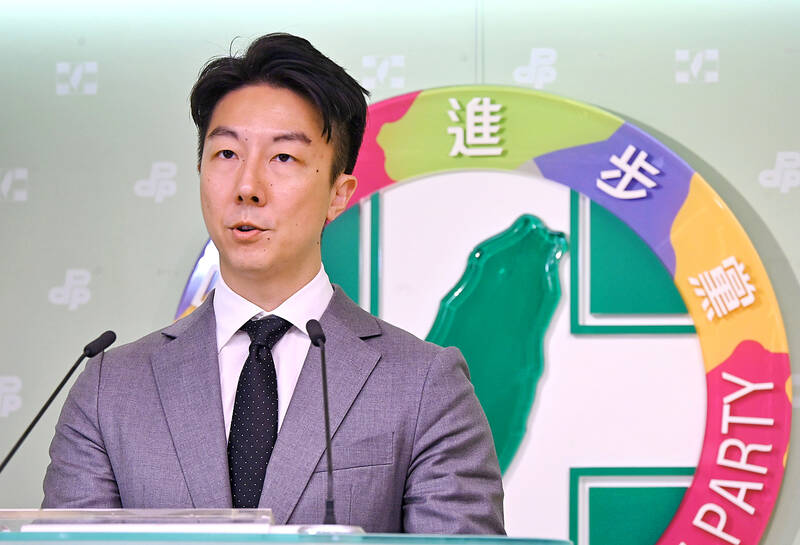
Democratic Progressive Party spokesman Justin Wu speaks at a news conference at the party’s headquarters in Taipei yesterday.
Photo: Liu Hsin-de, Taipei Times
Taiwan’s economy is having an exceptional year, with the nation’s exports expected to reach an unprecedented US$900 billion before the year’s end, Lai told the meeting.
The nation’s exports reached US$87.72 billion last month, another record, he said.
The artificial intelligence (AI) sector is largely responsible for the growth, and its benefits should be shared with the rest of Taiwan without affecting the nation’s fiscal health, he said.
The handout dubbed the AI bonus is included in the administration’s proposed budget, which means legislators must collaborate to authorize government spending before Jan. 5 next year, Lai said.
The Executive Yuan has already created a task force to establish mechanisms for distributing the handout, which could be ready before the Lunar New Year holiday, which starts on Feb. 2, he said.
The administration also plans to accelerate the AI-driven transformation of traditional industries and small-and-medium sized enterprises to ensure all sectors of Taiwan’s economy remain competitive, he said.
That would entail funding the administration’s proposed AI infrastructure projects and a NT$100 billion small-business development fund centered on promoting digital technology and developing links between new and traditional industries, he said.
DPP officials and lawmakers are urged to communicate the government’s intent with the public and entrepreneurs, he said.
The administration hopes the Chinese Nationalist Party (KMT) and the Taiwan People’s Party (TPP) would pass next year’s budget and a bill governing the small-and-medium sized enterprise development fund before the legislative session ends, he said.
Separately, Minister of Finance Chuang Tsui-yun (莊翠雲) yesterday defended the administration’s rejection of the KMT caucus’ counterproposal for a NT$20,000 cash handout at a legislative meeting.
Adopting the KMT proposal would add to the national debt and require passing a supplementary budget act, whereas the government’s NT$10,000 handout is fiscally responsible and more speedily distributed, she said.
Although the government’s revenue increased by NT$700 billion in the first nine months of this year, under the amended Act Governing the Allocation of Government Revenues and Expenditures (財政收支劃分法), the central government and local governments respectively share NT$250 billion and NT$450 billion of the bonus, she said.
The central government would need to borrow more money to fund the KMT’s proposed NT$20,000 handout, contrary to the opposition’s claims that no new debts would be raised, Chuang said.
The tax revenue increase is mostly benefiting local governments, she said.
“I’m not sure if the idea is to take funding from local governments and use them to pay out cash to everyone.”
KioskNews shows a cleaned-up reading view extracted from the publisher’s page — the original always lives on their site, not ours.