BN Prose: Is Grammar Still a Legal Tender in This Country? By Toyosi Onikosi
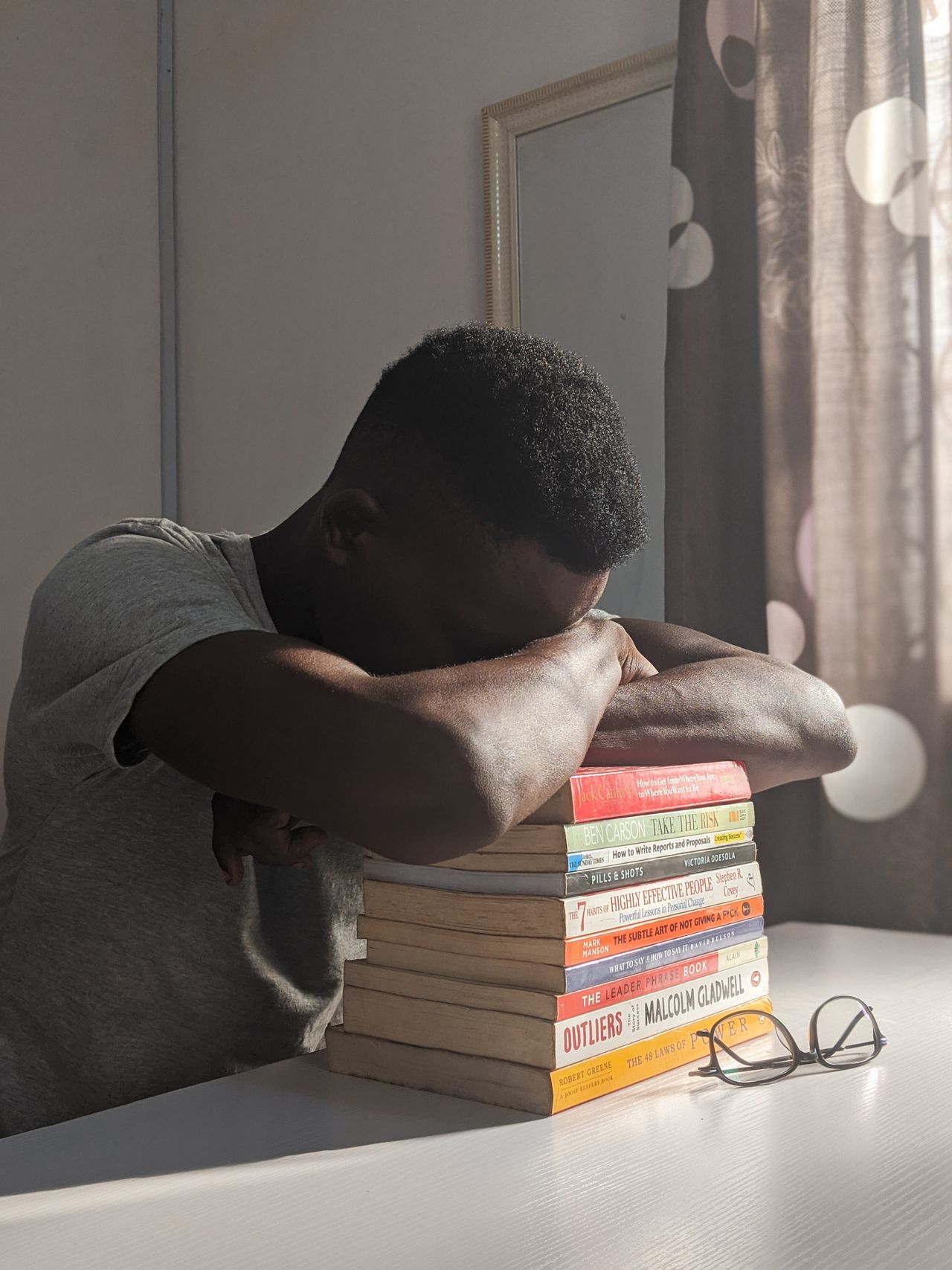
A young man rests on a stack of books at a desk, sunlight filtering through a window. Photo Credit: Oladimeji Ajegbile/Pexels.
They buried Ebiakpo’s father, Papa, in June. The rain that day was the small, annoying kind that did not commit. Papa had taught History for thirty-one years. When he died, the state owed him nineteen months of salary and a pension nobody could prove existed. Ebiakpo was the third of four children, and the scholar. That was his role. His father’s small revenge on a country that had refused to pay him: he would build one more of himself, and this one would be paid what he was owed. Ebiakpo read Law. First class.
In August, he went for an interview at a firm on Victoria Island. The partner who saw him spent twenty minutes bragging about representing a luxury influencer accused of beating two girlfriends and turning up at his own arraignment high. The firm offered Ebiakpo 130,000 naira a month. Transport alone would have eaten seventy. On the bus home, he did the arithmetic and understood, for the first time, that his father had not died of a stroke.
His eldest brother Tamunotonye did the thing they did not name. He now called himself Chief Dollar Papi Money and had it airbrushed onto the boot of the BMW X6 he parked sideways at family functions. His large diamond chain hung to his navel. His girlfriend, Blessed, came with him everywhere, in a waist-length lace-front, acrylics she could barely type with, and a BBL he paid doctors in Turkey to install, as rumours had it. The chain around her neck hung a huge pendant that spelt Quila B — half for tequila, which was the only thing she drank, and half for the American popstar she was studying to become.
Chief Dollar took Ebiakpo to a place on the island where the drinks cost more than Ebiakpo’s rent. “Bro”, he said, wiping his mouth, “survival for this country no be grammar again. Na money. Na feeding your people. School na the biggest client Nigeria don ever run”. At the next table, a boy was livestreaming and shouting at his own phone. When the waitress bent to ask him softly to lower his voice, he turned and told her, at full volume, that a girl her size should be grateful he was patronising the restaurant she cleaned. His table applauded.
The second brother, Preye, had broken Papa’s heart. He read Engineering at the University of Portharcout but left in his third year to do music. He did not do music. He managed a boy from the streets called Flexable, who could not finish a sentence in any language. Flexable’s last single had crossed five million streams in a week. Preye carried Flexable’s water bottle and towels to shows and said he was investing in the brand. Papa never once asked him about the music.
Before he died, Papa said one afternoon in the parlour, while watching TV. “This country no longer celebrates excellence. It now rewards performed foolishness, because foolishness travels faster on the internet than sense.”
Ebiakpo’s sister, Papa’s only daughter, Tarilaye, was fifteen. She did not know the capital of Taraba. When he told her Jalingo, she said no; she was sure Jalingo was a dance, then thought about it and said sorry, that one was Alingo, and laughed at herself for a whole minute. Her plan, she had told their mother, was to become an influencer first, then a reality-show girl, then to marry a musician, or possibly an actor; she was still deciding.
Tarilaye had been the brilliant one. Before Papa died, she had read all Chinua Achebe cover to cover at eleven and even corrected her teachers in school. But school na scam had become a hymn in her generation, and she quietly stopped trying. She turned instead to endless scrolling and devotion to the lives of celebrities who did not know her name. She was happier now, or something that looked from a distance like happier.
The Yoruba word for one who knows zero used to be the worst thing a boy could call another in a schoolyard — Olodo. Now the ones who know zero owned everything the market would price. Ebiakpo’s first-class certificate lived in a drawer. It smelled faintly of batteries. One night, Ebiakpo had dreamt his father was still teaching. The classroom was empty. He was writing on the board in his beautiful handwriting, and behind him, through the window, the whole country was dancing.
He woke, and started thinking about which of his father’s children was the actual dullard.

Toyosi Onikosi is a Nigerian writer, development finance lawyer, and passionate advocate for Africa’s creative and cultural heritage. She currently lives in Cairo, Egypt, where she works with an African development bank. Toyosi holds a degree from the University of Oxford, where she was also awarded the Rex Warner Short Story Prize. Toyosi is the author of two children’s book When You See the Red Sea and What Happens When I Read. She has been writing stories since childhood and engages in other forms of artistic expressions such as food art and poetry.
KioskNews shows a cleaned-up reading view extracted from the publisher’s page — the original always lives on their site, not ours.