Norway rethinks new technologies in classrooms
‘HAPPENED TOO QUICKLY’: The country is expected to present a bill to ban ‘harmful’ platforms such as TikTok and Snapchat for children younger than 16
Three years ago, a schoolteacher in Norway was reprimanded for putting his pupils’ iPads aside to return to pen and paper. Now, the whole country is rethinking its approach to new technologies.
After making laptops and screens ubiquitous in schools across the country, Norway is bringing back textbooks to reverse a sharp decline in pupils’ reading and writing skills.
The desire to regain control over technology, rather than just accept the consequences that come with it, extends beyond the school environment in the tech-loving country.
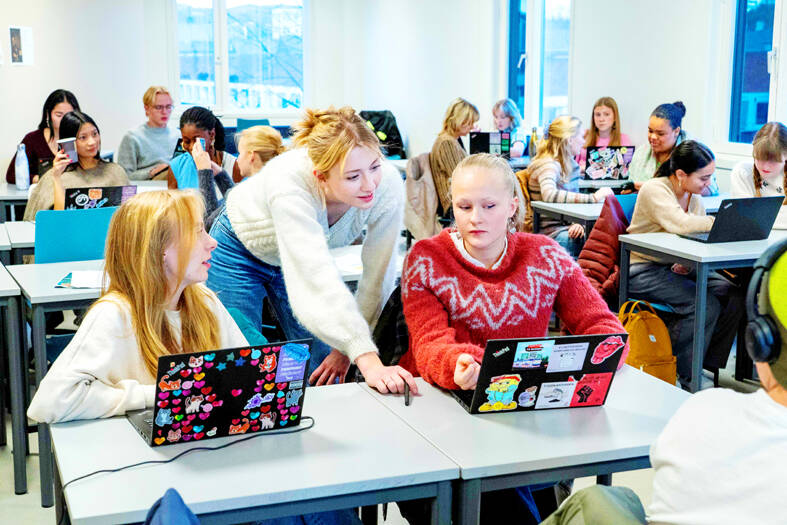
A teacher helps students use their laptops in a classroom at a school in Oslo on Sunday last week.
Photo: NTB via AFP
“There is reason to believe that the introduction of screens in schools happened too quickly, before we had sufficient knowledge about their effects and about what constitutes good pedagogical use of digital devices,” Norwegian Minister of Digitalisation and Public Governance Torgeir Micaelsen said.
For about 20 years, Norway has been pushing computers and tablets in classrooms, a trend further reinforced during the COVID-19 pandemic. Since 2023, primary schools in Oslo were even supposed to equip every pupil with a digital device.
Third-grade teacher Pal Ludvig Finstad broke with the prevailing regulations one day, deciding to temporarily put tablets away in favor of paper and pencils to help his pupils who were struggling with reading and writing.
“My pedagogical assessment was that, at that point, the pupils needed a new approach, and that it was urgent,” he told the newspaper Klassekampen in 2024.
He ended up getting a written warning from the school administration.
Ironically, Oslo municipality has just dropped its requirement for one device per pupil in primary schools, giving schools more leeway in choosing their teaching tools.
“The screen itself is not the problem. It is the way it is used, when the tool becomes more important than the content,” primary school principal Silje Ween said.
“Just as a book is a useful and absolutely necessary tool, an iPad can be as well, but one does not exclude the other,” she added.
Norwegian authorities have, in turn, recommended regulating the use of mobile phones in schools and introducing artificial intelligence into the school curriculum only gradually.
The government is also seeking to enshrine access to printed textbooks in law.
A Norwegian commission on screen use in 2024 said that students generally understand long texts better if they read them on paper.
In last year’s Programme for International Student Assessment (PISA) survey — an international survey which measures the skills of 15-year-olds — Norwegian students scored below the Organisation for Economic Co-operation and Development’s (OECD) average in reading comprehension, mathematics and science, a first in all three areas at once since 2006.
The distraction caused by omnipresent screens has been mentioned as one possible explanation.
The backpedaling on new technologies, while very relative, also extends to other areas, for an array of reasons.
Norway in 2024 announced plans to restrict social media to protect its young people.
The Norwegian government is expected to present a bill by the end of this year banning “harmful” platforms such as TikTok, Snapchat and the gaming platform Roblox for children younger than 16.
Citing risks to privacy, the government also wants to temporarily ban the use of smart glasses, which are equipped with cameras, in some public places such as parks, beaches and schools.
“Not so long ago, we put the development of digital infrastructure on the same level as the invention of electricity. In our haste, we may have forgotten to regulate,” said Christer Hyggen, a sociologist and researcher at OsloMet University.
“Political leaders have lagged behind and tried to solve complex problems with quick fixes,” he said.
The measures announced by Norway so far are “superficial” in the face of deeper issues, including the addictive design of digital services, targeted marketing and the profiling of children and youths, he said.
Given the scale of these problems, Hyggen said he believes that “the paradigm shift can only happen at a larger level: that of Europe.”
KioskNews shows a cleaned-up reading view extracted from the publisher’s page — the original always lives on their site, not ours.