Opinion: Opinion | Congress' New Electoral Formula In Uttar Pradesh
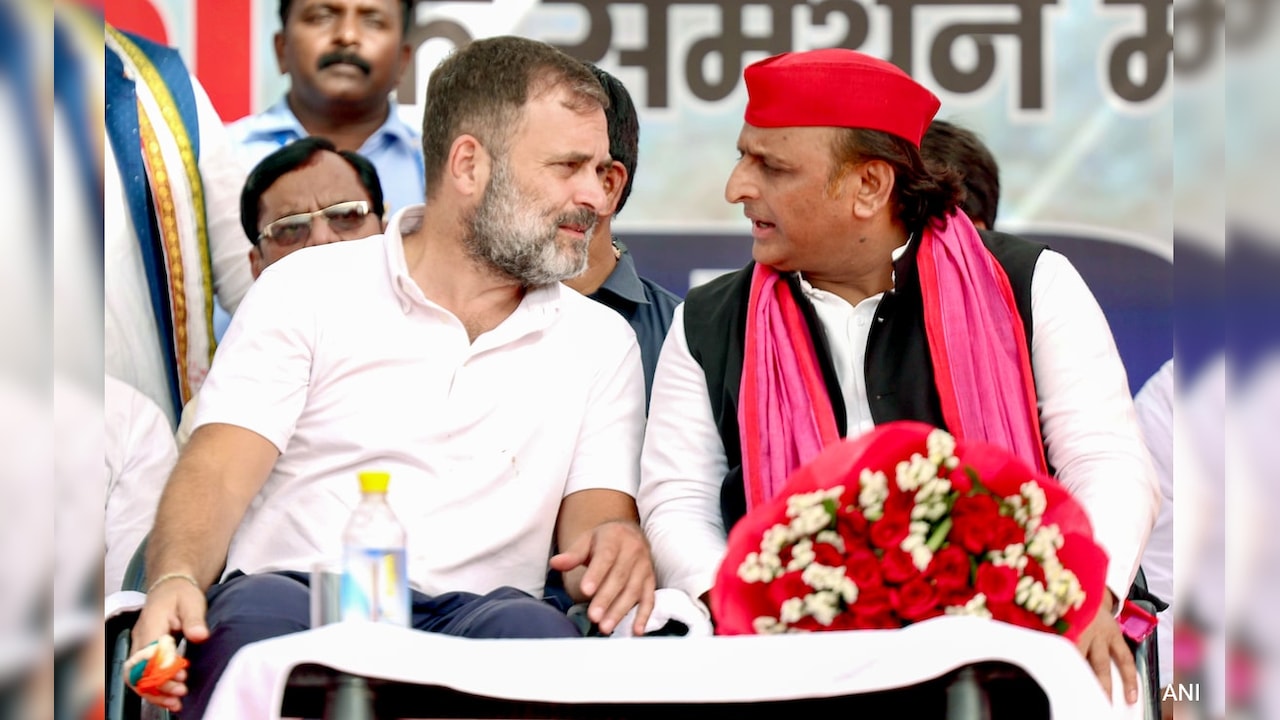
Uttar Pradesh has always been the ultimate test of political arithmetic. For any opposition formation hoping to challenge the BJP in the state, the question is not merely whether individual parties have pockets of influence. It is whether their votes can be combined without their organisations, ambitions and social coalitions pulling in different directions.
The recent selection of Aradhana Misra Mona as Uttar Pradesh Congress president and Imran Masood as working president seems less like a routine organisational reshuffle and more like an attempt to balance Samajwadi Party honcho Akhilesh Yadav's PDA (Pichhda, Dalit and Alpsankhyak) arrangement. In other words, Congress appears to stand in tandem with SP as far as caste and community equations are concerned in UP.
It is in a way a signal to SP to consolidate its backward-class and minority base while Congress will try to add sections, which SP finds difficult to reach- Brahmins as well as some urban and unaligned voters.
However, symbolism can open a political conversation, it cannot substitute for votes at the booth. With seat-sharing talks still in limbo, can the INDIA alliance strategy actually work in assembly elections?
Real test of relationship
The political significance of Brahmin support is known to political parties. More so, since 2007, when Mayawati's Bahujan Samajwadi Party pulled off one of UP's most successful experiments in caste-based social engineering.
Otherwise, the BJP has traditionally enjoyed strong support among Brahmins in UP. But for 2027, both SP and now Congress are seeking to make inroads into this influential vote base - roughly 10% of the electorate.
Misra, a three-time MLA from Rampur Khas, is the daughter of veteran Congress leader Pramod Tiwari. She brings in a Brahmin face with a long-standing organisational base in eastern UP, where Brahmins have significant presence.
Masood gives the party a prominent Muslim leader with influence in western UP. However, his appointment can create misunderstandings with the SP, which has traditionally relied heavily on Muslim-Yadav support.
The party has also included an OBC and Dalit representation in its senior organisation.
Congress may seem like rebuilding its social coalition in a state where its traditional support base has progressively weakened. Yet indirectly, it is also hoping to garner Brahmin votes for the alliance which have been elusive until now.
Indeed, Congress is also pushing for an early seat-sharing arrangement and says it wants to identify winnable seats, while SP has its own organisational ambitions.
Congress has pushed for a much larger share of seats, with reports putting its demand around 150-200 (total 403 seats), while SP is reluctant to concede such a large number.
Every other day, leaders of both the parties (including Masood) are sparring over quality and quantity of seat sharing.
Hundreds of local Congress-SP workers fight over who gets the ticket. That makes seat-sharing considerably more complicated than simply saying ‘we are allies'.
That tension matters because assembly election is fundamentally different from a Lok Sabha election. A party needs functioning booth-level organisation, credible local candidates and a clear understanding of constituency-level social equations. Simply adding together SP and Congress' 2024 vote bases cannot automatically reproduce the 2024 result.
This is possibly the biggest danger to INDIA in UP- not ideological disagreement, but competition between allies for tickets and political space. In this context, Congress' new appointments are also a bargaining tool with the SP.
Changed political equation
In the 2022 assembly election, Congress won just two of 403 seats and polled 2.33% of the vote. The BJP won 255 seats polling 41.29% votes, while the SP won 111 seats with 32.06% vote share.
However, the 2024 Lok Sabha election changed many misconceptions of the political parties. The Congress and SP fought together as INDIA bloc partners winning 43 of the 80 Lok Sabha seats (SP won 37 while Congress won six). The BJP won just 33. That result demonstrated that the BJP's previously formidable UP coalition was not immune to electoral disruption.
But it also showed something else - SP was the principal opposition force within the INDIA alliance while Congress was pushed to the periphery.
This created a dilemma for Congress. It wants enough seats to rebuild itself in UP, but SP is unwilling to give those constituencies where it already has a stronger base. Afterall, UP happens to be the principal organisational and electoral arena for the SP. Therein lies the tussle for political space.
Given the situation, Congress needs a distinct identity within the alliance. If it becomes merely the junior partner carrying the INDIA label, its long-term revival becomes difficult. The appointment of Misra and Masood appears designed partly to give the party identifiable faces across different social constituencies.
However, it would be good for Congress to avoid competing with SP for exactly the same political space.
Also, seat-sharing needs to be settled without prolonged public friction. Recent statements from both sides have occasionally exposed differences over leadership and the number of seats. Masood has emphasised Rahul Gandhi's national role, while SP leaders have stressed Akhilesh Yadav's centrality in UP.
That is precisely the kind of competing messaging that can unsettle alliance workers even when the top leadership continues to call the alliance intact.
For the INDIA bloc, the central challenge is consequently not merely announcing an alliance. It is building trust, agreeing on seat-sharing early enough to prevent rebellion, coordinating candidates and presenting voters with a clear alternative.
KioskNews shows a cleaned-up reading view extracted from the publisher’s page — the original always lives on their site, not ours.