Cash handout preparation under way
PRINCIPLED SPENDING: The NT$10,000 cash handout was decided according to strict fiscal calculations and planning, the Executive Yuan spokeswoman said
By Chung Li-hua and Fion Khan / Staff reporter, staff writer with CNA


The government aims to distribute its planned NT$10,000 (US$314) universal cash payments before the Lunar New Year next year, Executive Yuan spokeswoman Michelle Lee (李慧芝) said yesterday.
The government has allocated NT$235.7 billion for the cash handout program, and relevant ministries have begun preliminary preparations, Lee told a post-Cabinet meeting news conference in Taipei.
Responding to calls from the Chinese Nationalist Party (KMT) caucus to increase the handout to NT$20,000 per person, Lee said the government’s proposal is based on three principles: First, it must not increase government borrowing; second, it must not crowd out spending on social welfare, national defense, healthcare or education; and third, it must comply with constitutional and legal requirements.
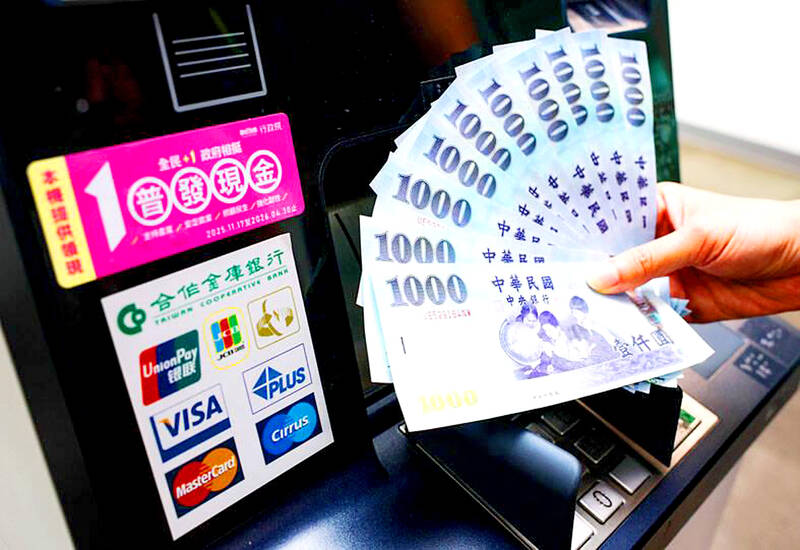
A person holds NT$1,000 notes in front of an automated teller machine with a sticker about the government’s NT$10,000 cash handout program in Taipei in November last year.
Photo: CNA
Citing Article 70 of the Constitution and Article 91 of the Budget Act (預算法), Lee said the Legislative Yuan is not permitted to propose measures that would increase government expenditures.
The proposed NT$10,000 payment was decided according to strict fiscal calculations and planning, taking into account the nation’s financial capacity, she said.
Lee urged legislators to review and approve the proposal for next year’s central government budget.
The Executive Yuan submitted the central government budget proposal and related spending plans to the legislature at the end of August, with revenue and expenditure budgeted at NT$3.9266 trillion.
Unlike previous universal cash payments, which were funded through special budgets and involved a streamlined administrative process, the latest proposal is included in the annual budget.
The Ministry of Finance has estimated that it would take about five months to complete the necessary system setup and procurement procedures after the budget is passed by the legislature and is promulgated by the president.
The ministry said it has applied to the Executive Yuan for about NT$100 million from the government’s second reserve fund to begin procurement and preparatory work in advance.
The ministry has already initiated procurement procedures in accordance with the Budget Act, Deputy Minister of Finance Chen Yong-sheng (陳勇勝) said.
Separately, KMT Culture and Communications Committee Director Chen I-hsin (陳以信) said that the KMT caucus’ proposal to distribute NT$20,000 would be funded by the excess tax revenue collected this year, not by borrowing.
Chen said current estimates suggest that excess tax revenue could exceed NT$1 trillion this year, providing a substantial source of funding for the proposed NT$20,000 cash payment.
The government collected more from taxpayers than expected, and after accounting for necessary spending and maintaining fiscal discipline, part of that surplus could be returned to the public, he said, adding: “How does that amount to leaving debt for the next generation?”
KioskNews shows a cleaned-up reading view extracted from the publisher’s page — the original always lives on their site, not ours.