Jump scares, leather gloves and squeaking moth noises: theatre horror masters on how they make their shows so scary
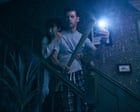
It was 1am. Total darkness. Locking up a wedding venue, Sam Beech’s car sensor went off: there was something behind him. “It went on for half an hour,” the writer and director recalls, “on the front bumper, then round the back. But every time I looked, there was nothing.” It kept going, snuffling around the car. So he stopped looking. “I thought: ‘If I don’t look behind me, it won’t get me.’” Since then, Beech, the creator of one of a plethora of horror shows currently haunting the stage, admits, “I don’t like driving in the dark”.
Beech’s experience was eerily similar to a scene in Andy Nyman’s hit 2010 play Ghost Stories, which Beech had seen four times, so the gnarly end the character had met on stage filled his mind when the sensor went off in the dark. Now, the uncanny experience has fed into his own new horror show Blackout (touring the UK to 27 February), which uses everything that made him so scared that night: the quiet, the absence, the idea of something lurking in the shadows. “It’s the Jaws effect,” says Chris Fisher, the illusions designer behind the stage show of Paranormal Activity (at London Ambassador’s theatre to 27 February, and touring the UK), which had me sheepishly checking under my bed for several nights and stopped just short of nightmares. “It’s scarier to see the fin and hear the music,” Fisher says, “than it is to see the mechanical head of the shark.”
On stages across the country, theatre-makers are hoping to make their audiences grab the arms of strangers next to them. But it’s easy to go wrong with horror, Fisher says: “It often goes too far, too hammy. Too – and I say this affectionately – Blithe Spirit.” But when you get it right, he says, discounting Noël Coward’s farce about an eccentric clairvoyant, “people leave with a newfound understanding of what theatre can do”.
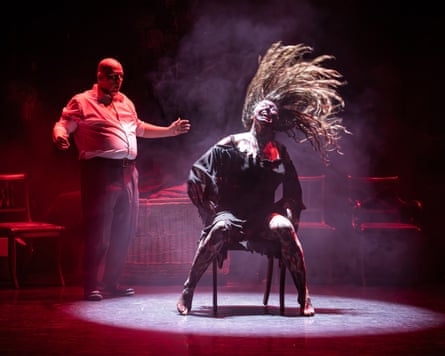
For years, 1987’s The Woman in Black was the reigning champion of achieving a proper nail-biting scare on stage. On a sparse set, the show invited the audience to imagine a pony and trap as the story set off, priming them, like Beech’s stalking shadow and Fisher’s Jaws theory, to fill in the gaps for themselves. It was unrivalled for years, but recently, perhaps kicked off by the success of Ghost Stories, there’s been an increasing flood of shows trying to eke out new ideas of horror plays. The campily satisfying haunted house thriller 2:22: A Ghost Story is ever-touring and the hallucinatory Stranger Things: The First Shadow (which also features Fisher’s illusions) is going strong in London’s West End. Farther west in the city, at the Bush theatre, Mei Leng Yew’s recent debut The Hungry Ghost played with Chinese traditions and queer obsession to create a nightmarish story of possession. Going down the route of psychological horror, the immersive touring experience Sins uses audience participation to determine what happens on stage. This Halloween season, the ghosts and ghouls have busy schedules.
“Maybe 2.22 was so successful that it just initiated a cascade,” says comedian Kirsty Mann, who tests her audience’s belief in ghosts with a true tale of her haunted house in the comedy-horror Corpse, which is coming to London’s Soho theatre in February after an Edinburgh fringe run. “These things come in cycles,” she says. “But people go to the theatre for escapism and horror is the ultimate escapism. There’s so much awfulness in the world right now, people are turning more to the fantastic, and with horror, you’re not just following the story. You’re totally separated from reality.” Now, finding the scariest night out possible has become “almost a drug”, Fisher says, for audiences chasing the high of the collective fright. “It’s like being on a rollercoaster,” says Mann, who saw Paranormal Activity three times in one month.
The line between successful scare and unimpressed shrug is a fine one. “It’s a bit like comedy,” says Carolyn Downing, sound designer on The Silence of the Lambs, the stage adaptation of the psycho-killer movie that is touring the UK to 26 June. “It has to be super-precise. It only takes a mistimed or misaligned moment, and your brain’s quick enough to go: ‘I didn’t believe that.’” The success of that minuscule moment relies on the atmosphere created by dozens of people backstage. “It’s all about the buildup,” Downing says. Achieving the perfect jump scare requires the increase in tension, the wrongfooting, and the offbeat fright just as you’ve relaxed. “It won’t scare you if you’re half expecting it,” she says.
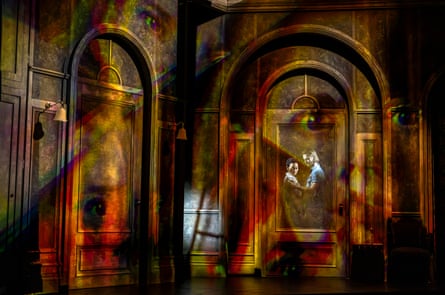
Horror works best, set designer Ti Green believes, “when your understanding of the rules are pulled apart”. For the stage adaptation of Shirley Jackon’s 1959 gothic novel The Haunting of Hill House, Green wanted to build a world that looked solid and dependable. “That’s the first step,” she says. “The second is to dismantle everyone’s sense of safety.” Jackson’s story is a quintessential haunted house, with a group of ghost seekers wandering around a decrepit mansion. Paying homage to Jackson’s description of “Hill House, not sane”, much of Green’s set is made of translucent gauze, so depth and vision can play with the idea that everything is constantly in flux, making it feel, she says, “as if the house is doing it, not as if the theatre is doing it”.
In Blackout, Beech aims for the opposite effect: he wants the theatre itself to feel haunted. Having created the award-winning Statfold Scream Park, he is moving his experience in horror events on stage with this touring show that plays in each venue for just one night. “Five hundred people walk into a theatre and choose to accept something they know isn’t real,” he says, setting up the show, which is framed as a rehearsal. With the audience as ghosts to the action, Blackout aims to dissect and strengthen the classic tropes of horror: “darkness, silence, negative space”. As in The Woman in Black, the agreement to suspend disbelief allows the paranormal to take a step closer.
These conventions of horror on stage are not cheat codes. “Anyone can go and buy a magic trick and try to perform it,” Fisher says, “but they’re not actually doing real magic. It’s all about how you present it, what story you put with it. It’s the same with horror.” Many of the principles of good illusion – and good horror – have remained largely unchanged over time. “For Paranormal Activity, I went back to the ways that Victorian magicians or spiritualists would have done it,” Fisher says. “The majority of the illusions could have been used for hundreds of years.”
after newsletter promotion
Illusions such as Fisher’s have become a significant selling point for modern horror on stage, perhaps, as Mann suggests, because they give a “wow factor” that is hard to recreate on screen with the ubiquitous powers of AI and CGI. “In live theatre, if you pull off an amazing trick,” she says, “you can have that moment of, ‘Holy shit, how did they do that?’”
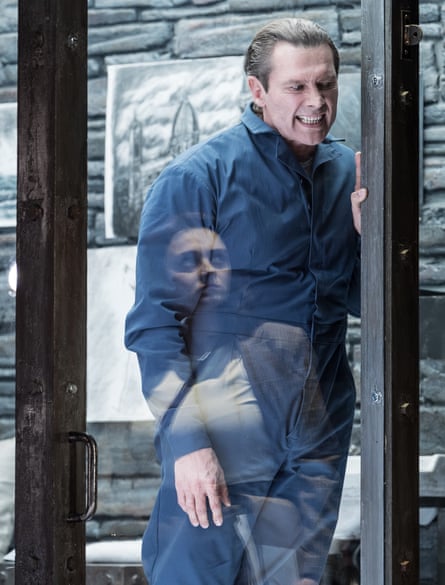
Maximising the bodily experience of sharing the space, theatre has the opportunity to be even scarier than film, allowing the fear to slip off the stage and follow you home. “The really scary stuff is when it taps into a deep fear you have,” says Mann. In Corpse, which uses minimal set and choice illusions by John Bulleid, she pushes on the bruise of the feeling: this could happen to me.
Other shows have the challenge of a direct comparison with their originals; that Paranormal Activity, The Silence of the Lambs and The Haunting of Hill House, which is touring the UK to 21 November, are all adaptations says something of the endurance of spooky stories. For The Silence of the Lambs, Downing felt a responsibility to achieve the iconic sound of moths, which marks a significant turning point in the story. Using foley techniques, she’s previously made the sound of birds with flapping leather gloves, but the moths needed to be smaller and finer. Her list of moth-making ingredients includes rustling leaves, swooshing paper, rubbed hands and the real recorded squeaking of death’s-head hawkmoths. “The juiciness of horror is that you can zoom in on sound,” she says, “make it feel visceral and intense.”
This is key; a horror play has to be felt. So much of that feeling being handed over to the audience, Fisher says, is down to the actors. “Like with illusion, when you see something again and again, you become a bit jaded with it. It’s the same thing with horror scares. It’s so important to keep those reactions as if they are experiencing it for the first time, because that’s what we’re doing.”
Halloween in the UK is growing. “We’re about 10 or 15 years behind America,” says Beech. “I think that’s probably the same with horror shows and audience appetite.” As demand grows, so do these theatre-makers’ ambitions. “I want to keep pushing it,” says Fisher. When the Paranormal Activity team recently locked the show in New York, he says, “we all sat down for dinner, together for the first time in months, and were like, ‘What shall we do next?’” He nods to me: “Make sure you have those nightmares.”
KioskNews shows a cleaned-up reading view extracted from the publisher’s page — the original always lives on their site, not ours.