Cold War lessons for the AI age: how a US-China hotline could help stop a nuclear attack
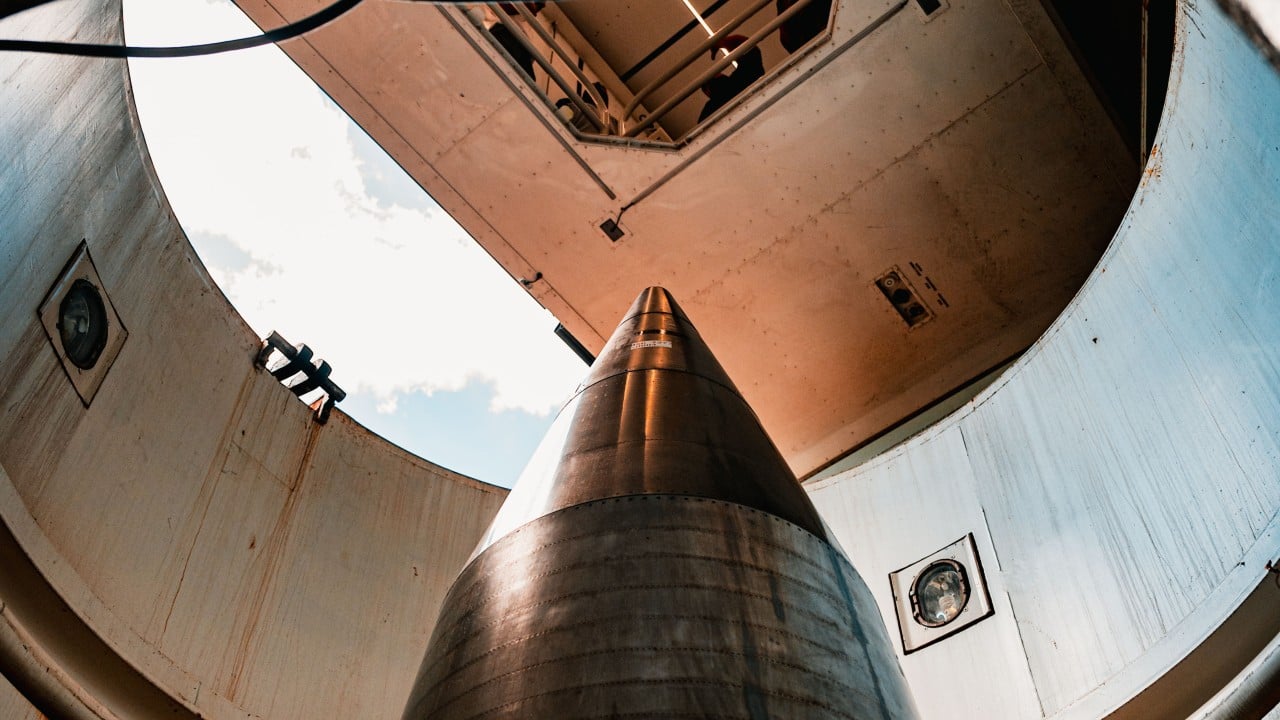
The United States and China should set up a dedicated hotline to help reduce the risk of AI-induced nuclear attacks, analysts have said.
The call came amid a fresh push by Washington to prioritise high-level talks on arms controls.
In a phone conversation on Wednesday, US Secretary of State Marco Rubio and his Chinese counterpart Wang Yi agreed that meaningful leader-level conversations would help “advance goals such as peace and denuclearisation”, according to the Department of State.
US President Donald Trump has been repeatedly trying to engage his Chinese counterpart Xi Jinping on nuclear arms controls since his first term.
Trump recently renewed his call to discuss the issue ahead of their meeting at the Asia-Pacific Economic Cooperation summit in Shenzhen, which may also feature three-way talks with the Russian leader Vladimir Putin.
He insisted that denuclearisation should be the focus of any trilateral meeting, saying it would be “a very positive thing for the world”.
Although talks on cutting warhead numbers are widely believed to be far off, managing the use of artificial intelligence could open a window for further discussions between the US and China on nuclear arms.
However, the two countries have had few talks on the specifics of this issue despite their broader discussions about AI, according to Zhou Bo, a retired senior colonel in the People’s Liberation Army.
Zhou told a forum in Shenzhen on Saturday that the military use of AI was now already a reality.
He added that an intercontinental ballistic missile travelling between China and the US would take around 30 minutes to reach its target, leaving little room for humans to respond – something that made the case for using AI virtually indisputable.
There was an urgent need to draw “red lines” on the use of AI in the nuclear domain and the US and China should lead the way, added Zhou, who is now a senior fellow at the Centre for International Security and Strategy at Tsinghua University.
“AI is developing so fast that governments should probably be talking about it every month, and there should probably be a dedicated hotline,” he told the forum, which was co-hosted by the Shenzhen Loop Area Institute and the University of Hong Kong’s Centre on Contemporary China and the World.
Zhou said Beijing and Washington could discuss ways to prevent AI controlling nuclear command systems.
“I think autonomous AI algorithms should be prohibited from causing nuclear attacks,” he added.
The two sides also needed to discuss ways to prevent cyberattacks on nuclear command, control and communication systems, as well as AI-induced false alarms, he said.
He cited several Cold War cases in which the US or the Soviet Union mistakenly suspected they were under attack, including a notorious false alarm in 1983.
In that incident, Soviet officer Stanislav Petrov decided that a satellite warning of incoming US missiles was incorrect and did not escalate the matter, a decision widely credited with averting a nuclear war.
Cui Hongjian, a professor at Beijing Foreign Studies University, said China and the US should learn from the unchecked nuclear arms race in the earlier stages of the Cold War to prevent the “wild growth” of AI from the outset.
“In the age of AI, it is both necessary and important for China and the US to build basic mutual trust through dialogue,” said Cui, a former Chinese diplomat.
He also warned that AI could speed up the miniaturisation and tactical use of nuclear arms.
“If AI involvement keeps lowering the threshold for using nuclear weapons, the nuclear risks facing humanity will keep growing,” he added.
Trump open to nuclear talks with Xi and Putin
Cui said both countries should have a degree of transparency about their AI policies, using mutually acceptable information disclosure as a first step for building trust.
He also called on the two sides to seek incremental results and promote their consensus on AI governance to the wider international community to prevent a disorderly global AI race.
“AI is now moving from the digital realm into physical machines, including areas such as embodied manufacturing, where more detailed rules are needed,” Cui said.
“The use of AI in military and battlefield settings involves specific industrial sectors, which also require more detailed rules.”
Meanwhile, a commentary published in the official PLA Daily on Thursday also called for “a governance framework with broad participation and consensus” and “red lines for the military application of AI” to avoid an unchecked arms race.
But the article also argued China should grasp the “inherent laws” of intelligent combat systems to help “shape strategic superiority”.
KioskNews shows a cleaned-up reading view extracted from the publisher’s page — the original always lives on their site, not ours.