Amid Punjab’s shifting battle lines, can Sachin Pilot be a game changer for Congress?
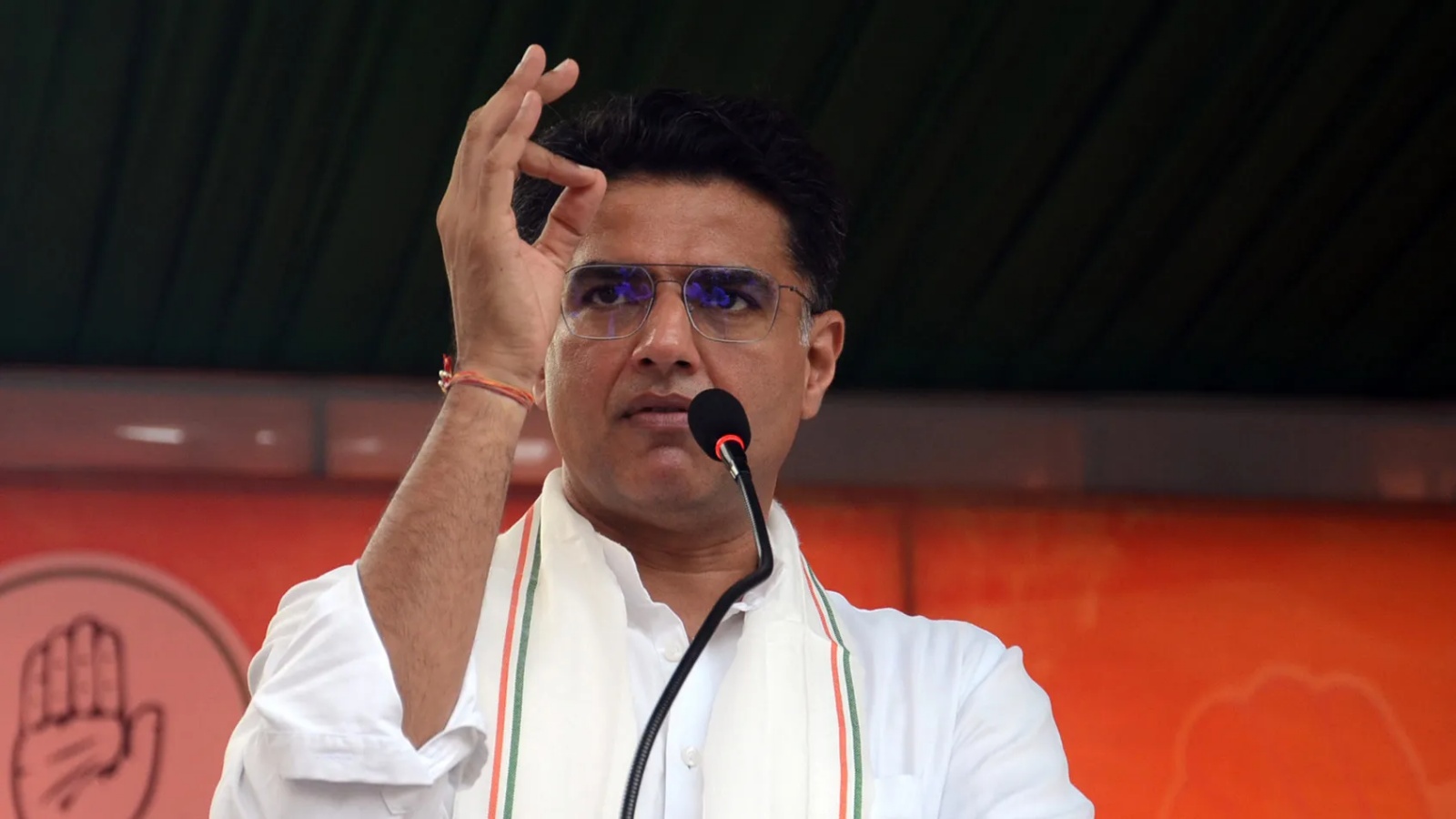
The Congress has made a smart move by sending Sachin Pilot as the party general secretary in charge of Punjab in place of Bhupesh Baghel. It has signalled the Congress leadership’s seriousness about addressing the divisions within the state party unit, which could cripple its chances in the upcoming Assembly elections.
Pilot, 49, has the confidence of Rahul Gandhi, is well regarded nationally and, most importantly, has been welcomed by all party factions in Punjab.
He would take it up as a challenge. Swinging Punjab for his party would come as a real feather in Pilot’s cap, who is seen as its potential chief ministerial face in Rajasthan.
He is familiar with what intra-party feuds entail, given his bitter tussle with former Rajasthan CM Ashok Gehlot. But what goes for him is the will to power he displayed between 2014 – when he was appointed the Rajasthan Congress chief for turning around the party’s abysmal fortunes, and he criss-crossed the state to pull it off – and 2018, when the Congress wrested the state from the BJP under his leadership.
But, as the Punjab in-charge, Pilot has his task cut out with the elections barely five months away.
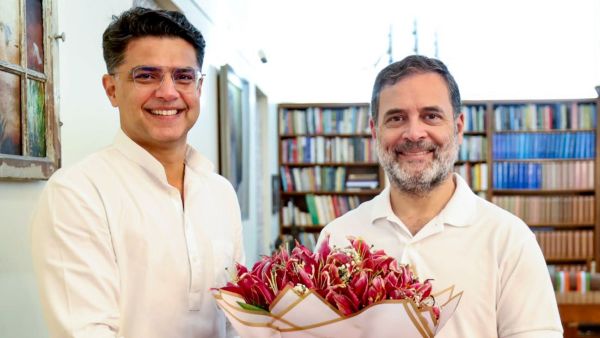 Leader of Opposition in the Lok Sabha and Congress MP Rahul Gandhi being felicitated by party General Secretary and in-charge of Punjab Sachin Pilot during a meeting, at 10 Janpath, in New Delhi. (@INCIndia/X via PTI Photo)
Congress infighting
The Congress should have been the natural beneficiary of the anti-incumbency sentiment this time in the border state. But the open war in its state unit has dealt a blow to the party. Pilot has to deal with the raging conflict between state Congress chief Amarinder Singh Raja Warring and ex-CM Charanjit Singh Channi – something that should have been addressed by the party leadership before it burst in the open.
Power sharing is usually the secret for effecting “unity” in a party. Pilot, who has already met several top state Congress leaders, is believed to have conveyed a simple message to them: Whoever delivers the maximum number of seats from their belts becomes a frontrunner for the top job in the event of the party’s victory in the elections.
The Congress is pitted against the incumbent AAP as its main foe. The AAP, which swept the 2022 elections by winning 92 of 117 seats, is facing discontent, though it still holds its own on the strength of its welfare schemes.
Paradoxically, both the Congress and the BJP believe that a fragmented polity can go in their favour. The Congress feels they would corner the largest chunk of votes to romp home. The BJP calculates that the more splintered the electoral scene, the greater would be its chances of getting a toehold in the next government.
BJP-Akali play
As of now, Punjab looks like a five-way contest between the AAP, Congress, Shiromani Akali Dal (SAD), BJP, and Akali Dal (Waris Punjab De) headed by Khadoor Sahib MP Amritpal Singh.
It will become a four-cornered battle if the estranged former allies BJP and Akali Dal join hands again, which is not being ruled out despite the BJP’s declaration of its intent to contest all 117 seats. Both ex-NDA partners need each other; the BJP has yet to come out of the setback it suffered in the state after the farmers’ agitation during 2020-21.
The Akali Dal, down to one Lok Sabha MP and three MLAs, including two rebel legislators, has hardly shown any signs of revival. The Akalis fear that a hard bargain for seats by the BJP could send younger Sikh leaders into the arms of the Akali Dal (Waris Punjab De), a fledgling outfit.
To rebuild its base in Punjab, the BJP has announced a “Nasha Mukti Yatra” from the third week of September from four corners of the state, modelled on the “Parivartan Yatra” the party held in West Bengal ahead of the Assebly elections there earlier this year.
The BJP hopes that its anti-drug Punjab yatras, which will converge in Jalandhar, would resonate with common people, especially with the party’s traditional constituency of urban, middle class Punjabis. The party’s tie-up with the SAD, if it comes about, might however weaken the credibility of this initiative. For, some prominent Akali Dal faces were under a cloud of alleged drug business, when their coalition had been in power.
Amritpal factor
The wild card this time however could be the Waris Punjab De, whose pro-Khalistan chief Amritpal has been in a jail in Assam’s Dibrugarh under the National Security Act (NSA) since March 2023.
Given the perceived angst against the AAP, public fatigue from existing political parties, and Gen Z’s growing unrest, many do not rule out young Sikhs gravitating to Amritpal’s outfit. Privately, some SAD insiders express their worry on this score, pointing out that Punjab has had a “tendency to vote emotionally”.
The Waris Punjab De has already named some candidates for the 2027 elections, who include Satwant Singh, son of Kehar Singh who was executed for his role in the assassination of ex-Prime Minister Indira Gandhi, and Mandeep Singh Sidhu, brother of late actor-activist Deep Sidhu, who was an accused in Red Fort violence on the Republic Day during farmers’ rally in 2021.
There is also speculation whether Amritpal may be released from prison in the run-up to the elections.
Former PM Atal Bihari Vajpayee used to defend the BJP-Akali Dal alliance for being a coalition which kept Hindus and Sikhs on the same page. BJP leader late Arun Jaitley had once claimed, in a private conversation, that the BJP had “transferred” its votes to the then Captain Amarinder Singh-led Congress at the last moment in the 2017 Punjab elections to “prevent” the AAP from clinching it. The Congress had won that election. The BJP had then accused AAP supremo Arvind Kejriwal of “hobnobbing” with pro-Khalistani elements for electoral advantage.
Even in 2017, many Punjab youth were rooting for the AAP, then a new entrant. “Our parents can vote whichever way they want, but we are voting for the Jharoo (AAP’s poll symbol),” they would say. In 2022, both the youth and their parents voted together for the AAP, propelling it to power in the state.
Punjab’s high stakes
Punjab has seen the consequences of divisive politics – and suffered as a result. In the late 1970s, the Congress had propped up a fiery preacher Jarnail Singh Bhindranwale to counter its rival Akali Dal. He became a metaphorical tiger the party could not dismount from. It was to trigger developments (like the Army’s Operation Bluestar in the Golden Temple complex in June 1984) which hurt the Sikh psyche deeply and led to the assassination of then PM Indira Gandhi.
Punjab has always had implications that go beyond the state. In recent years, India’s diplomatic ties with Canada had come under strain because of pro-Khalistani elements living there, which hit a flashpoint in the wake of killing of a Canadian citizen and Sikh separatist, Hardeep Singh Nijjar, outside a gurdwara in Surrey in June 2023.
It is risky, and foolhardy, for parties to play petty politics in Punjab to win an election or to decimate an opponent, tempting though that might be. For, Punjab is not like any other state of India. All parties will do well to remember that.
(Neerja Chowdhury, Contributing Editor, The Indian Express, has covered the last 11 Lok Sabha elections. She is the author of ‘How Prime Ministers Decide’.)
KioskNews shows a cleaned-up reading view extracted from the publisher’s page — the original always lives on their site, not ours.