Taiwan in Time: When Keelung hosted Taiwan’s largest Korean community
Artist Ho Bin Kim’s latest work touches on a little-known chapter of the port city that was home to hundreds of Koreans before and after World War II
By Han Cheung / Contributing reporter


Sept 14 to Sept 20
Hwang Tae-im’s in-laws were among the many Korean families that congregated in Keelung after World War II, hoping to board a ship home. Japanese colonial rule had ended in both Korea and Taiwan, and many Koreans were eager to return to their newly-liberated homeland.
Around 3,000 Koreans were recorded living in Taiwan in 1943, with Keelung hosting the largest population at 612.
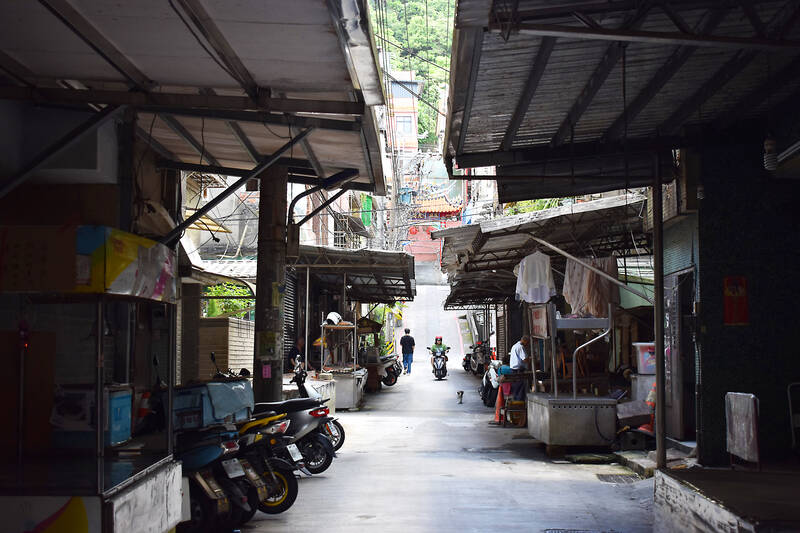
Keelung’s Shengli Alley, once home to a large Korean population.
Photo : CNA
However, only one ship arrived to repatriate civilians, leaving many, including Hwang’s in-laws, stranded in Keelung. When the Korean War broke out in 1950, they gave up going home and settled in Keelung’s Shengli Alley (勝利巷, now Lane 656, Zhongzheng Road), which became known as Korean Street. A 1947 register shows 197 Koreans in Keelung, accounting for more than half of the 358 recorded in Taiwan.
Hwang, who arrived in Taiwan in 1971 to marry her husband, is one of the last Korean residents of Shengli Alley. She operates a hair salon that also sells homemade kimchi.
An impromptu conversation with Hwang is the centerpiece of South Korean artist Ho Bin Kim’s latest three-channel video work. It is the 13th episode of his “Reality Sandwich” documentary series, which has evolved from free-form conversations with artists around the question “What is Reality Sandwich?” to exploring the global Korean diaspora in its past three episodes.
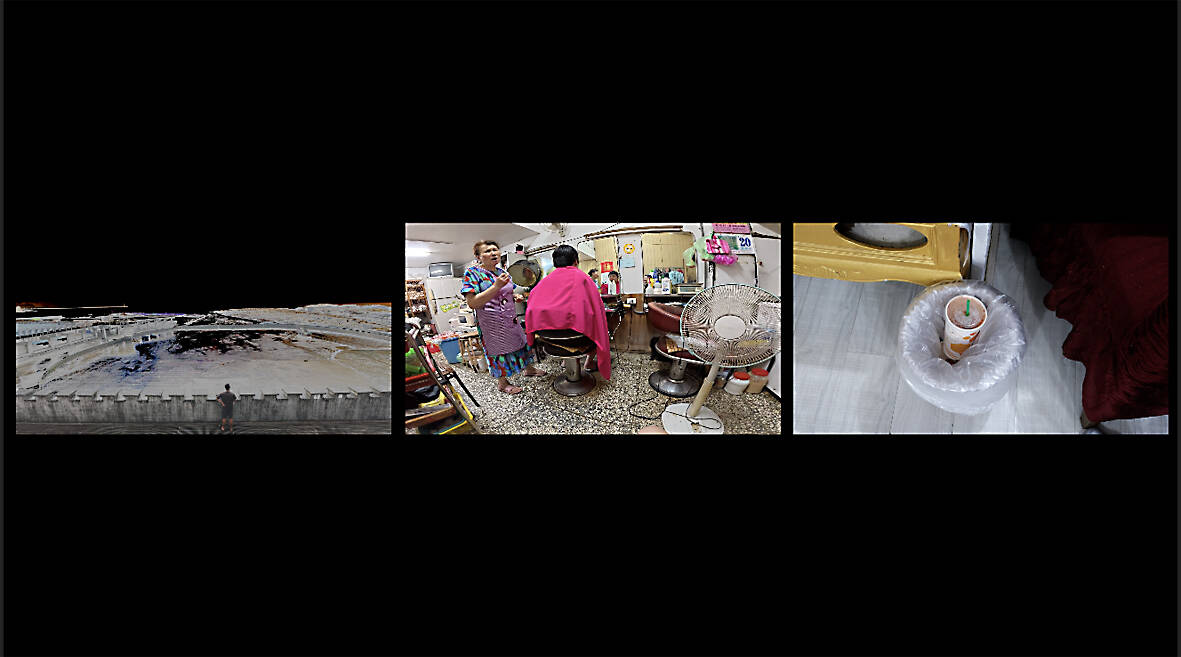
A still from Reality Sandwich Ep. 13 — Keelung Harbor by Ho Bin Kim, featuring a time lapse of Keelung harbor on the left, Hwang Tae-Im’s hair salon in the center and the Aloha Hotel on the right.
Photo courtesy of Ho Bin Kim
Kim spent the past four months as a resident artist at the Hsinchu City Art Site of Railway Warehouse (新竹市鐵道藝術村), where his solo exhibition opens Tuesday at 2pm.
“This part of Korean migration is a gap in history that’s not talked about a lot either in Korea or in Taiwan … A lot of people are surprised,” he says.
HARD LIFE ON THE DOCKS
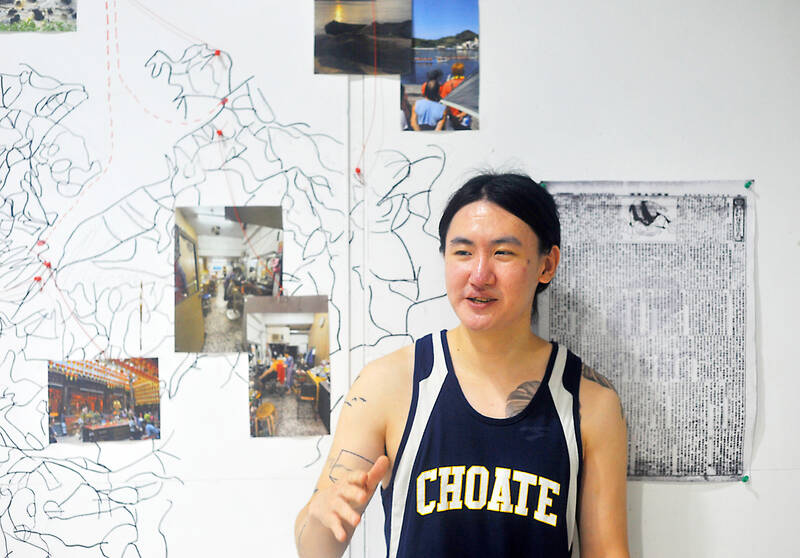
Ho Bin Kim discusses his artwork in his studio at the Hsinchu City Art Site of Railway Warehouse on Aug. 24.
Photo: Han Cheung, Taipei Times
Even after Japan annexed Korea in 1910, few Koreans moved to Taiwan. Government statistics show that there were only 20 Korean residents in 1918. Things started to change with the March First Movement against colonial rule in 1919, while the effects of colonial land policies contributed to increasing numbers of Koreans heading overseas in the 1920s.
Scholar An Seong-su’s study on the Korean Church in Keelung is one of the few academic resources on this migration.
By 1930, there were 898 Koreans in Taiwan. According to government data, most men either worked in the fishing industry or factories, or were traveling vendors and sailors. Women mostly worked in the service industry, with 160 listed as waitresses and 127 as sex workers. Aside from some business owners, most lived a hardscrabble life.
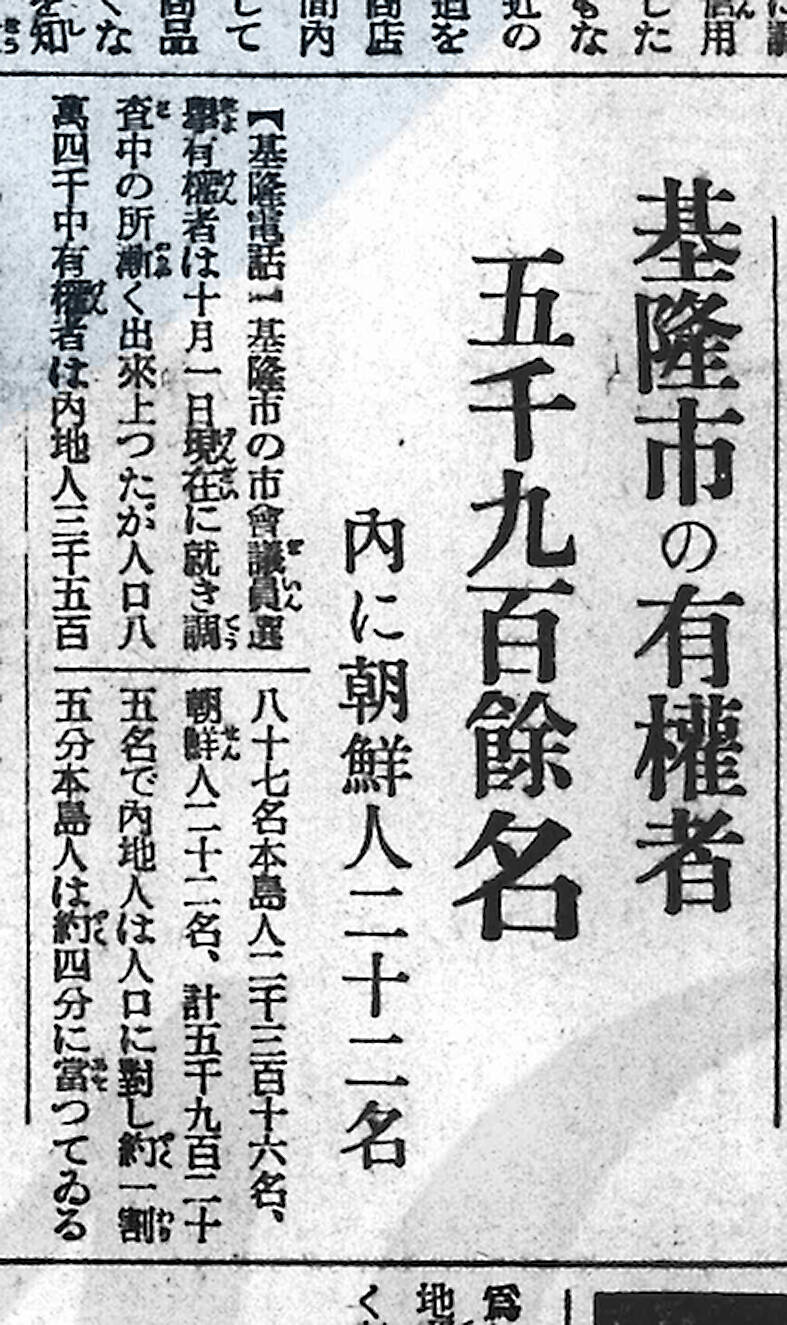
This Taiwan Nichi Nichi Shimpo article from 1935 mentions that 22 Koreans are eligible to vote in the upcoming Keelung City Council elections.
Photo: Photo courtesy of Ho Bin Kim
In 1935, Keelung’s Korean population reached 358, surpassing Taipei and Kaohsiung. This number continued to grow following the outbreak of the Second Sino-Japanese War in 1937. The Japanese began sending Korean soldiers to Taiwan, while some Korean women were forced or deceived into coming here to work in the sex industry or as “comfort women” for the military.
The conscription of Japanese fishermen also created a labor shortage in Taiwan, as relatively few Taiwanese worked in the industry. This led to the recruitment of more Korean fishermen, especially to Keelung.
THOSE WHO STAYED
After Japanese surrender, the Chinese Nationalist Party (KMT) announced in 1946 that a ship would arrive from China to repatriate Korean soldiers and residents. The soldiers were gathered in Taipei and underwent political reeducation classes for three months before being sent home.
Civilians across Taiwan sold their belongings and headed to Keelung to await repatriation. However, not everyone made it in time or got a space on the ship. Along with those who chose to stay, many left behind settled in Keelung’s Shengli Alley and found work in the fishing industry, where they initially received preferential treatment from the government because of the pressing need to keep the facilities vacated by the Japanese operating.
Researcher Yoshihisa Amae writes in “Becoming Korean: Decolonization, repatriation and the everyday lives of ethnic Koreans in postcolonial Taiwan” that 173 out of 197 Korean residents of Keelung were involved with the Taiwan Fishery Corporation, which offered stable jobs, free housing and opportunities to serve as captains and chief engineers.
Another group that stayed were sex workers who were struggling financially and unsure about their prospects in Korea. Others arrived afterward for different reasons, including those fleeing the Chinese Civil War.
A Korean elementary school opened in 1949 in a Taiwan Fishery Corporation warehouse. It got its own building in 1952. One of the better-known alumni is Jen Chiang-ta (任將達), founder of independent music pioneer Crystal Records. Born in 1956, he grew up in Shengli Alley at a time when about half the residents were Korean, he says in a Central News Agency article.
Taiwan’s first Korean Christian church was established in Keelung in 1950, serving as an key community institution. Hwang wanted to marry a Christian man, while her in-laws insisted that their children marry Koreans, so she agreed to move to Taiwan to join the family.
The advantage enjoyed by Korean fishery workers did not last long, however, and by the mid-1950s they were being replaced by trained Taiwanese, Amae writes. Many lost their jobs and suffered economically. This continued into the 1970s, improving only in the 1980s as their children graduated from university and landed better-paying jobs. Eventually, most Koreans of Shengli Alley either died or moved away.
REALITY SANDWICH?
Kim takes the title “Reality Sandwich” from Allen Ginsberg’s book, which he says he does not plan to ever read. Keeping the concept open-ended, he uses it as an abstract phrase in his documentaries, asking participants to offer their own interpretations or thoughts on what it might mean.
During his visit to Keelung, Kim stayed at the Aloha Hotel. Its old appearance allowed him to imagine what it might have been like for Koreans arriving in Taiwan decades ago, while its name also alludes to Korean migration to Hawaii and the US role in World War II, which helped shape the fate of Koreans in Taiwan. In one channel, he films himself discovering in his room six century-old articles about Korean immigrants that he found in the Taiwan Daily News.
Another channel shows a time-lapse overlooking the ocean and the area around Shengli Alley from Heping Island. The indoor and outdoor spaces converge in the center channel, which focuses on Hwang’s hair salon and its partially outdoor space.
The encounter with Hwang was unplanned. Kim had gone to Shengli Alley without knowing what he would find and happened upon her shop, the only one still open on Korean Street.
The conversation is casual, with Hwang talking about her experiences while also asking Kim questions about his personal life. At one point, a longtime customer arrives for a haircut.
“I tried not to ask a lot of questions,” he says. “All the information she gave me was because she wanted to give it to me.”
Hwang has retained her Korean citizenship, meaning she doesn’t receive social welfare or elderly benefits in Taiwan. She tells Kim that in South Korea, she is considered an overseas Korean and does not receive a pension there either.
“Even when I go back to Korea, I’m not Korean,” she says in the video. “I’m also not Taiwanese in Taiwan.”
Taiwan in Time, a column about Taiwan’s history that is published every Sunday, spotlights important or interesting events around the nation that either have anniversaries this week or are tied to current events.
KioskNews shows a cleaned-up reading view extracted from the publisher’s page — the original always lives on their site, not ours.