Hope for progress after US, Iran hold talks
‘BIG DECISION’: Trump suggested he was at a crossroads in his UN address, saying he would make a deal with Iran or ‘annihilate’ it; the Iranian delegates walked out
Reuters, DUBAI, United Arab Emirates, and UNITED NATIONS


The first shuttle talks between the US and Iran for months raised hopes yesterday that the adversaries could make some progress toward ending the Middle East war, although neither side spelled out any change in their positions.
Iranian Minister of Foreign Affairs Abbas Araqchi and US envoys Steve Witkoff and Jared Kushner communicated through mediators on the sidelines of the UN General Assembly in New York, the first such contacts since an interim ceasefire agreement collapsed in July.
“Steve and Jared had a very productive meeting today with mediators of Iran, merely mediators. Let’s see what happens with that,” US President Donald Trump said. “They’ve been mediated for a while, but I think there’s a lot of momentum for them to make a deal. It’s what we’re hearing from everybody.”
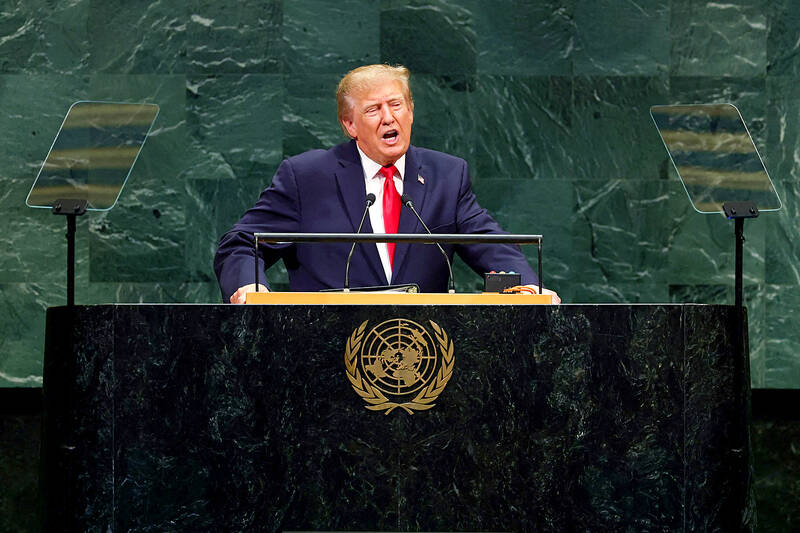
US President Donald Trump addresses the UN General Assembly in New York on Tuesday.
Photo: AFP
Earlier, Trump had told the UN General Assembly in a speech that he had to decide whether to make a deal with Iran or “annihilate” the country.
US Secretary of State Marco Rubio said that Trump is open to meeting with Iranian President Masoud Pezeshkian, who was yesterday to address the General Assembly.
“This is a president that will meet with anybody for the most part, because he believes that engaging with people is important if you’re going to solve problems,” Rubio said on NBC’s Today show. “It doesn’t mean you’re going to end up agreeing with them, but it’s important.”
Iranian Ministry of Foreign Affairs spokesperson Esmail Baghaei said Tehran had engaged with the US through a Qatari mediator in New York and conveyed conditions, including an end to the war on all fronts and a halt to US “acts of aggression.”
Some Iranian state media had earlier reported that Araqchi and Witkoff had met, but Iranian officials clarified that this was not face-to-face. Araqchi met the Qatari Prime Minister Sheikh Mohammed bin Abdulrahman Al Thani, who has been one of the main mediators at previous talks.
The diplomatic opening helped keep oil prices near two-week lows, with Brent crude holding just below the US$100-a-barrel threshold it had shot through this month, after Houthi fighters in Yemen launched a major offensive and fired into Saudi Arabia.
The war, launched by Trump in February alongside Israel as “Operation Epic Fury,” has lasted nearly seven months, killing thousands of people, disrupting global energy supplies and spreading to other countries in the region — first to Lebanon and more recently to Yemen.
Trump repeated previous assertions that the war could end around the time of November’s US midterm elections, although he has not explained why.
Since diplomacy broke off in July, the sides have repeatedly exchanged fire, although Trump has held back from a full-blown resumption of strikes after receiving advice from his military commanders that munitions were running low.
In his address to the General Assembly, Trump made the case that he has shown fortitude while other leaders have equivocated as he defended his decision to start a war with Iran.
Trump also suggested that he could be at a crossroads in the conflict even as he called on the Islamic republic to fully reopen the Strait of Hormuz and return to the negotiating table to find a settlement to end the conflict.
“I have a big decision to make,” Trump said. “Will a deal be made with Iran that lets them rebuild and create a far greater country than it ever was before, maybe one of the greatest in the Middle East or even the world, or do I annihilate the Islamic republic and do it quickly, never giving them a chance to kill and destroy people and countries again?”
The president’s comments came in his wide-ranging address to the international body in which he also celebrated this year’s US military operation to oust Venezuelan president Nicolas Maduro from power, hailed a new agreement to expand the US military presence in Greenland and pushed back against calls for greater regulation of the artificial intelligence industry.
At the heart of the address was a fulsome defense of the war and pushback on the notion that Iran has shown a measure of resilience.
“The terrorist regime is behaving badly, not because they are strong and confident, but because they are weak and desperate,” Trump said.
Most of Iran’s delegation walked out of the chamber as Trump railed against the Islamic republic.
KioskNews shows a cleaned-up reading view extracted from the publisher’s page — the original always lives on their site, not ours.