Tom Fornelli's CFP Vibe Check: No matter how big playoff field gets, no game will ever be meaningless
Every week the CFP Vibe Check tries to put its finger on where things stand in the College Football Playoff race without overreacting to what it just saw, but also probably overreacting to everything it just saw.
There may not have been a better weekend of college football to reflect the week's news in the sport. If you had your head in the sand all week, the College Football Playoff is expanding to 24 teams. The news came and was not well-met by most of the college football literati, or the more vocal sect of college football fans online.
But Saturday might have caused some to reconsider.
To be clear, I am not a proponent of expanding the field to 24. In fact, I spent years arguing against expanding to 12, and for many of the same reasons you hear people arguing against expanding to 24. But when I stopped yelling and looked around at the current state of the sport, I realized 12 made sense. Maybe 16 would make even more.
We're never going to see NFL-style parity in college football, but we're seeing far more of it than ever before. It's been brought on by a host of different changes. Conference realignment is the primary factor. It has concentrated so many of the sport's traditional powers into a few conferences and forced them to play each other all the time when, in eras of yore, those same teams might meet once per decade, if at all. Toss in NIL and a transfer portal, and suddenly the talent becomes a little more evenly distributed at the top.
When all that happens, a bunch of strange things occur. Whether it's Indiana winning a national title, or eight top-20 teams -- and five of the top-10 -- losing in the same weekend. That's what happened this week, and things were almost more chaotic than that.
Miami needed double-overtime to beat Florida State. Had the Hurricanes lost, it would've been the first time in the history of the AP Top 25 -- which began in 1936 -- that the top three teams in the poll all lost during the same week.
These are the kinds of results that just didn't happen through the sports history. They're the kinds of results that are far more likely to happen in a 24-team playoff than they would've been if the 24-team playoff existed a decade ago before the portal and NIL.
It's possible to both long for a time when every loss was a deathblow while also realizing holding teams to that same standard in this era just isn't fair anymore. You can find all sorts of people to blame for what's happened, but it doesn't change the fact that everybody is still watching, and we're all still feeling every single emotion.
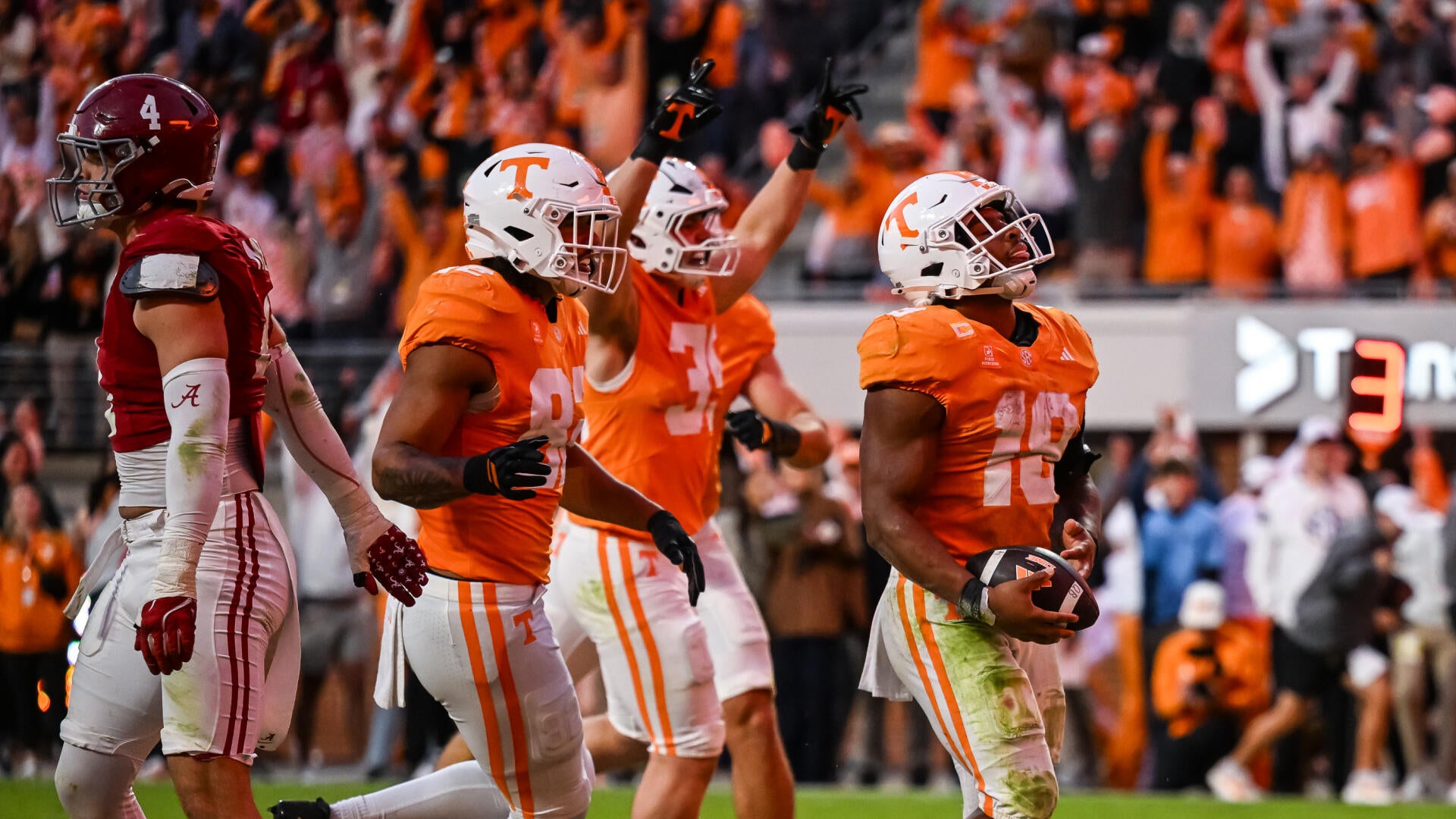
Seriously, I got a bit teary-eyed on Saturday. After spending a good portion of the week hearing and reading angry thoughts about how the sport was dying, on Saturday I saw the complete opposite. I saw Auburn coach Alex Golesh fighting back tears, one arm around his son, while giving a postgame interview after Auburn's first win over Georgia in Athens since 2005. I saw Tennessee fans storming the field at Neyland Stadium and lighting up cigars. I saw North Carolina players sprinting to the Victory Bell to reclaim it after beating Duke. I saw BYU fans storm the field after one of the biggest wins in program history.
I saw the other side, too. I saw Texas fans in disbelief that they'd lost to Florida again. I saw a broken-hearted Nick Marsh wishing he could disappear from the face of the Earth after realizing what he thought was his game-winning touchdown catch was an incompletion because he stepped out of bounds.
I saw all of it and knew that, no matter how big the playoff field gets, no college football game will ever be meaningless. No matter how many angry tweets or social media clips you see.
Anybody who doesn't see that does so because they choose to.
The Big 12 emerged from the chaos in a great spot
BYU's thrilling 28-24 win over Notre Dame wasn't just a huge moment for the program, but a great win for a Big 12 conference that has never received much credit from the College Football Playoff selection committee. It was the kind of marquee win the conference had lacked out of conference since 2024's new orer.
It was also the first step in the scenario I wrote about last week: the Big 12 not just getting two teams in, but three. Now, as I wrote last week, it's a bit far-fetched, but after the carnage of Week 7, it's a lot more likely. BYU wasn't the only Big 12 program to win this week. Both Texas Tech and Utah held serve to remain undefeated, and Houston picked up a win against Oklahoma State.
BYU now has the best odds in the conference at DraftKings, going from +200 (33.3%) to -140 (58.3%) after the win over the Irish. Texas Tech went from +120 (45.5%) to -110 (52.8%). Houston went from +800 (11.1%) to +475 (17.4%). Oddly, Utah's odds fell from +105 to +115. Still, if you add up the implied odds of every Big 12 team currently listed at DraftKings, the Big 12 is currently at 1.94 teams.
It's a much better position than they were at the beginning of the season.
The other side of things
Notre Dame's margin of error got a lot thinner Saturday night. The Irish entered the weekend with the best odds in the country of making the playoff. The good news is they still have the third-best odds.
The bad news is the odds aren't nearly as good.
The Irish went from -4000 (97.6%) to -1000 (90.9%). It's a pretty significant drop, and clearly most people expected Notre Dame to beat BYU. Now the team with the best odds in the country is the toughest test remaining on Notre Dame's schedule: Miami.
If there's a silver lining, it's that while the Irish were part of the wreckage on Saturday, they did benefit from it a little. If everything else around the country had gone according to plan, the Irish would be looking at a situation where if they lost to Miami, they were very likely to miss the playoffs for the same reason they missed last year: a good record, but no marquee win.
Now there's more of an argument for a 10-2 Notre Dame even if it loses to Miami simply because there may not be many other 10-2 teams out there. I can't help but wonder where Notre Dame's odds would be if not for all the other upsets this weekend. I'm guessing they'd be far closer to Alabama (-250) or even BYU than Georgia (-1100) and Miami (-2500).
Oh, and that's one other thing worth mentioning. Miami has the best odds right now at -2500. That same number would've been good for third-best before the weekend.
The field has opened up a bit for everybody.
It's anybody's guess in the SEC
There are two ways to look at what happened in the SEC on Saturday. One is that five of the league's top 20 teams lost. The other is that the SEC picked up five wins over top-20 teams on Saturday!
However you want to look at it, what's left is a pretty jumbled mess, and I'm not sure how it impacts the league's ability to dominate the field at the end of the year. The one thing I am pretty confident in at this point is that we will have a 9-3 team in the field this year, and it may be because the SEC champion finishes the regular season at 9-3.
What should be a serious cause of concern for the league is that it's gone from having a great chance of getting five into the field to looking at four at best. While Georgia has the second-best odds, the next best team is Alabama at -250 (71.4%). Ole Miss -125 (55.6%) is eighth, and Texas +110 (47.6%) is tenth.
Texas, thanks to its 27-24 loss to Florida, is now behind both BYU and Texas Tech on the odds board. I'm sure that won't be brought up in conversations across the Lone Star State this week.
What might be stranger to comprehend is that both LSU and Tennessee are at +154 (39.4%), which puts them behind UCLA and Boise State. Kentucky is behind James Madison. Missouri and Mississippi State fell so far down the board that the oddsmakers are basically saying they don't believe either has a chance, but maybe somebody will be dumb enough to bet on them.
The SEC is the only Power Four conference that doesn't have any undefeated teams remaining in conference play, and most teams aren't even halfway through their SEC slate. There's going to be a lot more chaos in this league before all is said and done.
Beware of Ohio State
The Buckeyes scored a huge win over Indiana on Saturday, but it came at a considerable cost. Julian Sayin finished the game on the sideline with his throwing arm in a sling, and Ryan Day said after the game that Ohio State's starting quarterback will miss "several weeks."
There's a lot of leeway in that assessment, and the Buckeyes are on a bye next week. So depending on the severity of the injury and Ryan Day's definition of "several," it's possible Sayin might not miss a game.
I think it's more likely he misses at least one, and Ohio State's next game is at USC on Halloween. The following week it's Oregon in Columbus. While he was thrown into one hell of a fire, backup Luke Fahey did not inspire much confidence after replacing Sayin.
So I was quite surprised to see Ohio State's odds of reaching the playoff improve from -750 (88.2%) to -950 (90.5%). On the other side of the game, Indiana went from -800 (88.8%) to -700 (87.5%), and I'm more confident in the Hoosiers right now than the Buckeyes. They're healthier and have an easier finish to their schedule.
My rooting interest
Listen, I'm not supposed to root for teams in this job. I get that. But I'm also human, and I'd be lying to you if I didn't say I want Oregon State to be the Group of Six representative in this year's playoff.
They're not currently the favorite. In fact, they're currently behind Boise State, James Madison, New Mexico and UTSA with odds of +1200 (7.7%). All those teams should have better odds, and I mean no disrespect to them.
But I'd rather watch Oregon State. Honestly, they feel like the most dangerous G6 team, at least, in a playoff sense. If you haven't seen what this Beavers offense has done all year, I recommend checking them out. The QB/WR combination of Braden Atkinson and Jesse LeGree has been something to behold.
Perhaps you saw some of it earlier in the season when the Beavers lost at Houston 33-20, or at home to Texas Tech 35-24. Seriously, Oregon State gave both of them more problems than a few of the Big 12 teams they've faced have.
Whoever earns the spot earns the spot, but just know I'll be hoping it's Oregon State that does so from this point forward.
Week 8 Vibe Shifters
A look ahead to the five games on next week's slate most likely to impact the playoff race
- Ole Miss at Texas
- Houston at Utah
- Indiana at Michigan
- LSU at Auburn
- North Dakota State at New Mexico
This week's CFP projection
As if anybody knows after the weekend we just had.
- Miami
- Georgia
- Indiana
- BYU
- Ohio State
- Alabama
- Notre Dame
- Ole Miss
- Texas Tech
- UCLA
- LSU
- Boise State
KioskNews shows a cleaned-up reading view extracted from the publisher’s page — the original always lives on their site, not ours.