Donovan’s Deep Dives: TSMC’s overseas expansion is a necessity, not a choice
The company’s decisions are driven by a combination of geopolitics, domestic politics, client demands, legalities, economics and logistical issues
By Courtney Donovan Smith 石東文 / Staff columnist


In 2020, Taiwan Semiconductor Manufacturing Co (TSMC, 台積電) announced plans to establish a semiconductor foundry (aka “chip fab”) in Phoenix, Arizona. This has expanded into a whole cluster of fabs and TSMC has plans to expand further, with an eye on Texas.
Technically, this is not TSMC’s first foray into the US. In 1996, TSMC Washington was established in Camas, Washington. When the Arizona expansion was announced, then-retired TSMC founder Morris Chang (張忠謀) panned the plans as “futile,” citing high costs and labor problems encountered in that first investment. He has been proven wrong, as the Arizona investments today produce high yields and profits.
This was soon followed by the 2021 announcement of a joint venture called Japan Advanced Semiconductor Manufacturing (JASM) that would see TSMC build and operate a fab in Kumamoto, Japan. In 2023, another joint venture was announced to create European Semiconductor Manufacturing Company (ESMC) in Dresden, Germany.
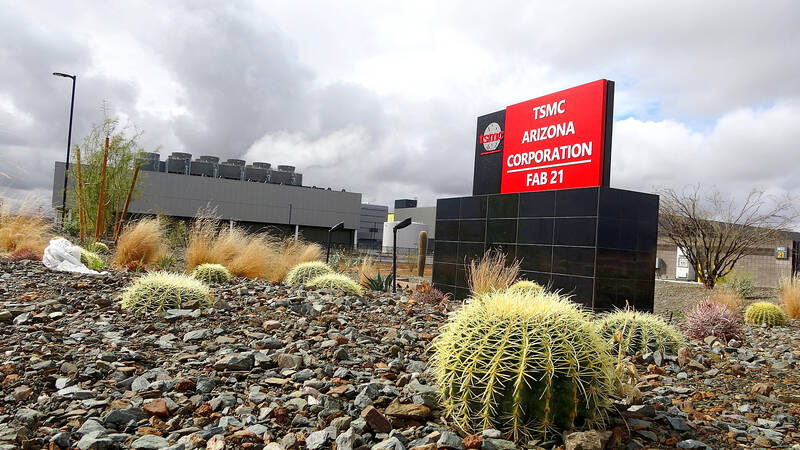
A view of Taiwan Semiconductor Manufacturing Co’s Fab 21 in Phoenix, Arizona, US.
Photo: CNA
Some critics of the current and previous administrations are aghast that the government is allowing this to happen, as many view TSMC as the “silicon shield” that protects Taiwan.
What the critics miss is that TSMC had no choice. To say that it “produces” chips is not entirely accurate. It is part of a vast supply chain that stretches across the planet. Often, it is not even the final step in the chain. However, it sits at a key node in the process, and to a certain degree, all information roads lead through TSMC. Working with the customers’ chip designers, the company ascertains that designs match its technical capabilities, and liaises with other key suppliers to ensure production is possible. TSMC is the orchestra conductor, not the entire orchestra.
This means that it cannot operate entirely on its own. Geopolitics, domestic politics, client demands, legalities, economics and logistical issues all both define and constrain the field the company is playing on.
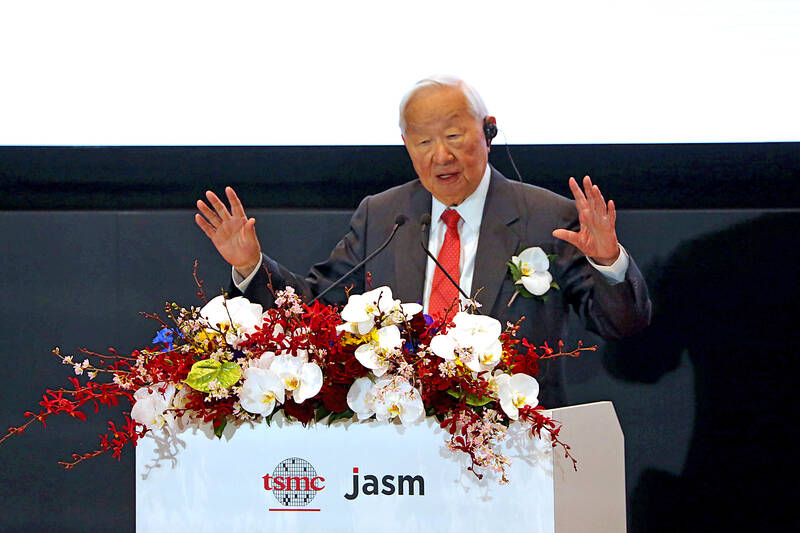
Taiwan Semiconductor Manufacturing Co founder Morris Chang speaks at the opening of Japan Advanced Semiconductor Manufacturing in Kumamoto, Japan on Feb. 24, 2024.
Photo: CNA
PRE-PANDEMIC PUSH
The initial pressures that influenced TSMC’s decision to expand into Phoenix took place before the COVID-19 pandemic.
In 2018, Chang retired from his last leadership role as chair, and Mark Liu (劉德音) took his place. C.C. Wei (魏哲家) remained as CEO, and in 2024 also replaced Liu as chair, putting him firmly in charge.
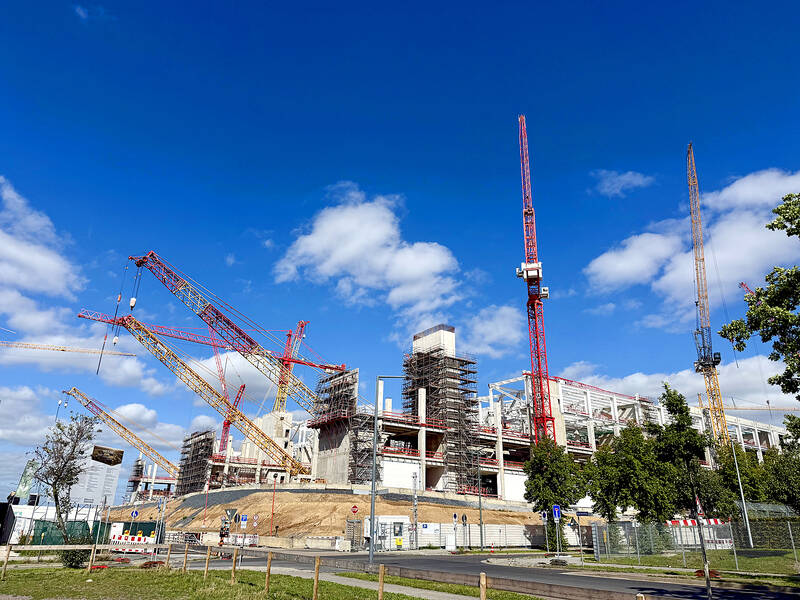
The European Semiconductor Manufacturing Company fab under construction in Dresden, Germany, in September.
Photo: CNA
In Taiwan, expansion faced (and continues to face) difficulties in securing enough electricity, water, land and qualified staff. One estimate puts TSMC’s percentage of Taiwan’s entire energy usage at 4.6 percent in 2018. Today, it is around 9 or 10 percent, depending on the source, and a 2024 S&P Global report forecast it could reach nearly 24 percent by 2030.
To put the scale in more relatable terms, in 2023, after a year-and-a-half review, TSMC received approval to build a 2-nanometer fab in Taichung. The approval took so long in part because the city had to figure out how to accommodate the fab’s power and water needs, which were estimated to be equivalent to one-quarter and 6 percent, respectively, of what the entire city of 2.7 million used at the time.
At the time, Apple was TSMC’s largest customer, accounting for around one-quarter of its business. In 2015, Apple set aggressive renewable energy targets for its suppliers, and in 2020 demanded that suppliers use 100 percent renewables by 2030. By then, Taiwan’s renewable energy targets were already slipping behind schedule.
The American Southwest offers ample land, plenty of wind and solar energy, and access to a large, educated workforce. Surprisingly, considering the ever-increasing tensions over water resources in the region, TSMC calculated that this would not be a problem. Considering that TSMC is now the largest foreign direct investor in US history, they presumably were given priority.
POST-PANDEMIC PULL
Then the pandemic hit, and the public and politicians discovered what “supply chain disruptions” meant. Automakers, in particular, were hit hard by a shortage of chips. Initially, they scaled back orders, but when demand bounced back, they discovered their lack of foresight left them at the back of the line.
The list of investors in the Japanese and German fabs reflects those fears as they wanted to ensure stable supply to automotive, industrial and consumer electronics makers. Japanese investors included Sony, Denso and Toyota, while German investors included the German government, Robert Bosch, Infineon and NXP. Incentives and investments made it cheaper and easier for TSMC to expand closer to its customers to shorten supply chains.
The pandemic experience also created enormous political pressures, particularly in the US. “Bringing back the semiconductor industry” was no longer just a business consideration; it was considered a national security priority.
The Biden administration took a carrot approach, with Congress passing the CHIPS Act to provide billions in investment, credit and incentives to make it easy and inexpensive for TSMC to expand further.
The second Trump administration took a sticks approach. It threatened to impose a 100 percent tariff on imported semiconductors, while exempting companies that made a commitment to build or were in the process of building fabs in the US. Clearly, they had TSMC in mind. Likely, the tech titans that fawn on the president had something to do with that; they are all utterly dependent on TSMC.
The US also put immense pressure on Taiwan by threatening cripplingly high tariffs on its export-dependent economy. Taiwan’s negotiators got a better deal than regional peers, but still at a high cost: a promise of US$250 billion in investment in the US, and a further US$250 billion in credit to Taiwanese companies investing there. A terrible deal, but more flexible and potentially more profitable than the deals Japan and South Korea made.
This incentivized Taiwan’s government to pressure TSMC and other companies to invest in the US, both to meet the terms of the agreement and to reduce Taiwan’s enormous trade surplus. In September, the central bank forecast this year the trade deficit with the US will reach US$219.2 billion, making it the third largest and a potential target for Trump’s ire. However, TSMC recently announced they will increase their total investment in the US to US$265 billion, single-handedly meeting Taiwan’s promised investment.
As eye-watering in scale as TSMC’s investments look abroad, their most advanced cutting-edge crown jewels remain in Taiwan and they continue to invest heavily locally, ensuring Taiwan retains its centrality. TSMC is currently planning to build 13 leading-edge and advanced packaging fabs in Taiwan over the next several years, which is significantly more than they are planning to build overseas.
Donovan’s Deep Dives is a regular column by Courtney Donovan Smith (石東文) who writes in-depth analysis on everything about Taiwan’s political scene and geopolitics. Donovan is also the central Taiwan correspondent at ICRT FM100 Radio News, co-publisher of Compass Magazine, co-founder Taiwan Report (report.tw) and former chair of the Taichung American Chamber of Commerce. Follow him on X: @donovan_smith.
KioskNews shows a cleaned-up reading view extracted from the publisher’s page — the original always lives on their site, not ours.