In 1963, a plane flew to space. Why couldn’t we go farther?
In 1926, when Albert Scott Crossfield was five years old, a priest came to his home to administer the last rites. Suffering from an advanced case of pneumonia that had scarred his lungs and attacked his heart, the young Crossfield was drifting in and out of a coma when his parents summoned Father Skiperelli. They feared their son would not make it through the night.
Despite his delirium, Crossfield distinctly remembered Father “Skip” noting how the pictures of airplanes plastered across his bedroom walls were crowding out a symbol of the Sacred Heart. Crossfield survived but struggled with his health for years, which often confined him to bed rest. A doctor told him he would likely never pass a flight physical exam.
When he was nine years old, Crossfield outfitted a wicker chair in the family’s backyard with a cockpit-like control stick and rudder pedals, practicing for hours at a time. He would follow the instructions of a flight book propped on the chair’s arm, imagining himself soaring across oceans and over mountains, setting world records.
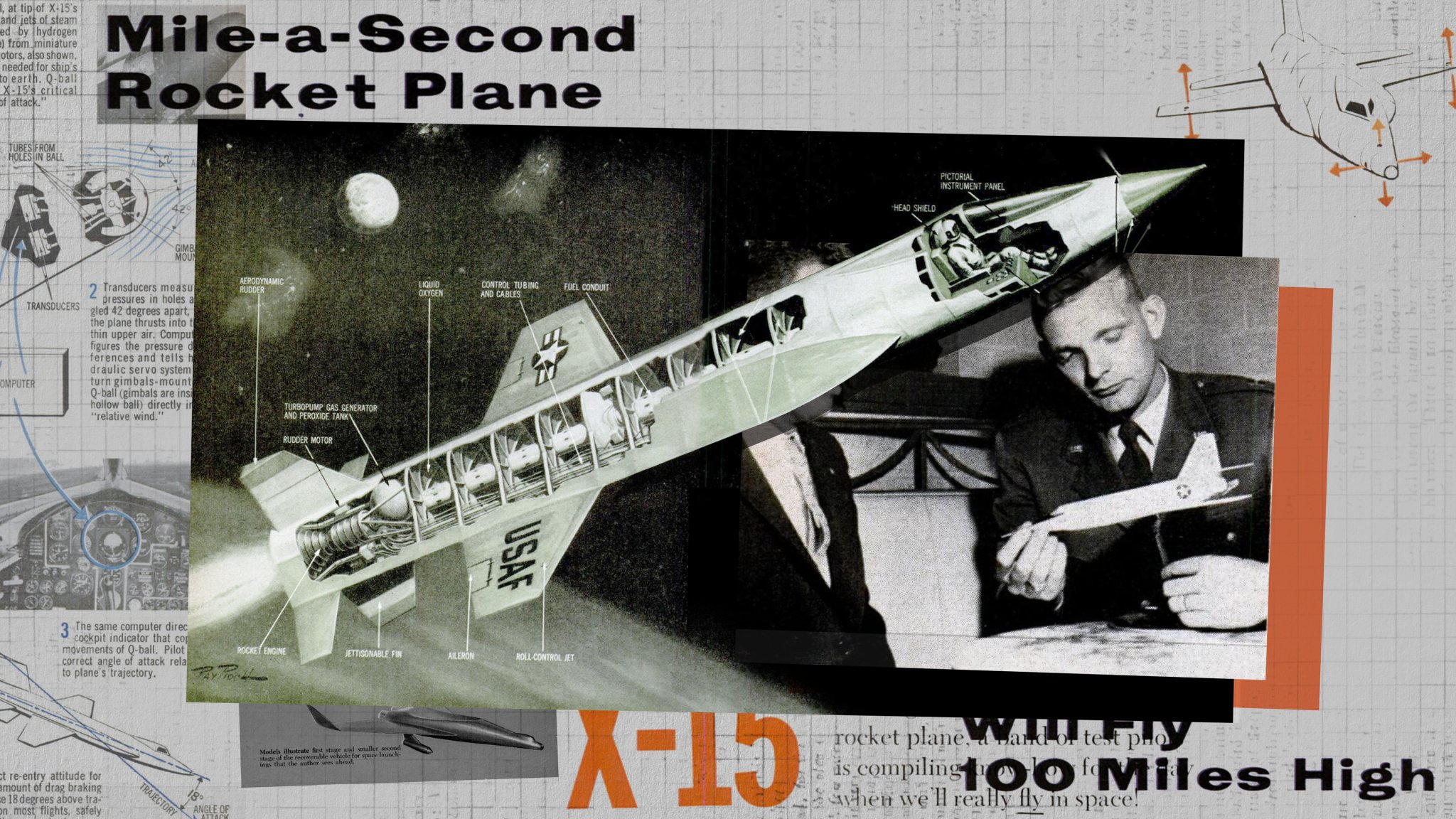
In 1953, Crossfield realized those childhood dreams when he steered a research plane, the Douglas D-558-II Skyrocket, to Mach 2, twice the speed of sound, making him the fastest person alive to date. Six years later, he was the first to pilot the X-15, a new experimental aircraft that was the world’s first plane to fly into space. But reaching space and staying there are different problems.
We’ve spent more than half a century since trying to take that next step—flying planes from a runway into orbit. After decades of disappointment, spaceplanes have found their place. On the edge.
The edge of space—defined
In February 1963, an 81-year-old Hungarian émigré paused before making his way down the steps of the White House to receive the first National Medal of Science from President Kennedy. Kennedy reached to offer a hand. Theodore von Kármán waved him off with a witty remark: “Mr. President, one does not need help going down, only going up.”
By then, von Kármán had become the 20th century’s preeminent aerodynamicist, an expert in going up. Von Kármán came to the U.S. in the 1920s to help expand the California Institute of Technology’s aviation research. At Caltech, he took charge of a band of student rocket experimenters known as the Suicide Squad for the hazards of their research. During World War II, their workshop became the Jet Propulsion Laboratory, eventually funded by NASA.

.jpg)
While von Kármán’s students were experimenting with rockets in California’s arroyos, a European contemporary, Eugen Sänger, was testing rocket engines at the University of Technology in Vienna. During WWII, Sänger teamed up with German physicist Irene Bredt to design a spaceplane bomber for German High Command. Based on concepts from Raketenflugtechnik (Rocket Flight Engineering), Sänger’s 1933 treatise and the first theoretical study of spaceplanes, the bomber would be capable of skipping across the edge of space like a stone on a lake. Their unfulfilled goal was to drop bombs on America.
After WWII ended, Sänger and Bredt’s work prompted the U.S. and other nations to explore skip-glide spaceplanes. Meanwhile, von Kármán sought to answer a very simple question: How high can an airplane fly before it stops being an airplane?
Because Earth’s atmosphere doesn’t have an abrupt end—it just thins until traces of it drift past the moon—von Kármán offered a practical demarcation point. A wing works by pushing air down; the thinner the atmosphere, the faster the wing must move to push enough of it. Climb high enough, von Kármán reasoned, and a wing would have to fly so fast to hold its own weight up that it would already be traveling at orbital speed—roughly 17,500 miles per hour at the bottom of low Earth orbit, or 100 miles above the surface. At that velocity, a wing becomes moot. The object isn’t being held aloft by air pressure at all; it’s continuously falling, tugged by Earth’s gravity, but moving sideways fast enough to keep missing Earth. Too slow and it spirals back down; too fast and it sails off into space.
Von Kármán calculated that crossover at around 50 miles up, though the number drifts with fluctuations in atmospheric density. In the 1960s, the Fédération Aéronautique Internationale rounded it to 100 kilometers, or 62 miles. NASA and the Air Force still use 50 miles. Regardless of the precise figure, it has become known as the edge of space, a turbulent shoreline where the physics of flying shift dramatically. Although no treaty has ever made it official, the Kármán line serves as the conventional divide between aviation law and space law, where wings serve no purpose in keeping an object aloft—only speed matters.
Getting to space requires altitude, but staying there requires speed. The gap between them is where the dream of the spaceplane has always faltered, beginning with the novel machine Crossfield helped design in the 1950s.
The Incredible X-15
“Starting a flight in the X-15 is like starting your car while falling off a cliff,” wrote Popular Science editor Wesley S. Griswold in 1963. The plane would take off from a runway, hanging from a pylon under the wing of a B-52 bomber until it reached an altitude of 45,000 feet. There, it would detach and its engine would ignite, hurling it upward “as though shot out of a cannon.”
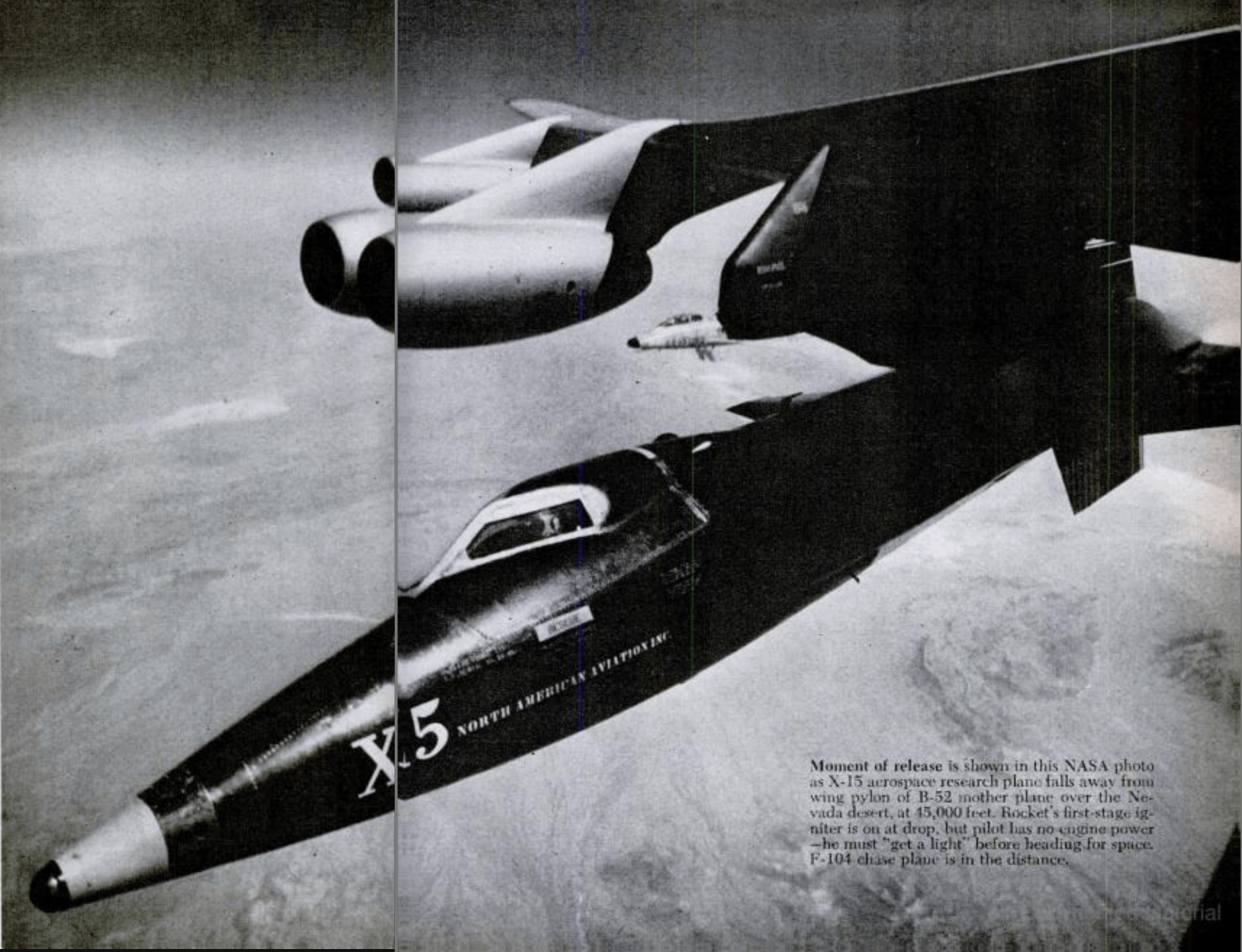
A cross between a rocket and a plane, the engineers building the X-15 called it a “missile with a cockpit,” Griswold reported in a 1958 preview for Popular Science. Like a rocket, the plane was mostly a fuel tank. Like a plane, its stubby wings and tail fins enabled it to negotiate Earth’s atmosphere. The vessel’s most telling feature, however, was its twin sets of flight controls: one for navigating air, the other for space. As the plane approached the Kármán line, the pilot switched from traditional airplane controls to jets of superheated steam in the nose and wings, pointing the airplane with thrusters, just like a spacecraft.
When Scott Crossfield learned of the X-15 program around 1955, he left his government post at the National Advisory Committee for Aeronautics, NASA’s predecessor, to work for North American Aviation, the X-15’s builder. There, Crossfield helped design the machine and became its first test pilot. He survived an engine explosion on the ground, which required the machine to undergo extensive repairs, and a landing that snapped the fuselage in two. By the time the plane was handed over to the joint U.S. Air Force-Navy-NASA program, he’d topped out at 88,116 feet, about 17 miles up. The plane had flown well short of space, but it was ready. Crossfield’s part was done.
Air Force pilot Bob White took the X-15 to space first, reaching 314,750 feet in July 1962, earning the first astronaut wings ever awarded to a winged aircraft pilot. NASA pilot Joe Walker flew the X-15 to 354,200 feet in August 1963—67 miles up, an altitude no winged aircraft has beaten, and one of only two X-15 flights to clear the Kármán line. Air Force pilot Pete Knight pushed the X-15 to Mach 6.7 in October 1967, still the fastest a piloted airplane has ever flown. In all, 13 flights crossed 50 miles—space’s threshold by NASA’s standards. Eight pilots earned astronaut wings, among them a NASA research pilot named Neil Armstrong.
Theodore von Kármán did not live to see Walker cross his eponymous line, the official edge of space. He died ten weeks earlier, in May 1963.
Amidst the X-15’s remarkable flights, in September 1965, Wernher von Braun, the director of NASA’s George C. Marshall Space Flight Center, penned a feature for Popular Science that predicted the coming era of spaceplanes. “Re-usable launch vehicles, looking more like airplanes than rockets, will boost manned and unmanned craft into orbit,” he wrote. But von Braun also hedged his prediction, claiming that such planes might not take off from a runway; they would be launched vertically on a booster.
The spaceplane graveyard
In his 1986 State of the Union address, Ronald Reagan promised a “new Orient Express,” a spaceplane capable of reaching low Earth orbit. It would also take off from Washington, D.C., and reach Tokyo in two hours. The Rockwell X-30, the hypersonic aircraft designed to fulfill Reagan’s vision, would be powered by a scramjet engine, which captures oxygen from the air rather than carrying it in a tank. It was never built.
Britain pursued its own spaceplane program, dubbed HOTOL for Horizontal Take-Off and Landing. It never left the drawing board. West Germany designed Sänger II, named for the man whose 1930s skip-glide concept helped inspire spaceplane technology. It was cancelled before production.
A recent and promising winged attempt to reach orbit was Reaction Engines, a British company that took up where HOTOL left off and succeeded in getting the hardest part of a hypersonic engine working. But it failed to raise enough funding to build its spaceplane.
After Reagan’s X-30 program failed, NASA tried again, hiring Lockheed Martin to build the X-33, a test vehicle part of NASA’s Venture Star program. The X-ee would launch like a rocket, using its own engines, and fly like an airplane when descending. The program was canceled in 2001.
In 1999, Popular Science writer Bill Sweetman profiled Space Access, a Palmdale, California, startup founded by Rockwell engineer Steven Wurst, who had come out of the defunct X-30 program.
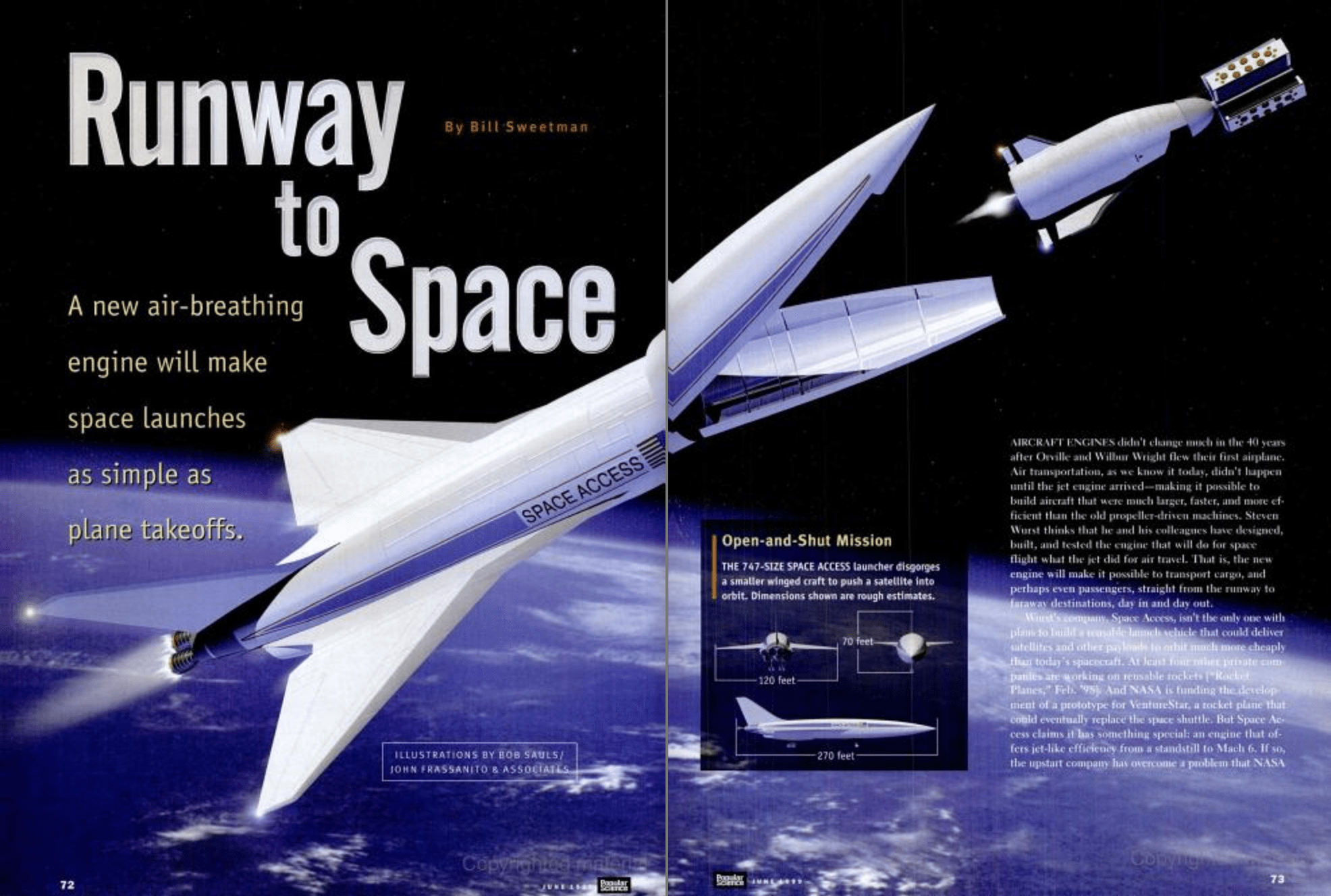
“It’s the flight rate, stupid,” Wurst told Sweetman. Unless a spacecraft flies often, it will never be cheap enough to be competitive. Wurst was right about the economics but wrong about the shape. An airplane light enough to fly well can’t carry enough propellant to reach orbit, and a vehicle carrying enough propellant to reach orbit is no longer much of an airplane. Two decades later, Space X proved the point with a reusable rocket that lands on its tail.
Shuttles—part plane, part payload
The term “spaceplane” has relaxed from its mid-20th century meaning to include shuttles—aircraft that are launched into space on the backs of rockets but have wings that enable them to return to runways.
From 1981 to 2011, the U.S. Space Shuttle flew 135 missions to space, landed on runways, and looked like a plane. But it never took off like one. It went up vertically, riding on a disposable tank and recoverable rocket boosters, just as von Braun predicted, because the shuttle’s own engines could never have lifted it into space or achieved orbital velocity. As a payload fitted with wings and roughly 24,000 finicky thermal tiles that required manual inspection after every mission, it was too elaborate and expensive to continue operating.
But a new generation of shuttles has improved the economics. Smaller, uncrewed, and equipped with a more reliable heat shield, the X-37B looks like a mini Space Shuttle. It has completed seven missions since 2010. Its eighth was launched atop a SpaceX Falcon 9 in August 2025. Using a similar design, Sierra Space’s Dream Chaser shuttle is scheduled to debut in late 2026.
Spaceplanes find their place
Despite decades of failed programs, true spaceplanes have begun to carve out an important niche, traveling at hypersonic speeds to extreme altitudes and the edge of space but not into orbit.
Dawn Aerospace’s Aurora is a tiny rocket-powered suborbital spaceplane that takes off from and lands on conventional runways, which is the whole point. Operating under remote control—it’s too small for a crew—it has flown 64 times since 2016, occasionally twice in one day. In November 2024, it became the first civilian aircraft to fly supersonic since Concorde. It has carried research payloads for Johns Hopkins, Arizona State, and the Royal New Zealand Navy. Future versions are designed to exceed Mach 3.5 and cross the Kármán line—twice a day.
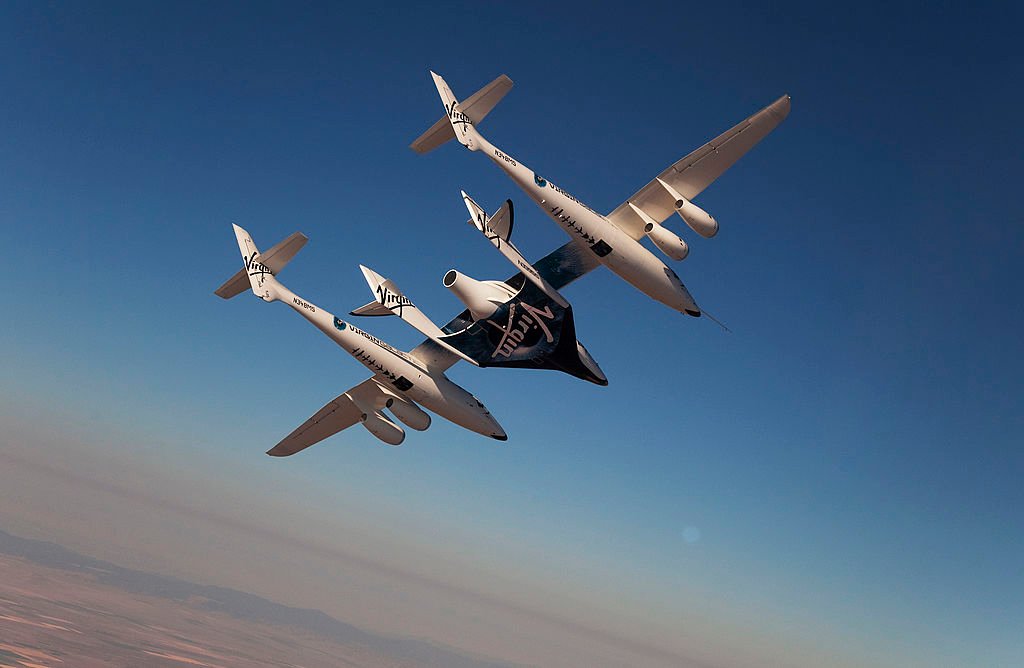
Just like the X-15 nearly 70 years ago, California-based Stratolaunch drops its Talon-A hypersonic research spaceplane from beneath the wing of the world’s largest airplane. Similarly, Virgin Galactic’s suborbital aircraft is dropped from a plane, firing its own rocket engine to transport sightseeing customers to the edge of space, before landing on a runway in New Mexico.
A rich shoreline
The edge of space offers more than just sightseeing. Since it requires traveling at multiple Mach speeds to remain aloft, spaceplanes are on the cutting edge of hypersonic research, experiencing conditions that can’t be replicated in terrestrial wind tunnels. The edge of space also offers microgravity conditions, which are vital for research.
The thermosphere, where the Kármán line falls, is among the least studied layers of our atmosphere—too high for research aircraft, too low for satellites—yet it matters for climate models and for the safety of spacecraft passing through. And, while an “Orient Express” from Washington, D.C., to Tokyo in two hours remains a dream, plumbing the shoreline of space may teach us enough about hypersonics and Earth’s upper atmosphere to someday make it real.
X-15 redux—from runway to the edge of space and back
On April 19, 2006, Scott Crossfield took off from Prattville, Alabama, flying his own Cessna 210A, heading home to Virginia. He was 84 years old and still flying himself to speaking engagements, evangelizing for aerospace education. He was killed over northern Georgia when his airplane came apart in a line of thunderstorms.
Having nearly succumbed to pneumonia as a boy, Crossfield had survived a rocket engine detonating behind him on a test stand and walked away from a landing that broke his airplane in half. He had flown the most dangerous aircraft ever built, flying faster than any human at the time. What finally killed him was Earth’s own atmosphere, the place of his childhood dreams, and the medium wings were made for.
For more than half a century after Crossfield’s X-15 debut, engineers have kept trying to build planes that could bridge the physics of atmosphere and space, not only taking off and landing on conventional runways but also orbiting Earth. Yet our propulsion technology does not support coupling atmospheric lift with extreme orbital speed. If it did, we’d likely be flying in saucers, not planes. In the end, the X-15 had the spaceplane’s destination right all along: surfing the atmospheric shoreline along the edge of space.
In A Century in Motion, Popular Science revisits fascinating transportation stories from our archives, from hybrid cars to moving sidewalks, and explores how these inventions are re-emerging today in surprising ways.
KioskNews shows a cleaned-up reading view extracted from the publisher’s page — the original always lives on their site, not ours.