Pete Hegseth To Face Questions On US Role In Indo-Pacific At ASEAN Summit
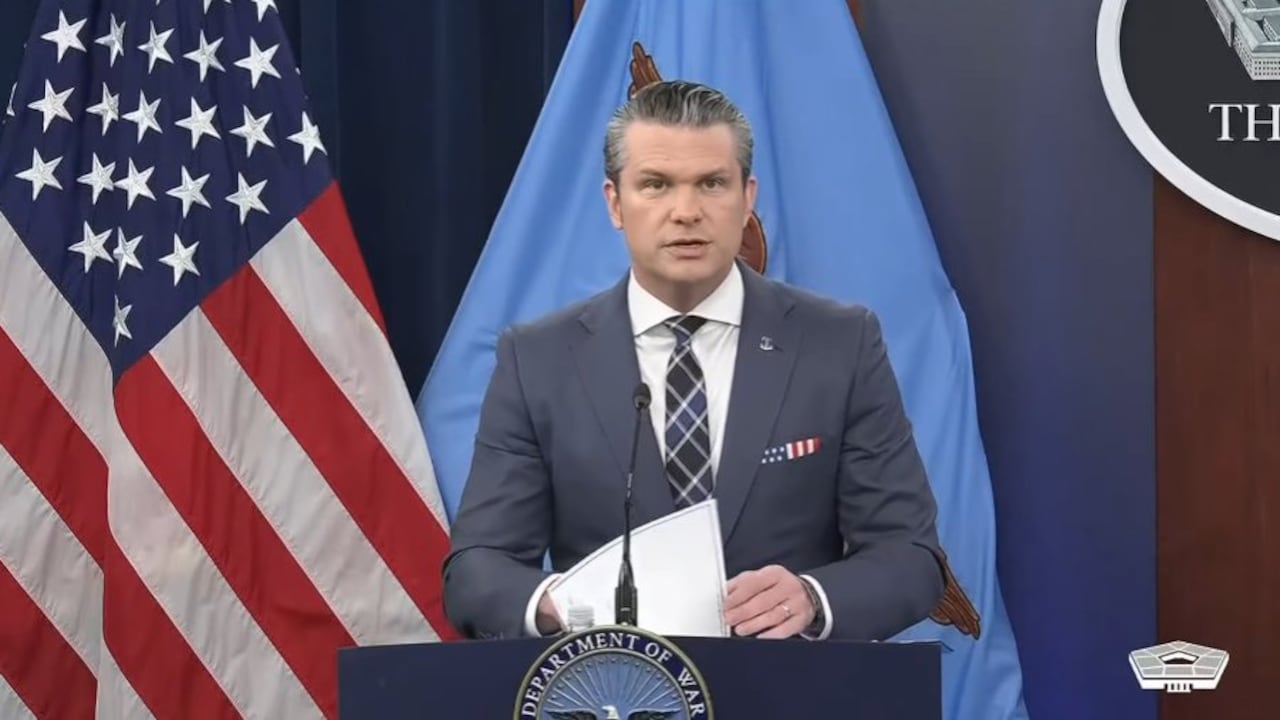
US Defense Secretary Pete Hegseth is likely to face questions about Washington's commitment to the Indo-Pacific region when he meets Southeast Asian counterparts in the Philippines on Wednesday.
As the Iran war strains US military readiness and tension rises with China, the Pentagon said Hegseth's attendance at the gathering in the Philippine province of Cebu would reaffirm Washington's commitment to "peace through strength" in the Pacific.
Analysts said Southeast Asian nations could use meetings with Hegseth on the sidelines to seek clarity about the endgame in Iran, US expectations from allies and partners, and how the conflict's demands square with commitments to the Indo-Pacific.
"They will want to seek answers from the United States regarding certainty towards alliances and partnerships," said Collin Koh, a security scholar at Singapore's S. Rajaratnam School of International Studies.
"And of course, the bigger elephant in the room is how does that juxtapose with US commitment to the Indo-Pacific or Western Pacific theatre."
ECONOMIES GRAPPLING WITH IRAN WAR IMPACT
Southeast Asian economies are grappling with the effects of Iran war, while tension between host the Philippines and Beijing add another source of friction to a forum meant to promote dialogue and practical cooperation on security.
The Iran war, launched by US and Israeli strikes on February 28, has disrupted shipping and oil markets, exposing Southeast Asia's vulnerability to imported-fuel shocks and pushing energy security higher on ASEAN's agenda.
Greg Poling, director of the Asia Maritime Transparency Initiative said Hegseth would get an opportunity at the gathering to tackle aspects regarding China, the disputed South China Sea and Washington's commitments to its treaty allies.
"Most will want reassurance about U.S. commitment to the region, despite the political turmoil in Washington and the weakening of both U.S. capabilities and readiness by the war in Iran."
The topic is critical for the Philippines, a US treaty ally whose ties with Beijing have soured amid repeated confrontations in the disputed South China Sea, Chinese sanctions and, more recently, a summoning of the Chinese ambassador.
China's defence attaché in the Philippines will attend the meeting, its defence ministry said on Tuesday.
Days before the meeting, set for October 28 and 29, the Philippine military said it monitored and shadowed China's Liaoning aircraft carrier group as it passed through waters off the southern Philippines toward the Celebes Sea.
Stronger signals were more likely to figure in talks among like-minded partners, added Poling.
Such partners include the Squad, a grouping of the United States, Japan, Australia and the Philippines, whose defence chiefs are set to meet on October 28.
EVENTUAL CHAIRMAN'S STATEMENT SEEN AS RESTRAINED
However, the eventual chairman's statement was likely to be more restrained than talks behind closed doors and would employ familiar ASEAN language, said Koh.
Manila's position as ASEAN chair while embroiled in a dispute with China was "particularly sensitive", he added.
Poling said the Philippines had to balance "aspirational cooperation" on issues such as energy connectivity, the digital economy and coast guard cooperation against rising tension with China and stalled progress on a South China Sea code of conduct.
"For the Philippines, the whole ASEAN chair year has been a difficult balance," added Poling, who is also a fellow with the Southeast Asia Program at the Center for Strategic and International Studies.
"I'd expect tactical cooperation on the ADMM workstreams ... but no strategic alignment on the South China Sea or other thorny issues," he said, referring to the bloc's effort to tackle issues such as maritime security and counter-terrorism.
(Except for the headline, this story has not been edited by NDTV staff and is published from a syndicated feed.)
KioskNews shows a cleaned-up reading view extracted from the publisher’s page — the original always lives on their site, not ours.