WA councils face an ‘unsustainable gap’. Could it be the source of their woes?
As councils across Perth contemplate amalgamations, Western Australia’s peak local government body isn’t convinced “putting a couple of them together” will solve anything.
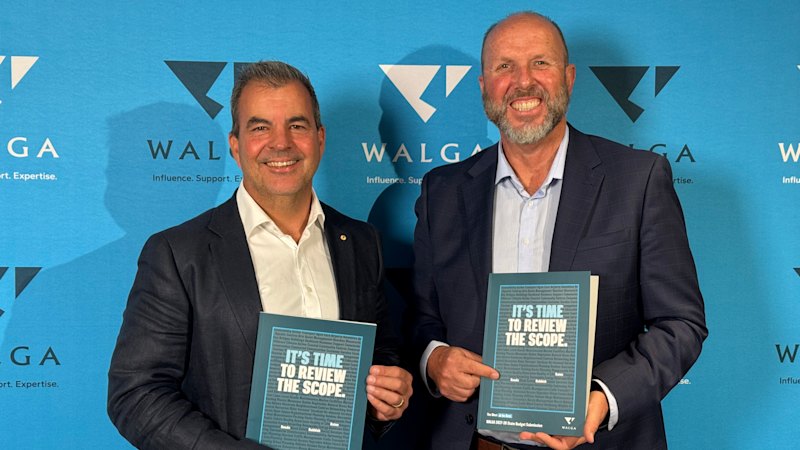
Instead, as part of WALGA’s 2027-28 state budget submission, they’re calling on the government to undertake an independent review of local government responsibilities, functions and funding.
The submission says that in response to population growth, demographic shifts and rising community expectations, “the sector’s role has incrementally expanded and is now significantly beyond its traditional remit”.
“Today, local governments are routinely funding and delivering services – including support for healthcare, childcare, housing, community services, airports and local economic development – to address critical market gaps left by other levels of government and the private sector,” the submission reads.
“Crucially, the sector’s funding arrangements have not evolved to match these expanded responsibilities.
“Local governments continue to rely heavily on rates and user charges to fund this widening scope of work even as the demand and cost of delivering core infrastructure escalate.
“This has created an unsustainable gap between state policy objectives, community expectations and the actual resources available to councils.”
WALGA president Mark Irwin said ratepayers often don’t know what tier of government handles community services and even council members are starting to get lost when making decisions.
“The stories we’re hearing [from councillors] are about increased expectations on their delivery of community safety programs, the increase in cost of doing business to provide community infrastructure for children playing sport,” he said.
“Many things that are happening right throughout our state, most people wouldn’t even have an understanding that local governments are responsible for them.
“Almost 90 per cent of our road network is under the care and control of local governments. The emergency services provision of volunteer fire brigades right throughout Western Australia, the GP services in our communities, the economic development contributions they make.”
Irwin said WALGA would like to see the independent review commence at the start of the next financial year and would be a great first project for the proposed 2050 Commission – a new productivity commission created to strengthen the state’s economy and delivery of public services.
But he believes it should happen in conjunction of investigations into amalgamations and not after.
“The reality is, you can’t have a solution to a problem you don’t know what it is. That body of work will understand the scope of all of those projects, all of the services that our local governments provide,” he said.
“It can have a look at what those sticking points are and what the actual big problems in local government in sustainability are.
“But until we have an understanding of what local governments are delivering right throughout our state, what it costs to deliver them, and how they’re delivering it, I find it hard to believe that putting a couple of them together is going to be a solution to anything.”
Speaking at a press conference on Tuesday, Irwin addressed local government dysfunction across Perth and the negative connotations around council monitors.
“The monitors were seen as a real positive from the sector. There is no reason that local governments shouldn’t have access to skill sets to be able to assist them to provide good governance for their districts,” he said.
“It is unreasonable to expect that when you grab 12 people untrained from their community and sit them around the table and tell them to fight for what they believe in and fight for their community under that increasing pressure and expectation, that there won’t sometimes be conflict, especially when all of those conversations are live-streamed.
“The monitor is supposed to assist that. It shouldn’t be negative.”
He said that 90 of the 139 councils have had some interaction with Local Government Inspector Tony Brown this year.
“The inspector’s role is to interact with local governments. [But] to say the absolute majority of local governments are dysfunctional, the inspector having a relationship with the local government isn’t a sign of dysfunction,” he said.
“It’s a sign of the regulator doing their job, and it’s a sign of 139 local governments who are operating in an increasingly complex legislative environment, trying to work out what they should be doing under the element of reform, which has been going on for a number of years now.”
Other key priorities in the WALGA submission include waste management, rural and remote health, emergency management and roads.
They are requesting the state government invest $350,000 to develop a state waste infrastructure plan and $41.1 million to clear the backlog of unfunded capital grant requests for emergency management.
Almost $10 million per annum from 2027-28 to establish a local government primary healthcare support fund for the regions and commit to fully funding the $250 million regional road safety program to improve regional roads if the federal government contribution is not secured.
KioskNews shows a cleaned-up reading view extracted from the publisher’s page — the original always lives on their site, not ours.