Jensen Huang scandal could spur tighter US scrutiny of AI cloud providers in Southeast Asia: Analysts
The alleged Chinese spy scandal involving Nvidia’s CEO could lead to tougher enforcement of artificial intelligence chip export restrictions and create opportunities for rival chipmakers, analysts tell CNA.
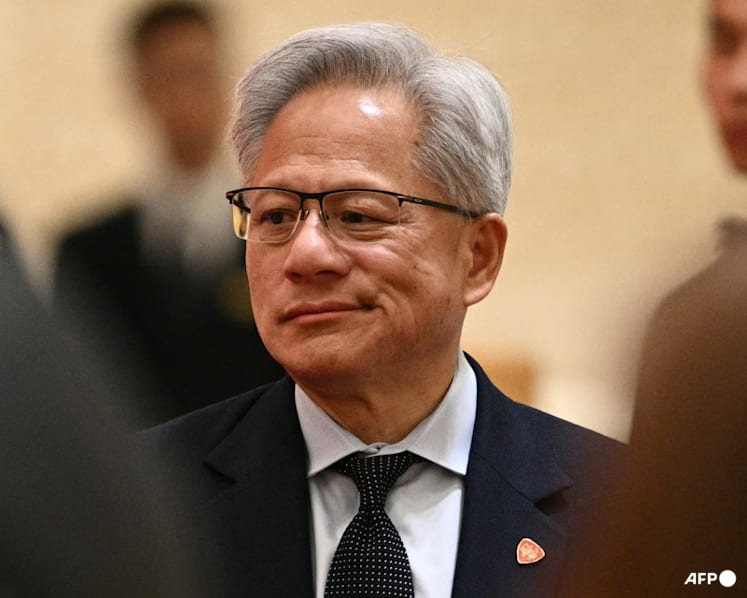
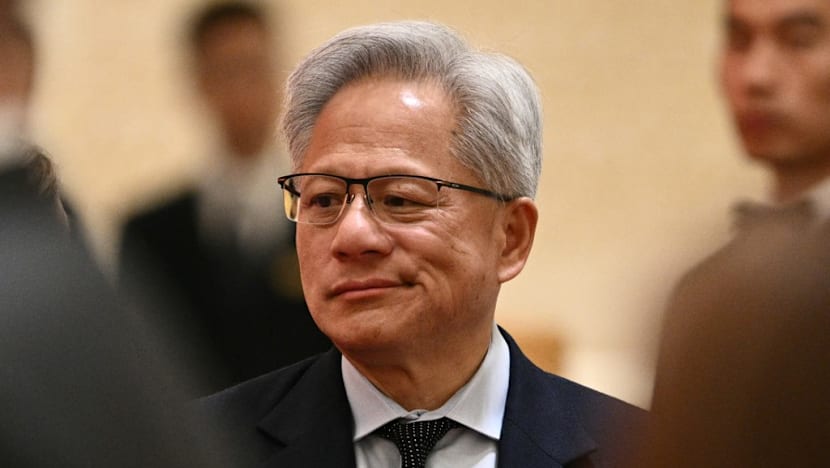
Nvidia founder and CEO Jensen Huang arrives ahead of a state banquet for United States President Donald Trump and China's President Xi Jinping at the Great Hall of the People Beijing on May 14, 2026. (File photo: AFP/Brendan Smialowski)
New: You can now listen to articles.

This audio is generated by an AI tool.

11 Nov 2026 05:21PM
Allegations that a woman linked to Nvidia chief executive Jensen Huang was a Chinese spy could lead to tighter enforcement of United States export restrictions on advanced artificial intelligence chips, with cloud computing providers in Southeast Asia potentially facing greater scrutiny.
Rival chipmakers could also benefit from the fallout, even as demand for Nvidia's products remains strong, analysts told CNA.
The allegations emerged following reports that Huang had an affair with Alice Huang, a Chinese businesswoman and former executive of Singapore-based cloud computing firm Megaspeed, who is said to have links to Beijing's intelligence services.
China has rejected the claims as baseless.
Nvidia's board is investigating whether Huang was targeted by a foreign intelligence operation, but the company says it has no reason to believe that US national security or its trade secrets were compromised.
Megaspeed, an Nvidia customer, has also come under scrutiny over suspicions that it helped Chinese companies obtain advanced AI chips restricted from export to China. Singapore police are investigating the company over suspected breaches of domestic laws.

CLOUD COMPUTING UNDER SCRUTINY
The US and China are at odds over critical technologies, with Washington restricting China's access to advanced semiconductors and Beijing imposing export controls on rare earths and other minerals used in industries such as electric vehicles.
Alex Capri, senior lecturer at the National University of Singapore Business School, described cloud computing services as a long-standing loophole in US chip export controls.
He said these services allow companies around the world to rent computing power without directly purchasing advanced chips, and expects Washington to focus more closely on providers known as neocloud companies. These firms provide cloud services that are optimised for AI workloads.
"I think we're going to see a major crackdown on these cloud computing companies," Capri told CNA's Asia First on Wednesday (Nov 11).
Capri added that the close relationships between major technology companies and the US defence establishment could also force governments and businesses to rethink how they work together to enforce restrictions on sensitive technology.
"We're in the beginning stages of an entirely new phase of export control enforcement," he said.
He also expects greater pressure from Washington on countries such as Singapore and Malaysia, which serve as trading and transit hubs. Both countries have faced scrutiny over the movement of advanced AI chips.
In Singapore, four individuals and four companies face fraud-related charges in a separate case involving servers believed to contain Nvidia chips that were shipped to Malaysia. Authorities have questioned whether Malaysia was their final destination.
The country has said it does not enforce unilateral export controls imposed by other countries, but will act against companies and individuals that violate its laws or engage in fraudulent practices.
Last month, Malaysian customs seized 30 servers containing advanced AI chips worth about US$12.1 million at Kuala Lumpur International Airport, as part of an investigation into suspected smuggling.
RIVAL CHIPMAKERS COULD BENEFIT
Tighter restrictions could create opportunities for Nvidia's competitors, according to Jay Goldberg, senior semiconductor analyst at US equities research firm Seaport Research Partners.
He identified US chipmakers AMD and Broadcom, along with Chinese companies such as Huawei, as potential beneficiaries.
Further restrictions on Nvidia sales to China or Southeast Asia could also help domestic Chinese alternatives, he said.
Goldberg added that AMD and Broadcom may be less affected by tighter US export controls because their AI chip businesses have relatively limited exposure to China.
Capri, meanwhile, expects Beijing to intensify efforts to develop its own semiconductor capabilities.
The US eased its licensing policy for exports of certain advanced chips to China in January, allowing such shipments to be considered on a case-by-case basis.
But Capri noted that Beijing continues to require approval for imports of Nvidia chips, reflecting its push to develop domestic alternatives and reduce reliance on US technology.
He added that the scandal surrounding Huang could further strengthen China's determination to achieve chip self-sufficiency.
"This incident, I think, is just fuel for the fire," he said.
NVIDIA FACES LEADERSHIP UNCERTAINTY
Nvidia shares fell more than 5 per cent on Tuesday, but Goldberg does not expect demand for its chips to weaken significantly in the near term.
He said customers have already committed to purchases and continue to need computing power for AI applications.
"People still want Nvidia chips. There's still a huge demand," he said.
Nvidia is scheduled to report quarterly earnings on Nov 17, while US lawmakers have asked Huang to attend a closed-door briefing on Nov 18 over the spying allegations.
Goldberg said the uncertainty surrounding Huang's future could overshadow the company's financial performance, even if its underlying business remains healthy.
He noted that replacing Huang would be particularly difficult because of how closely the company's leadership and decision-making are tied to its founder.
Huang has dozens of direct reports and is involved in major decisions across Nvidia, Goldberg said, with no obvious successor who could readily take over his role.
"If he's not there to do it, the system stops working and it's very unclear who could replace him," he said.
KioskNews shows a cleaned-up reading view extracted from the publisher’s page — the original always lives on their site, not ours.