Cat’s whiskers: Nan Goldin proves that she’s the greatest US artist since Warhol – review
It’s the dirty realism of Nan Goldin’s images, her unfazed photography of the rough seams of spontaneous, dangerous lives, that enables her to create a film of such unlikely ambition as Stendhal Syndrome. This ecstatic condition is named after the French novelist who in 1817 fell ill in Florence, after gorging on the beauty of the Renaissance city’s treasures until “I had palpitations of the heart … I walked with the fear of falling”. Goldin, too, has suffered a bout of this aesthetic delirium, not in Italy but Paris – “the first time I was alone in the Louvre”, she explains on screen.
She infects you with it in a ravishing work housed in what looks like a bronze yurt entered via a vaulted corridor. If this seems ostentatious, the film justifies the ceremony. A montage of sensual images teems with Goldin’s uniquely raw, immediate feel for the human presence as she photographs her friends, mostly in the nude, legs wrapped round each other, or lying in a swoon, or touching themselves, or bathing together. Here is the unfeigned, honest impact her work has had since she first put her world viscerally on camera in her early photo series The Ballad of Sexual Dependency. But there’s a difference.
A Caravaggesque young man looks with bedroom eyes at the camera. Then we cut to an actual Caravaggio painting for comparison. The resemblance is magical. And the 17th-century queer outlaw and murderer is not the only great artist whose images are collaged with Goldin’s photos. As Goldin relates on the film’s soundtrack, she saw, wandering the Louvre in a trance, her friends’ faces in sensual masterpieces including works by Correggio and Canova.
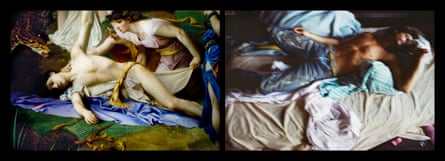
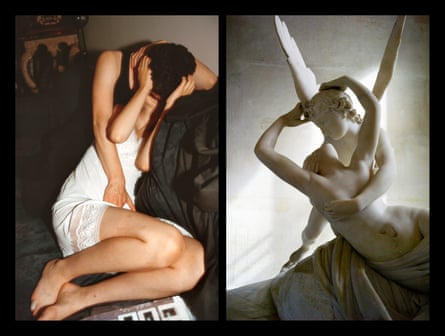
These timeless portrayals of beauty and love, in glowing paint and smooth marble, are intercut with Goldin’s erotic snaps to a rousing score. And here’s the thing. Intentionally or not, her live subjects pose their bodies in ways that mirror the old masters: lovers fondle like Cupid and Psyche, their warm living flesh as sculpted and perfect as Canova’s marble. Meanwhile, Goldin tells tales of desire from Ovid’s Metamorphoses. It turns out that this Roman poet’s kinky versions of Greek myth uncannily anticipate 21st-century boho life. She photographs a Pygmalion and Galatea she happens to know, a Narcissus in love with his own reflection.
You expect mythological references from your Twomblys and Kentridges but when an artist seen as an unvarnished recorder of opioid America mixes her world with high art and ancient mythology, it poses acute questions. What is beauty? What is art? Are they both just ways to freeze, for a moment, the passing glory of life?
In another film, Memory Lost, Goldin looks back on her and her friends’ experiences of addiction. A photo of a mattress with a huge dark hole, burnt into it by an addict’s cigarette (you guess), is juxtaposed with enraptured romantic images of red skies and wintry woodlands. There is beauty in us and all around us. But do drugs, from heroin to prescription opioids, make you see it sharper or lose sight of it in the cravings and wastings? Art is a healthier high, suggests Stendhal Syndrome, but even that can make you swoon. Goldin campaigns against opioids, but the lure of the addictive sublime pulses through her work in the Romantic spirit of American creativity from Edgar Allan Poe to Lou Reed. Even when it’s at its sweetest.
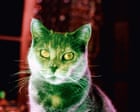
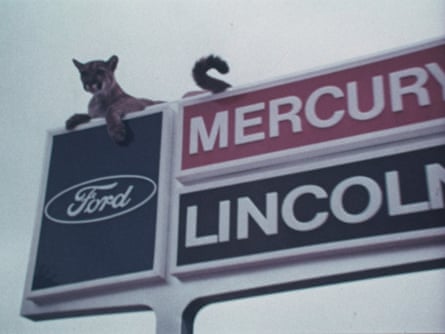
And what could be sweeter than a pussycat (unless you’re a bird)? Cat’s eyes stare at you in the film You Never Did Anything Wrong, parts one and two, that gives this show its title. They keep staring. And not just cats – owls and alligators, too. It’s a disturbing montage of glaring animal faces that makes you ponder the nature of other-species consciousness.
“You never did anything wrong”, it transpires, is an inscription from a gravestone in a pet cemetery. Another says: “We are sorry.” You may laugh. You may wonder why the pets’ owners are apologising. Then you get it. We all should be sorry. Goldin is showing us the innocence of the natural world we are destroying. Horses leaping, birds flocking, a tortoise helping a fellow tortoise get the right way up, even a pig crawling under someone’s duvet – wild and domesticated animals are all here in a rapid succession of found images. But the film clips are old, their colours untrue. All these beasts must be dead by now. That all the natural abundance here belongs to the past, that’s it going and gone, speaks obviously to our moment.
after newsletter promotion
Human beings are beautiful, shows Goldin, but look what we do. We are lovely but not innocent. Yet art and life, humanity and nature, merge as you stumble dazed from one film to another. She tries to cross between worlds – to connect art and life, humans and animals, in an ecstasy of love and beauty. This exhibition is a moving and compulsive wonder by the greatest American artist since Andy Warhol. Somehow, it makes you hopeful.
KioskNews shows a cleaned-up reading view extracted from the publisher’s page — the original always lives on their site, not ours.