Operation Jensen: Trump’s rescue mission might end in pain
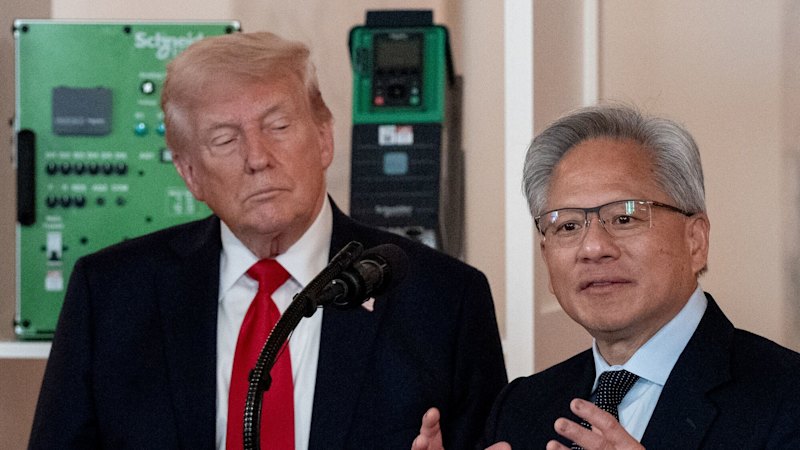
The Jensen Huang who has been parachuted back into the chief executive’s chair at Nvidia by the White House and the company he will again lead are likely to be very different to the ones that bestrode the artificial intelligence sector only a couple of weeks ago.
Huang himself has been exposed as a flawed character and his behaviours and his actions and Nvidia’s –before and after his reinstatement at the urgings of Donald Trump – are going to be under intense and continuing scrutiny by the US Congress, the media and his colleagues within the $US3.74 trillion ($5.6 trillion) company.
The environment in which he and Nvidia operate has also changed abruptly and significantly since the revelations of his affair with a suspected Chinese spy or agent, Alice Huang (no relation), emerged publicly.
A spotlight has been shone on Nvidia’s dealings with data centres in South-East Asia that have been training Chinese AI models with chips that flowed through a corporate structure Alice Huang helped create. Suspected large-scale smuggling of Nvidia’s most advanced chips to China by Huang’s companies is also being investigated.
In response to the controversies raging around the Huangs’ relationship, last week the Trump administration announced a new rule that requires overseas data centres to obtain US licences before they can supply any material amount of computing power to companies with headquarters in China, Russia and Iran, with the onus on the centres to determine whether their customers are linked to those countries.
The administration will also impose licences on exports of advanced chips to companies headquartered in South-East Asia.
Alice Huang’s Singapore-based Megaspeed imported massive volumes of Nvidia’s chips that were deployed in data centres in the region, or potentially smuggled into mainland China using data centre procurements as cover.
On Monday this week, the administration finally put Megaspeed on its “entity list,” which means it has been blacklisted and US chipmakers can no longer deal with it.
The US Treasury Secretary, Scott Bessent, had been advocating that for some time, after US intelligence agencies identified Alice Huang as a potential Chinese agent. The Secretary of State, Marco Rubio, had twice written briefs for Trump on the national security implications of the Huangs’ affair, although Trump claims not to have read them.
The Commerce Department, headed by Howard Lutnick, however, ignored Bessent’s urgings and Rubio’s warnings and allowed the exports of Nvidia’s best chips to continue.
Lutnick and Trump had lifted a Biden-era ban on exports of Nvidia’s second-tier H200 chips to China in return for a 25 per cent cut of the sales for the government – elevating revenue over the national security concerns. Nvidia itself, in the hiatus between Huang’s forced exit and return, said it would stop selling H200s to China.
Trump doubled down by elevating the health of the US sharemarket over national security concerns when he strong-armed the return of Jensen Huang to his CEO post.
The new measures restricting exports to China and its region, Nvidia’s inevitable more cautious approach and a looming raft of congressional inquiries have, however, significantly changed the landscape to which he has returned.
What happens if Nvidia is no longer able to sell its chips to data centres offshore that use them to train Chinese AI models, or act as conduits for smuggling the chips into China?
Trump inadvertently put that question on the table last week when, in response to the revelations that Nvidia’s most advanced chips were ending up in Chinese hands, he threatened to ban US tech companies from building data centres offshore and impose a “tremendous tax” on companies that try to build them.
“We’re not going to allow companies to build data centres in other countries,” he said.
If the US is going to actively police the existing restrictions on the sale of the most advanced US chips to China; if it is going to impose licences on their sale to data centres in South-East Asia and if it were to insist that the US companies that dominate AI outside China only build centres within the US, it would severely disrupt the development of AI in the rest of the world – and shrink the market for Nvidia’s chips.
Before Joe Biden imposed restrictions on the sale of Nvidia chips to China in 2022, more than 20 per cent of the company’s sales were to China, where its advanced chips had a near-monopoly.
Official sales to China now are in the single digit percentages, although sales via the South-East Asian backdoor and via smuggling probably mean that Nvidia is selling almost as many chips to China and its companies, directly or indirectly, as it was before.
The new restrictions, and actual policing of the old, would put a significant hole in Nvidia’s sales.
Because Nvidia is on the hook to its own supply chain for more than $US390 billion of future supply of chips and their components, the current tightness of the market for those chips that delivers 70 per cent-plus margins would be displaced by an over-supply.
Nvidia has profited immensely from the lax approach to regulation of its chip sales by the Trump administration – Lutnick’s Commerce Department seems to have benevolently turned a blind eye, if not actively encouraged sales it must have suspected were going to China – but, if the channels to China are cut off, that operational and financial leverage will work against it.
In turn, given that Nvidia has positioned itself as banker to those within the AI sector who couldn’t otherwise afford its chips or finance their data centres, there would be threatening flow-on effects for the rest of the sector.
Nvidia is at the centre of an increasingly capital-constrained AI ecosystem that is highly dependent on its continuing ability to continually swell is vast cash flows and expand its balance sheet.
Trump’s notion of a ban on US companies building data centres offshore – aimed at protecting America’s lead over China in AI – is a non-starter. It’s a thought bubble that Trump conceded hadn’t been previewed “to my people.”
If it had, they would have told him that the sweeping victories of Democrats at both the federal and state levels at the midterms, where data centres were a top-of-mind issue for voters, mean there will be fewer data centres built than were on the drawing boards before the elections.
Even if those obstacles could be removed, much of the world’s computing is managed by US companies via data centres sitting in countries other than the US. Those countries aren’t going to allow their citizens’ data, their banking systems, their government databases, including their defence data bases, their health data etc to be held outside their country.
The US companies would lose a swathe of customers, revenue and value, probably to Chinese and European competitors.
Moreover, the US power grid is already struggling.
US data centres accounted for roughly 4 per cent of US generation consumption before the AI boom developed momentum. By 2030 there are projections that data centre demand will grow to about 10 per cent of the expected generation.
The US can’t add enough power to its grid fast enough to keep up with the demand, so either it builds fewer centres in the US, which is near-certain, and/or it builds more outside the US.
The alternative, which presumably isn’t what Trump had in mind, is that the industry consolidates and shrinks dramatically and surrenders its offshore markets to China, with horrific financial and economic losses and dislocation in the process.
While Trump’s extreme position isn’t going to happen, almost all the likely scenarios for AI and Nvidia suggest that the new environment in which Huang will be managing the company (if he survives the internal and external investigations) will be different, and less helpful to the company, than the settings in the past.
No matter how pro-Huang and Nvidia Trump and Lutnick might be, the tide of Nvidia chips flowing towards China is being turned back by new US regulation and enforcement.
Huang and Nvidia’s successes saved him, at least for the moment but, in the space of less than a fortnight, their future now looks far more challenging and probably less prosperous than their past.
The Business Briefing newsletter delivers major stories, exclusive coverage and expert opinion. Sign up to get it every weekday morning.
More:
KioskNews shows a cleaned-up reading view extracted from the publisher’s page — the original always lives on their site, not ours.