Opinion: Attempts to redefine Zionism should be firmly rejected
Carleton University Prof. Mira Sucharov’s recent Globe and Mail op-ed — Anti-Zionism And Antisemitism Should Not Be Conflated — suggests that what is most urgently needed is not another debate over the definition of Zionism, but a history lesson. Yet it is Sucharov herself who appears most in need of one.
Sign In or Create an Account
She approaches the Israeli-Palestinian conflict through a highly selective account of its history, where Palestinian suffering is presented as the inevitable consequence of the creation of a Jewish state in parts of the Jewish people’s ancient homeland.
Arab rejection of Jewish self-determination, wars against Israel and repeated efforts to eliminate it are all omitted in the history told by Sucharov. She fails to mention that in 1947, when the United Nations proposed the creation of a Jewish and Arab state in Mandatory Palestine, Jewish leaders accepted the proposal while Arab leaders rejected it.

Columnist Jesse Kline keeps you up to date with what’s happening in Israel and the effects of antisemitism on life here in Canada. Friday mornings.
By signing up you consent to receive the above newsletter from Postmedia Network Inc.
A welcome email is on its way. If you don't see it, please check your junk folder.
The next issue of Channel Israel will soon be in your inbox.
We encountered an issue signing you up. Please try again
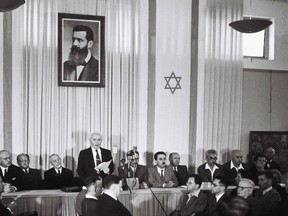
Following Israel’s declaration of independence in May 1948, neighbouring Arab armies started a war with the intention of destroying the fledgling country. The ensuing conflict resulted in the displacement of hundreds of thousands of Palestinians, a tragedy that ultimately became central to Palestinian national identity.
Sucharov does mention that Israel has served as a refuge for Jews, but gives too little attention to the historical reasons that it became so critical. The idea of creating a Jewish state preceded the Nazi genocide, but the murder of six-million European Jews made it urgent.
For Holocaust survivors and Jews elsewhere, Israel represented more than an abstract political ideology. It offered a measure of collective security after the catastrophic global failure to protect Jews. To reduce Zionism principally to an instrument of Palestinian dispossession is a troubling form of post-Holocaust historical revisionism, one that marginalizes the circumstances that made Jewish sovereignty a matter of survival.
Nor does Sucharov’s selective treatment end in 1948. Between that year and 1967, Jordan controlled the West Bank while Egypt administered Gaza. Yet neither established an independent Palestinian state in the territories under its control, nor was the creation of such a state within those territories the central demand of the Arab governments of the period.
This is hardly an insignificant omission from an account that presents Zionism as the principal obstacle to Palestinian self-determination. Subsequent wars, rejected diplomatic opportunities and continued refusal to accept Israel’s right to exist are indispensable elements of the historical record.
That brings us to Oct. 7, 2023. Hamas terrorists murdered approximately 1,200 people and abducted 251 hostages in an attack that deliberately targeted civilians. Sucharov refers to the Hamas “attacks,” but her discussion of the subsequent rise in global antisemitism focuses instead on Israel’s military response in Gaza.
The war has had devastating consequences for Israelis and Palestinians alike. Yet an account that examines Israel’s response without addressing Hamas’s objectives and responsibility for the original attack leaves a crucial part of the story untold.
Sucharov’s selective account of history is not merely a weakness in her interpretation of the conflict. The framing is also quite apparent in the way she conducts and interprets her survey research. She reports that 72 per cent of American Jewish respondents identified as Zionists when it was defined as support for a Jewish and democratic state. But when defined as privileging Jewish rights over non-Jewish rights, only 10 per cent accepted the label.
The question is whether a definition framed around unequal rights can fairly stand in for the broader meaning of Zionism. The resulting numbers reveal as much about the questions being asked as about the beliefs of those answering them. This doesn’t demonstrate that most Jews reject Zionism, but that most reject discrimination.
The survey usefully shows how responses vary with wording. The flawed survey question effectively incorporates a moral condemnation into the definition being tested. It does not establish what Zionism means to Jews. When a selective historical narrative portrays Zionism principally as domination, and a survey asks whether respondents support that characterization, its findings risk becoming no more than a reflection of the narrative itself.
Sucharov is right that criticism of Israeli government policies is not automatically antisemitic. But diminishing the history of Jewish vulnerability and self-determination is another matter. The problem is not simply that she asks the wrong questions, it’s that her version of history helps produce the answers she wants us to believe.
The prospect of reconciliation between Israelis and Palestinians remains distant. But making badly needed progress toward resetting the conversation requires an honest reckoning with the historical experiences, aspirations and fears of both peoples.
A narrative that minimizes the Jewish historical experience, overlooks Arab rejectionism and recasts Zionism as an ideology of domination does little to advance that understanding. Whatever one’s criticisms of Israeli policies, distorting the history and meaning of Zionism risks deepening the mistrust and divisions that make a more constructive conversation so difficult.
National Post
Join the Conversation
This website uses cookies to personalize your content (including ads), and allows us to analyze our traffic. Read more about cookies here. By continuing to use our site, you agree to our Terms of Use and Privacy Policy.
KioskNews shows a cleaned-up reading view extracted from the publisher’s page — the original always lives on their site, not ours.