Taiwan outlines US investment support
DISCUSSIONS: The nation and Washington are working on exemptions companies need for their US operations, as well as import quotas and visas, the vice premier said
Taiwan has secured preferential treatment for potential US semiconductor tariffs and is helping Taiwanese companies expanding there obtain tariff exemptions and investment support, Vice Premier Cheng Li-chiun (鄭麗君) said yesterday.
The vice premier made the remarks after Washington proposed to impose tariffs on 14 economies under an investigation into manufacturing overcapacity.
Taiwan’s semiconductor tariff arrangements fall under a separate Section 232 framework and an investment memorandum, Cheng said.
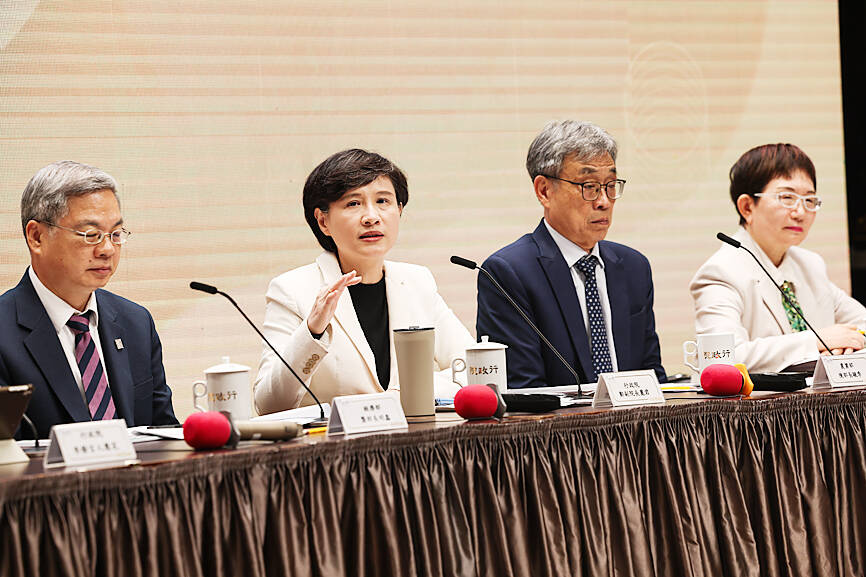
Vice Premier Cheng Li-chiun, second left, speaks at a news conference attended by Minister of Economic Affairs Kung Ming-hsin, left, Minister of Agriculture Chen Junne-jih, second right, and Minister of Finance Chuang Tsui-yun, right, in Taipei yesterday.
Photo: CNA
Washington has yet to announce its semiconductor tariff rate under Section 232 of the Trade Expansion Act, which allows import restrictions on national security grounds.
Under the investment memorandum signed in January, Taiwan negotiated exemptions from those duties within agreed quotas and a nonstacked rate of no more than 15 percent outside those quotas, or a lower rate if applicable, Cheng said.
Work is under way with the US Department of Commerce on exemption lists covering materials, equipment and components needed for Taiwanese companies’ US operations, as well as their semiconductor import quotas, she said.
Land, utilities and visas are also part of the discussions, including efforts to secure dedicated visa support for companies investing in the US, Cheng added.
The assistance comes as Taiwan Semiconductor Manufacturing Co (TSMC) evaluates a potential US$22.6 billion chipmaking project in Brazos County, Texas.
Companies plan their US investments according to operational needs, Cheng said, adding that the Ministry of Economic Affairs assists in compiling their plans and helping them obtain benefits under the memorandum.
Under the memorandum, Taiwan committed US$250 billion in investments by Taiwanese companies in the US, alongside government credit guarantees supporting up to US$250 billion in financing for Taiwanese businesses investing there, Cheng said.
Robust orders and capacity requirements are driving semiconductor companies’ US expansion, Minister of Economic Affairs Kung Ming-hsin (龔明鑫) said.
Eligible companies can import semiconductors free of Section 232 duties up to 2.5 times their planned US production capacity during the approved construction period, the US commerce department said.
That allowance falls to 1.5 times their production capacity after the projects are completed, it added.
Preferential Section 232 arrangements have already taken effect for several Taiwanese products, including 15 percent nonstacked tariffs on automobile parts, wood products and drones, Cheng said.
KioskNews shows a cleaned-up reading view extracted from the publisher’s page — the original always lives on their site, not ours.