Why are two college football teams playing at Wembley on Saturday?

There have been as many college football games played in Tanzania and Italy (one) as there have in England, and twice as many in China and Australia. It’s nearly 40 years since 6,000 or so intrigued spectators watched Richmond Spiders beat Boston University in Crystal Palace. “The gray, misty ways of Richmond proved far more compatible in the Land of the Overcast Sky,” reported the Boston Globe at the time.
The 1980s was a time of international expansionism for American college sports, with games in Japan, Milan and Dublin. They have returned to Ireland time and time again over the years. The College Football Classic has become an annual event at the Aviva Stadium in Dublin, where it has drawn in crowds of around 50,000 for the last five years, prompting the NFL to visit the city for the first time last September. It’s the other way round in London, where 20 years of NFL matches have paved the way for the college game.
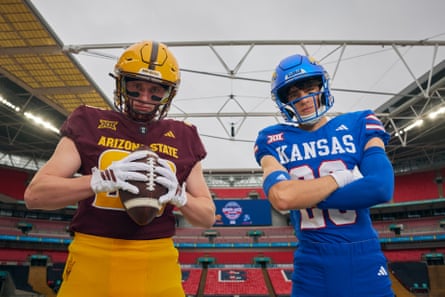
The match between Arizona and Kansas at 5pm on Saturday – dubbed the Union Jack Classic – is an inevitable reaction to the NFL’s work in the city over the last two decades. “We move a little bit behind the NFL,” says Brett Yormark, the commissioner of the Big 12 Conference – a league of 16 of the most successful teams in college sports.
“It’s important for the NFL to open up these markets before we do and develop a fanbase. The NFL have played 42 games in the UK so it seemed to be a mature enough market to bring college football here, versus breaking into a new market that might not have the appetite for the sport or the game. The timing just felt right.”
Why is college football going international?
Money and exposure. College sport is becoming increasingly professional and universities want to keep the cash flooding in. The top coaches are paid more than $13m a year and the players are paid substantial sums for their image rights. Arizona and Kansas pay their squads around $20m a year.
Most of that money comes from TV revenue. Teams in the Big 12 bank nearly $32m annually from broadcasters, with games shown on ESPN, Fox, TNT, CBS, and NBC. Having an international presence is a very handy carrot to dangle to broadcasters.
“Our media partners really like it when we go global, because it creates a big-event feel that they can capture – and they are in the big-event business,” says Yormark. “Fox will host their whole college football show – Big Noon Kickoff – here in London. It will be the first time they have ever taken that show international. They’re going to be here all week, making this game into something really big, not only here, but back in the US.”
“I’ve always had global ambitions for the conference - it’s good for business,” adds Yormark. “When I was the CEO of the Brooklyn Nets, we took the team to Mexico City, London and China. Football is a global sport. We were presented with an opportunity to come to the UK and took full advantage of it.”
There is another reason the universities want to play abroad: to market themselves to international students and advertise their global campuses (six of the universities in the Big 12 have campuses abroad). Having a successful college football team is a way of attracting students. “There’s real rationale behind it,” says Yormark. “About 14% of our student athletes are international, so how do you drive enrollment? How do you drive global appeal and fan engagement? All of that helps you to rationalise that going global does matter.”
Is this the start of something bigger?
“Our goal isn’t just to play here once,” says Yormark. “In sports, you’ve got to have continuity, you gotta build something. If there’s two Big 12 teams playing every year, British fans start gravitating to the Big 12 conference. They get to know our schools, our athletes, our coaches. Our ambition is to take many of our sports globally and take the conference global.”
What sort of crowd do they expect?
Young and loud. With ticket prices half what NFL International Games cost, the organisers are hoping for a crowd of 60,000. “That would be a tremendous number for us,” says Yormark. “We can build on it”. With family offers and cheap tickets for NHS and education workers, the event should beat the Big 12’s average attendance last year of 50,000.
Wembley is attractive to promoters as they can still make a handsome profit even if only two-thirds of the seats are filled. It’s why the RFL have kept the Challenge Cup final at the stadium despite not selling it out. Several thousand fans from Arizona and Kansas are travelling over for the away game of a lifetime. The match should feel different to the NFL, too, with both teams flying over their huge marching bands and half a dozen performers booked in for the pre-match and half-time shows.
“This isn’t just a game,” say the organisers. “It’s a full-scale celebration of sport, energy and culture: from pre-game tailgate parties and marching band pep rallies, to a half-time show that lights up the stadium.”
Why are Arizona and Kansas playing?
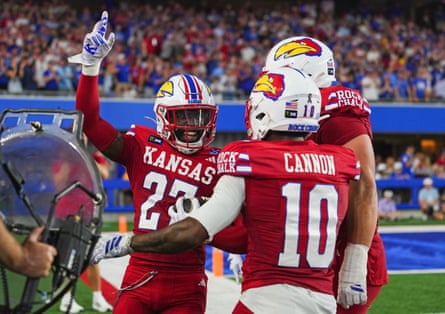
They volunteered. “Our schools were very excited about it, specifically Kansas, who said they wanted to move a home game to London. They were playing Arizona at home and Arizona were more than happy to come here,” says Yormark. The timing is perfect for Arizona, who have just opened a London branch, running a dozen or so degrees out of a University of London building in Clerkenwell.
As for the players, they are very excited. “About 90% of the student athletes coming over didn’t have a passport,” says Yormark. “For them to enjoy a wonderful international experience, while playing the game they love, doesn’t get much better. The students’ experiences are the most important thing to us.”
KioskNews shows a cleaned-up reading view extracted from the publisher’s page — the original always lives on their site, not ours.