Australia’s most stubborn icon, the Chiko Roll, turns 75 (with some chicks in its armour)
The Chiko Roll turns 75 this year along with Geoffrey Rush, Evonne Goolagong Cawley and Daryl Somers. I’d call this an impressive birth year group. However, there’s a difference between this set. The Chiko Roll is the only one that’s barely changed.
Australia certainly has. In 1951, takeaway food was usually a choice between corned beef sandwiches and the odd battered something from the local milk bar. Twisties, just a year old, were the flavour of the month at a time when no one stood in the aisle of Flemings reading the back of a yoghurt carton contemplating what it might do for their gut bacteria. This was the year that The Goon Show premiered, conscription for the Korean War was introduced and Australians voted against banning the Communist Party.
It was in the year before, 1950, that boilermaker Frank McEncroe found chop-suey rolls on sale outside a VFL match (40 years before it became the AFL) at Richmond Cricket Ground in Victoria. Yet these were so flimsy he couldn’t hold a beer in one hand while eating the roll in the other. Something had to be done. And thus, at the Wagga Wagga agricultural show in 1951, McEncroe launched his sturdier “Chicken Roll” – a deep-fried pastry tube that contained a filling including cabbage, barley, carrot and mutton (later beef) but, curiously, no chicken.
It soon became known as the Chiko Roll and was trademarked as such in 1958.
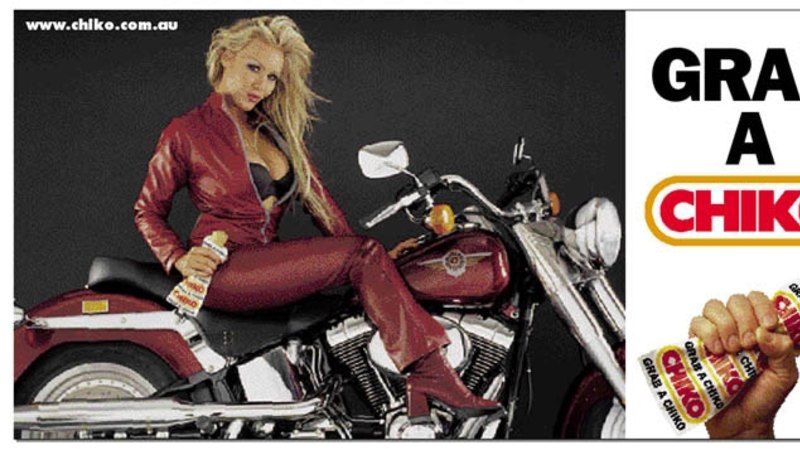
From the 1950s, it was marketed with the “Chiko Chick” in a familiar advertising formula: put a scantily clad woman on a motorbike next to the product (although she doesn’t seem much interested in eating it) and assume you’ll sell lots. It worked.
By 2000, the formula had developed a problem. Twenty-five complaints about a new billboard – which featured a leather-clad and busty Chiko Chick astride a Harley-Davidson – were enough for the Chiko Roll’s owner, Simplot, to replace her with a less revealing version. The Chiko had survived. The Chick had been required to put something on.
This is where the Chiko Roll wandered into my PhD research. My thesis, titled The Complexification of the Female Surf Protagonist in Australian Fiction, begins with the canonical novel Puberty Blues. In the 1979 text, girls who lived for surfing, but didn’t actually surf, fetched Chiko Rolls for their boyfriends. They were essentially Uber Eats before the app, except the delivery girls were paid in male approval.
By the 1970s, Australians were eating about 40 million Chiko Rolls a year. In a feat akin to selling coal to Newcastle, more than 1 million were exported to Japan.
The true birthplace of the Chiko Roll has been hotly debated. The argument has made it all the way to federal parliament, where three MPs have it for their electorates: Wagga Wagga (because it was launched there); Bendigo (because that’s where McEncroe came from, although he was born in Castlemaine); and Bathurst (because that’s where it is made). Declare something a national icon and Australians can become rather competitive about its ownership. Just ask the pavlova.
But, slowly, Australians’ food habits changed. Thai restaurants popped up. Banh mi became de rigueur. Sushi stopped being exotic and ended up next to the food court escalator. Much later, cauliflower started impersonating rice. Meanwhile, a vegetarian Chiko Roll emerged in 2017 but was discontinued in 2023.
The original, however, endured. The Chiko Roll has stayed much the same, even while everything around it has moved on. Women surfers, for one, have gained agency. And the Chiko Roll brand passed through a number of Australian owners before it was bought out in 1995 by Simplot, which has its headquarters in Idaho in the United States. The rolls, however, are still made in Bathurst.
Today, about 17 million are still consumed yearly in Australia. Could this be because, according to Good Food wine writer Katie Spain, they have just the right amount of crunch and a “smooshy cabbage, barley and beef interior” to match perfectly with a semillon?
Seventy-five years on, the Chiko Roll has outlasted Fantales, Sunny Boys, Space Food Sticks (how I miss those) and even the Polly Waffle. Perhaps an icon doesn’t need to be particularly edible? Maybe it just needs to hang around for long enough that no one has the heart to get rid of it. It might be too chewy a topic for another thesis.
KioskNews shows a cleaned-up reading view extracted from the publisher’s page — the original always lives on their site, not ours.