What would you cut? Chalmers challenges critics of government spending
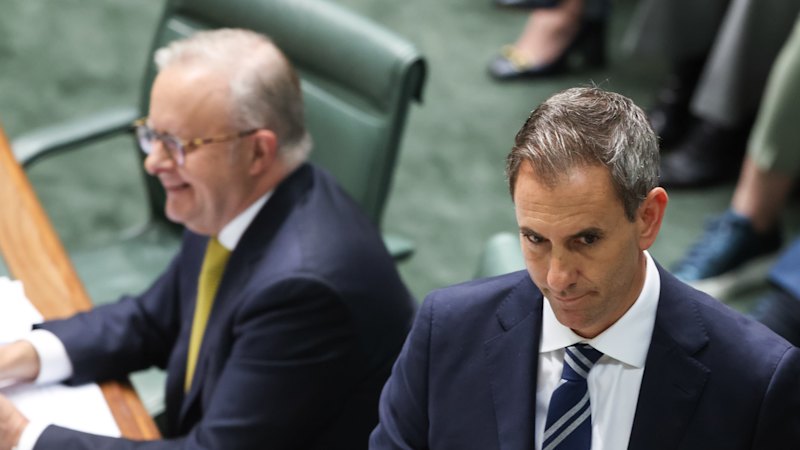
Treasurer Jim Chalmers has refused to put a cap on near-record government spending that economists and the opposition insist must be reduced to tame inflation while admitting his ambitious budget is causing his colleagues to worry about Labor’s electoral fortunes.
Chalmers told this masthead’s Inside Politics podcast he was “not prepared to put a specific number on the optimal spending as a share of GDP” despite calls from leading policy thinkers such as Ken Henry and Saul Eslake for rules to impose fiscal discipline.
The level of government spending, the state of the budget and its heavy dependence on personal income tax are becoming more powerful headaches for Chalmers who, with Finance Minister Katy Gallagher, say they are working on savings in the mid-year budget update due in early December.
In the just-completed financial year, spending as a share of the economy reached 26.9 per cent. Outside the pandemic, it was the highest share since 1986-87. The budget recorded a deficit of $22.2 billion which is expected to grow to $31.5 billion this financial year.
Chalmers said those advocating more cuts in spending should nominate what they would slash, arguing that pressures on the government were growing rather than receding.
“People will have different views about what the optimal level is. From our point of view, it needs to recognise some of these pressures in the care economy and elsewhere … defence spending and the like,” he said.
Financial markets put the chance of a fifth interest rate rise this year, at the Reserve Bank’s early November meeting, at 60 per cent. But that has prompted concerns about the state of the economy with the chief economists of the Commonwealth Bank and BetaShares warning the country could tip into a recession.
A growing problem is the surge in oil prices. At the weekend, Brent crude hit $US117 a barrel, its highest level since the war against Iran started.
Chalmers would not be drawn on the RBA’s next move but noted he and the Reserve had to balance the financial fallout from the war on the jobs market and the entire economy.
“Whether it’s the independent Reserve Bank weighing up all of those things or the government weighing up all of those things ... we’ve all got balances to strike,” he said.
The Coalition has declared the next election to be a referendum on the economy. A growing group of Labor-aligned figures, including backbencher Ed Husic last week, joined conservatives such as Mattias Cormann and Josh Frydenberg in making urgent warnings on the need for pro-growth reforms. Several leading policy voices say Labor’s budget should be in surplus at a time when tax receipts were strong and welfare payments low due to strong employment.
Many are driving for deep personal income taxes on top of those put in place by the government this year and in mid-2027.
Chalmers said the pressures on the economy and budget were complicating the timings for a round of larger tax cuts, expected to be promised in next year’s budget or before the election due in 2028.
“We will look to cut taxes again, but it’s not clear yet what the best way to go about that would be, or the most appropriate time to do that would be given the really substantial fiscal pressures,” he said.
Chalmers admitted the suite of tax changes contained in the budget in May “makes life tougher” for Labor MPs who have recently spoken out about the government’s handling of inflation and productivity.
The treasurer, who has come under the sharpest criticism of his four-and-a-half years in the job, argued Labor had “lost some paint over the course of not just the last six months or so but over a longer period”, suggesting Labor’s midterm turbulence was caused by factors outside the budget.
“I think it’s only right and only fair that I put my hand up and take responsibility for my share of that,” he said. “It’s up to other ministers and the prime ministers how they describe their part in that.”
The relationship between Chalmers and Albanese has come under the spotlight given the strong political reaction to key budget measures.
Chalmers has been more explicit than Albanese in taking responsibility for the government’s drop in the polls, which still has Labor in a winning position against a fractured right flank. The treasurer, 48, said he and Albanese, 63, “actually work really closely together”, adding “treasurers are lightning rods when the government is under pressure”.
Responding to observations from colleagues that he had become an isolated figure in the cabinet, Chalmers said: “If you’re asking me about my kind of internal political or factional management style, it is a fair criticism of me to say that I spend a lot of time locked in windowless rooms working very hard on some of these difficult economic challenges.”
Chalmers said he took very seriously the suggestion he was not open to feedback, also insisting the economic agenda was a top priority for a prime minister who critics say is not as personally interested in economic policy as previous leaders.
Shadow treasurer Tim Wilson said inflation had been a problem since July last year when it moved above the RBA’s target band.
“Inflation won’t be tamed until the government kicks its spending addiction,” Wilson said.
Chalmers came under heavy fire last term when he declared the RBA’s higher interest rates were “smashing the economy”, which the opposition said was an attempt to turn the monetary policy setting body into an economic bogeyman. He said the remark was a “a self-evident piece of economic analysis”.
He rejected the notion that Labor should have waited for clearer economic skies to pursue such an ambitious tax agenda.
“If you wait for calm in the world, you’ll be waiting forever,” he said. “The relative calm of the post-Cold War period has been replaced by chaos, and these rolling economic shocks mean that we are in a very substantial period of global economic uncertainty, volatility, risk and flux.”
Cut through the noise of federal politics with news, views and expert analysis. Subscribers can sign up to our weekly Inside Politics newsletter.
KioskNews shows a cleaned-up reading view extracted from the publisher’s page — the original always lives on their site, not ours.