What Taiwan’s nuclear referendum can change
A ‘yes’ vote would require government action, but would not itself repeal the nuclear-free provisions that remain in two laws
By Romain Blachier / Contributing reporter


On Nov. 28, voters will collect their ballots for mayors and councilors, and they will receive one more sheet. It asks: “Do you support the government using nuclear power to boost the economy and thereby abolish the ‘nuclear-free homeland’ energy policy?” This is the fourth national referendum on nuclear power since 2018.
What would a “yes” vote require the government to do? The answer lies in the Referendum Act (公民投票法). It is narrower than the campaign suggests. Su Yen-tu (蘇彥圖), a legal scholar at Academia Sinica, explained the distinction in an interview on Nov. 12.
The Chinese Nationalist Party (KMT) drafted the question and, along with its allies in the legislature, the Taiwan People’s Party (TPP), adopted it 59-51 on Aug. 14. The Central Election Commission (CEC) put it on the ballot on Aug. 28. The KMT caucus’ accompanying statement of reasons promises more, presenting the vote as a way to turn existing nuclear plant sites into “forward-looking technology demonstration parks.”
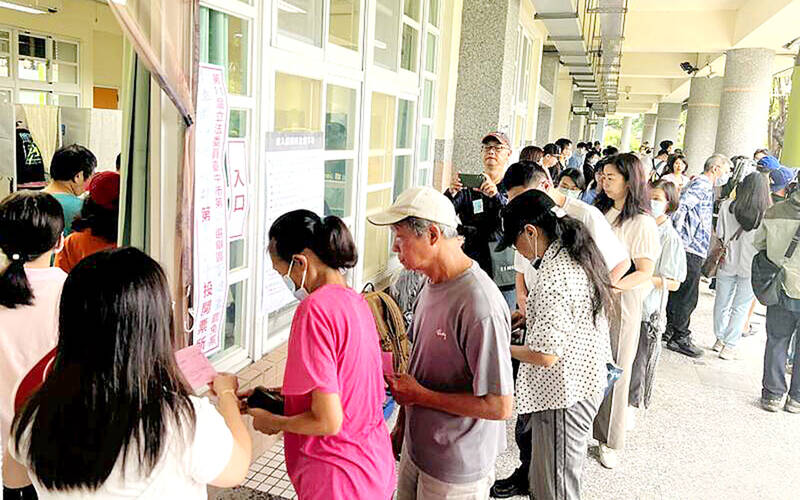
People line up to vote in this undated file photo.
TT file photo
The question is a vote on a “major policy” under Article 2 of the Referendum Act. That category decides almost everything. In 2018, Referendum 16 asked voters to repeal one sentence of the Electricity Act (電業法). That sentence, in Article 95(1), required all nuclear generating facilities to stop operating by last year. The “yes” side won about 5.89 million votes, and the sentence lapsed on Dec. 2, 2018. Article 30 of the Referendum Act gives a referendum that power over a law.
Referendum 22 leaves every statute in force.
POLICY VOTE
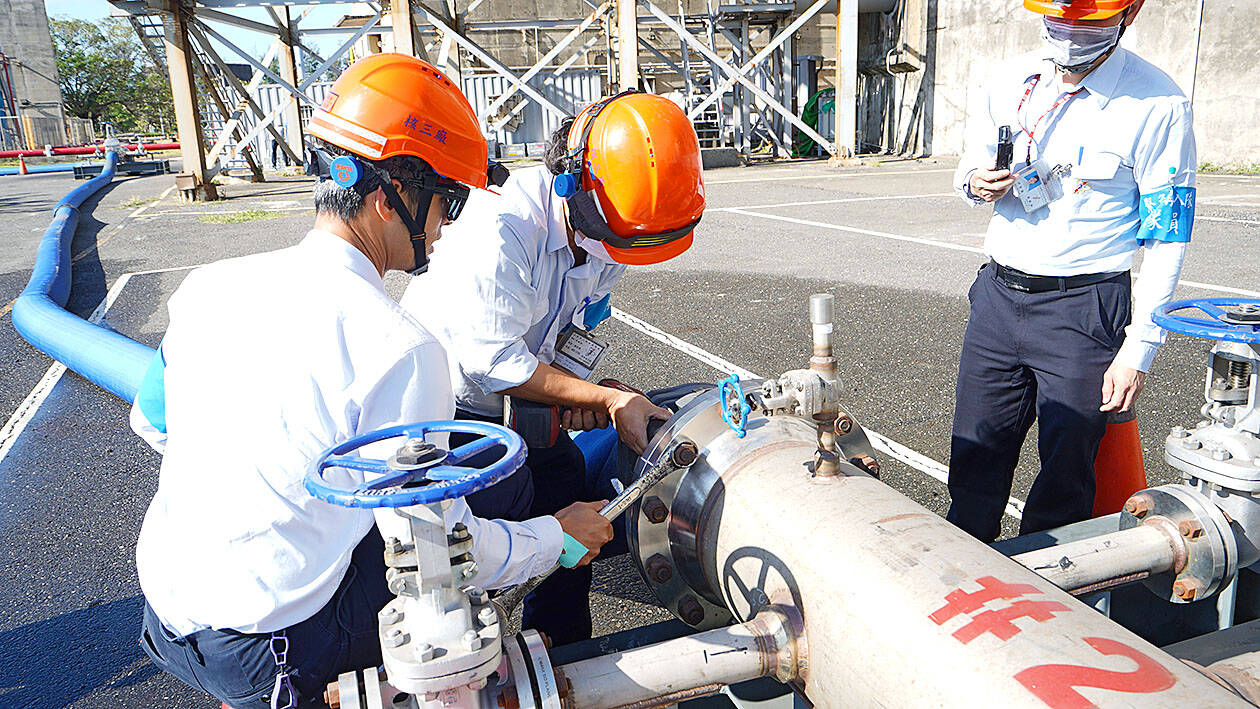
Workers at the Ma-Anshan Nuclear Power Plant in Pingtung County on Thursday participate in a disaster response drill.
Photo: Tsai Tsung-hsien, Taipei Times
“In theory we don’t recognize advisory or consultative referendums, but a policy vote is essentially advisory,” Su said. “It only requires that the president or the competent authorities do whatever is necessary to implement the outcome. It is not legally binding,” which means a policy vote has no direct effect on any statute.
The legislature, he added, “can only propose a policy vote, not a referendum in the narrow sense.” Repealing a law takes a citizens’ initiative, as it did in 2018. A “yes” on Nov. 28 would therefore oblige the government to act, while the statutes stay as they are.
But the nuclear-free homeland is more than a policy. Article 23 of the Basic Environment Act (環境基本法), adopted in 2002, says the government shall draw up plans to reach the goal of a nuclear-free homeland step by step. Article 5 of the Climate Change Response Act (氣候變遷因應法), as revised in 2023, refers to the same vision.
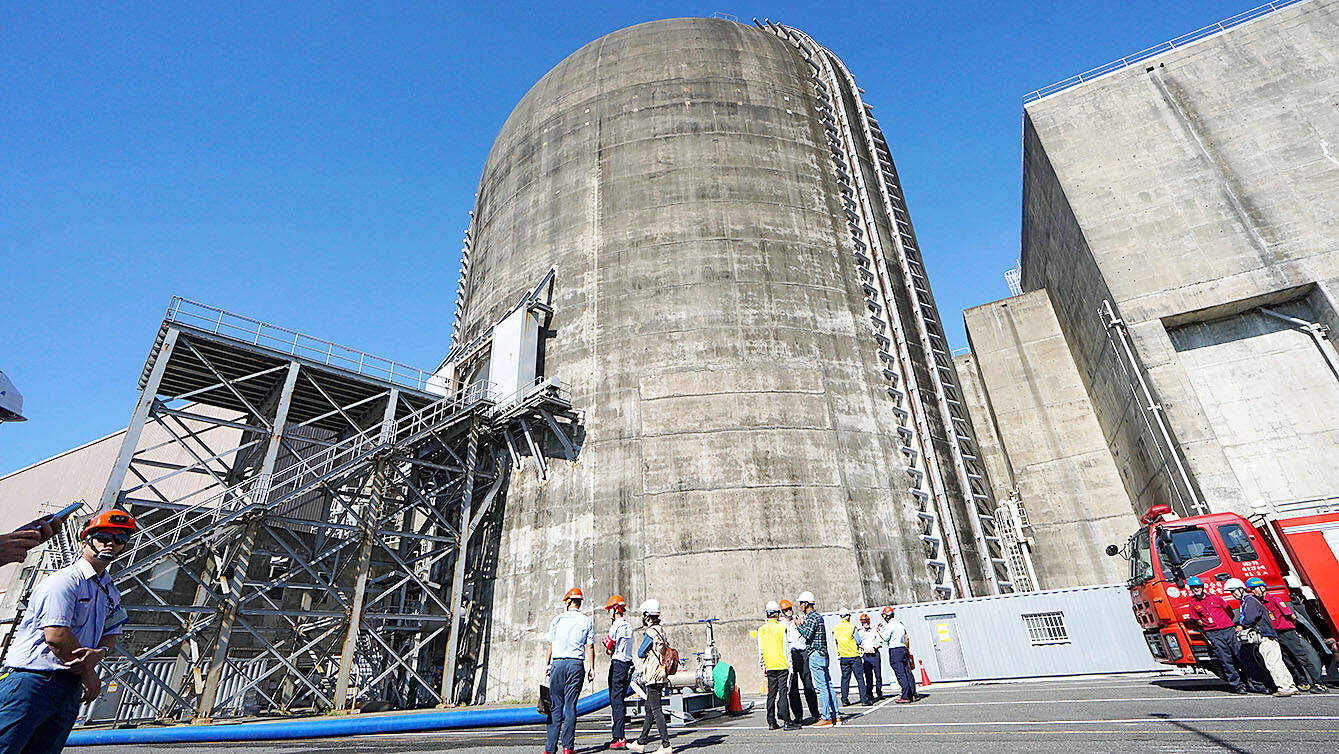
An annual disaster response drill on Thursday takes place at the Ma-Anshan Nuclear Power Plant in Pingtung County.
Photo: Tsai Tsung-hsien, Taipei Times
“We are sure that the referendum could not repeal these two statutes,” Su said. “There will certainly be some conflict between the two, and we don’t know how to solve this conflict.”
Su added that the legislature can repeal the statute. “It simply did not do so, and they cannot use the referendum to do that,” he said.
The last paragraph of Article 30 adds a two-year bar. Administrative agencies may not change course from an approved policy for two years. The bar does not bind the Legislative Yuan.
“It is a way to make sure that the vote means something,” Su said, “but it cannot last indefinitely.”
President William Lai (賴清德) signaled greater openness to nuclear power in March, and the Ma-anshan Nuclear Power Plant restart process began before the KMT’s referendum question was drafted.
To pass, a proposal needs more yes votes than “no” votes, with “yes” votes reaching at least a quarter of eligible voters. In August last year, voters decided to restart Ma-anshan with no nationwide election on the same day. “Yes” won 74 percent of valid votes, 4.34 million in all, on a turnout of 29.5 percent of total eligible voters. The measure fell about 660,000 votes short of the 5,000,523 it needed. On Nov. 21 last year, the legislature voted 56 to 44 to hold referendums on the same day as nationwide elections again under the notion that it would increase voter turnout. The amendment reversed a 2019 change.
A “no” or a “yes” that falls short of the threshold has clearer consequences. Article 32 bars a new proposal on “the same matter” for two years after the result is announced. The article leaves the CEC to decide what the same matter is. For example, would a later vote on a single plant count?
“We don’t have much case law, or jurisprudence, or prior practice under this article,” Su said. “It’s anyone’s guess how they would determine what counts as the same matter.”
LEGAL BASIS
The official referendum booklet offers no government explanation of these legal effects. When citizens initiate a referendum, Article 10 requires the agencies concerned to publish an opinion on the legal effects of a “yes” and of a “no”. When the legislature initiates one, Article 15 waives that step. The official gazette for Referendum 22 therefore carries only the KMT caucus’ question and statement of reasons. The agencies that would have to apply the result have no space in it.
The Taiwan Environmental Protection Union (台灣環境保護聯盟) has said that the gazette amounts to the majority’s argument alone. Su agrees. The legislators who wrote the act, he said, “simply assumed that referendums proposed by the Legislative Yuan would be genuine ones, without having to explain too much.”
The major parties, long the main users of the signature route, “found a shortcut” this year: the legislature also sent the CEC proposals on caning as a criminal punishment and on the use of traffic-fine revenue, which the commission rejected on Aug. 28 as outside the matters that Article 2 allows a referendum to decide. The nuclear question is the one that survived.
Whether it is a genuine policy question is, Su said, “the critical question we need to ask.” He has a name for the genre: a “crypto-referendum,” “a policy vote in disguise,” put forward for other political purposes, which he described as humiliating the administration and helping the KMT camp mobilize its voters.
Referendum 22 would not itself erase the nuclear-free provisions from either statute. Ultimately, the legislative majority of the KMT and TPP that put the question on the ballot could pursue those amendments directly in the legislature.
Romain Blachier is an associate fellow at the Fondation Jean-Jaures, and a consultant and lecturer in energy and international relations.
KioskNews shows a cleaned-up reading view extracted from the publisher’s page — the original always lives on their site, not ours.