Xi Jinping tells German president China and EU must ‘stay anchored to their partnership’
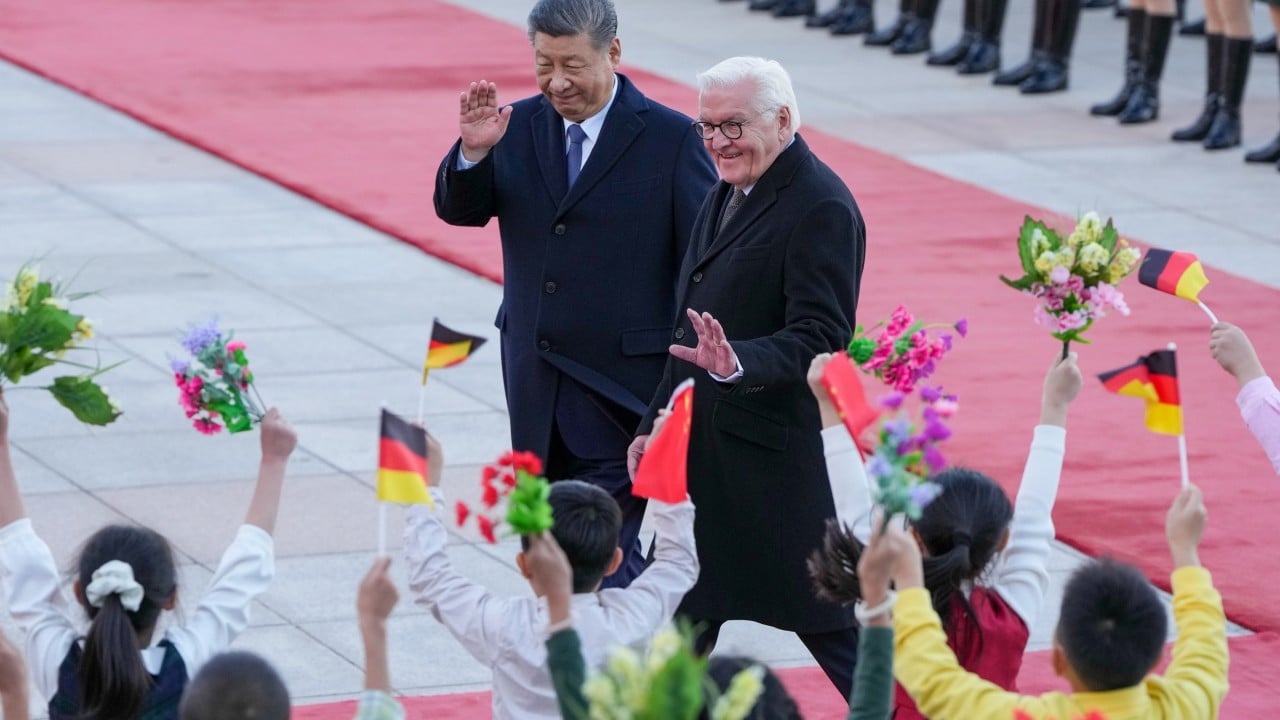
China and the European Union can resolve their differences through dialogue, Chinese President Xi Jinping told his German counterpart Frank-Walter Steinmeier on Friday.
“China has always regarded the European Union as a partner,” Xi said, according to state broadcaster CCTV, adding that cooperation between the two sides outweighed competition.
“As long as [both sides] stay anchored to their partnership and engage in dialogue on an equal footing, differences and challenges can always be resolved and will not stand in the way of China-EU relations moving forward,” the Chinese leader said.
He added that China and Germany could “project a positive signal to the world” by “choosing openness over closure and cooperation over confrontation”.
China and the EU remain locked in long-running disputes over industrial overcapacity and the trade imbalance.
Although the two sides recently agreed to cap exports of Chinese hybrid vehicles for four years, Brussels is alarmed by a ballooning trade deficit that stood at about €1 billion (US$1.1 billion) a day last year.
In the face of mounting pressure from the EU, Beijing has been working to shore up economic ties with key partners in the bloc.
The German president’s visit comes at a time when the country’s economy has come under severe strain from trade tensions and soaring energy prices, with its vital automotive sector facing particular strain.
Xi stressed that as the world’s second and third-largest economies, China and Germany had a particular responsibility to ensure the growth of the global economy.
Xi said he hoped Germany would view cooperation and China’s development with an open and positive mind, while maintaining a rational, pragmatic China policy anchored in mutual respect and equality.
The meeting came one day after this week’s major Communist Party meeting known as the fifth plenum, an event foreign dignitaries typically avoid when planning visits.
According to CCTV, Steinmeier said both sides could manage their economic and trade differences through dialogue and consultation to achieve mutual benefits and set an example for the world.
He added that Germany was willing to join China in safeguarding global peace and development, supporting free trade and World Trade Organization rules, while opposing protectionism.
02:05
Emboldened EU readies China company ‘kill switch’ as Beijing warns Brussels not to ‘fantasise’
Also on Friday, Xi met Swiss President Guy Parmelin for the signing of an upgraded free-trade agreement.
The deal, agreed in August, provides for greater access in sectors such as services, investment and trade, with zero-tariff imports ultimately set to account for more than 99 per cent of two-way trade.
The original deal, signed in 2013, was Beijing’s first free-trade agreement with a country in continental Europe and a top-20 global economy.
A day before meeting Xi, Steinmeier gave a speech at Peking University, where he said Germany was not seeking to decouple from China but must defend its economic interests.
His visit, which runs from Tuesday to Saturday, is meant to address “Germany’s diverse and complex relations with China, as well as the challenges involved”, according to his office.
His first stop was in Hefei in central Anhui province, where he visited Volkswagen’s local technology and R&D hub.
Volkswagen plans to cut up to 100,000 jobs globally by 2030 – the largest workforce reduction in the company’s history.
Electric vehicles have been at the centre of China-EU trade friction.
Economic pressure at home has fuelled growing public discontent and demands for political change.
Following strong performances in recent state elections, the far-right Alternative for Germany (AfD) secured the house speakership in Saxony-Anhalt state. It marked the first time a far-right party member has held a state house speakership in Germany since World War II.
11:33
Balancing trade and economic rivalry: the future of Sino-German relations
Under dual pressure from economic stagnation and the rise of the far-right, Germany is seeking alternative partners in Asia while maintaining stable relations with Beijing.
Steinmeier’s visit to China coincides with German Chancellor Friedrich Merz’s five-day Asian tour across Singapore, Japan and South Korea.
On Tuesday in Singapore, Merz warned against a full economic decoupling from China, calling it “a mistake” that “would make us neither safe nor more prosperous.” Instead, he advocated reducing “unhealthy, one-sided dependencies” in supply chains, technologies and raw materials.
In response to his remarks, Chinese foreign ministry spokesperson Guo Jiakun said on Wednesday that China and Germany, as well as China and the EU, enjoyed highly complementary economies.
“We hope the German and European sides will remain objective and rational and work with China towards the same direction,” Guo added.
The spokesman said both sides should resolve differences through dialogue and consultation to jointly safeguard the stability and smooth operation of global supply chains.
KioskNews shows a cleaned-up reading view extracted from the publisher’s page — the original always lives on their site, not ours.