‘All I want to do is put the red jersey on’: Eli Katoa’s road to recovery
“Today is the one-year mark,” Eli Katoa reminds me of that shameful day in the history of international rugby league.
Katoa was representing Tonga in a Pacific Championship match last November against New Zealand when the code failed him in its duty of care because he was twice ruled fit to take the field following head knocks, including one in the warm-up.
After a third blow to the head, the Melbourne Storm back-rower failed a head impact assessment and was removed from the field. He then suffered a seizure while on the sideline and was rushed to an Auckland hospital, where he had emergency surgery to remove fluid from the brain.
He has not played since.
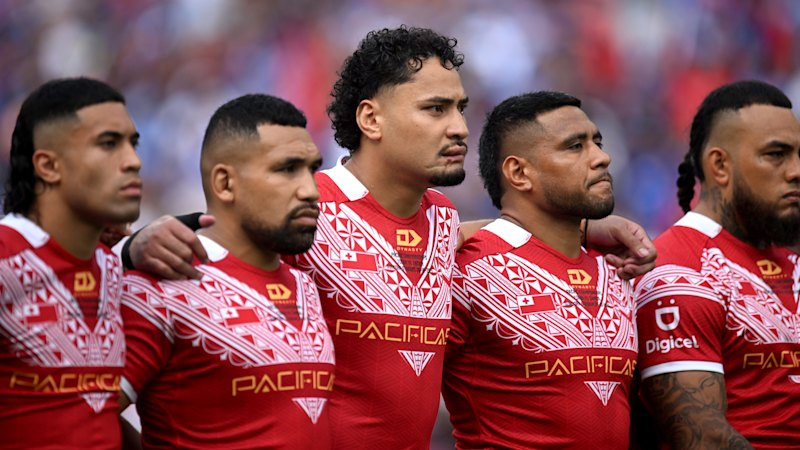
Yet, the night before we speak, Katoa was back with his Tongan teammates, celebrating their 20-18 win over Samoa in an absorbing World Cup clash before a joyful CommBank Stadium crowd. Wearing a trainer’s shirt, he wrapped his arms around his fellow Tongan warriors.
Katoa will be on the sideline again on Saturday night in Newcastle, when Tonga play New Zealand in the semi-final.
However, his presence is really an absence, because he reminds us of what we have missed in the 12 months since he was stood down from playing on medical grounds.
His captain at club level, Harry Grant, speaks warmly of Katoa, the NRL’s second-rower of the year in 2024 and 2025.
“My admiration for him is immense. It has shone brighter through his uncertainty the past 12 months,” Grant said.
“The frustration of not being able to share the field with him, or have answers, has been hard for me. I can only imagine how Eli and his loved ones feel. Your true character comes out in adversity and he’s a glowing refection of that.”
In medieval England, Katoa would have been a nobleman. Polynesian culture says he possesses mana, or moral authority. He has ennobled and embarrassed his code at the same time.
While three of Tonga’s medical staff were suspended for two years following an NRL investigation of Katoa’s triple head knocks, I question him as to why some of his teammates did not intercede, particularly when he lay limp on the ground following a collision with fullback Lehi Hopoate during a pre-game drill.
“People, particularly in the media, want me to blame someone,” he says after a short pause.
“All I want to do is play.”
Katoa concedes he can seek legal remedy for negligence in the future.
“I’m passionate to play for my club, my family, my tiny little Kingdom of Tonga and just the love of playing. At the moment, I must forget about that (legal) pathway and just come back and play.”
The 26-year-old will have scans in Melbourne after the World Cup to determine if he can return.
“I’m heading in the right direction,” he said. “My last appointment was with the NFL’s top specialist when the Los Angeles Rams and the San Francisco team came out to play a match at the MCG. The doctor [a neurologist] said that if I was his son, he’d let me go out and play now.”
“The doctor (a neurologist) said that if I was his son, he’d let me go out and play now.”
Eli Katoa
Katoa concedes the scans will always show scarring on the surface of the brain.
“A scan at the six-month mark showed a little area of the past bleeding and at the 12-month mark I hope it will show improvement. But some mark will still be there in 20 years time and it doesn’t mean I can’t do what I want to do.”
At the Storm’s Geelong pre-season camp in late January, less than three months after that fit on the sideline in Auckland, where he was also given oxygen, he appeared ready to play.
He led his group in the club’s traditional quizzing of a past player and was the outstanding performer in the non-contact conditioning drills. I recall watching him with a confused mix of admiration, anger and aching sadness.
It’s not as if Katoa needs to be saved from himself, particularly with controversy over CTE.
He had a bedside view of another player to experience cerebral bleeding and subsequently retire. His best friend and Storm teammate, Tui Kamikamica, suffered a stroke and Katoa sat by his hospital bed for days.
“Eli called me at 6am to inform me of Tui’s stroke,” Storm football manager Frank Ponissi says.
“When Craig [Bellamy] had his neurological problem, he was the first to comfort him. For the first time in 12 years, the annual Michael Moore Medal [awarded to the Storm’s club person of the year] didn’t go to a vote and was awarded unanimously to Eli.”
Asked the difference between playing for the Storm and Tonga, Katoa says: “It’s the red jumper. I put it on and it reminds me of my country and all the people at home. It’s more about my family. Both my parents are Tongan. Dad passed away in 2011 when I was finishing primary school. Mum is still there and has been to Melbourne twice. I became engaged to my fiancée [Tuitofa Aloua] in September.”
The feeling of pride to represent the Pacific kingdom transcends everything. His role as a blue shirt trainer for his country this Saturday involves relaying messages for the team – including tips designed to exploit his Storm teammate, New Zealand halfback, Jahrome Hughes.
“Everything is for the Tongan boys,” Katoa says. “Players will do anything to get the red jersey. I was just so happy with the boys when we beat Samoa. All I want to do is put the red jersey on and represent Tonga and know my family and my little country is behind me. Nothing compares.”
News, results and expert analysis from the week in sport sent every Friday. Sign up for our Sport newsletter.
KioskNews shows a cleaned-up reading view extracted from the publisher’s page — the original always lives on their site, not ours.