Love? No, just thousands of dispirited, stranded passengers, actually
Washington: At the end of the film Love Actually, the split screen gradually expands to show hundreds of different scenes from airports: people hugging, crying, saying their hellos or goodbyes. It serves as a touching reminder that everyone has a story; we all matter to somebody.
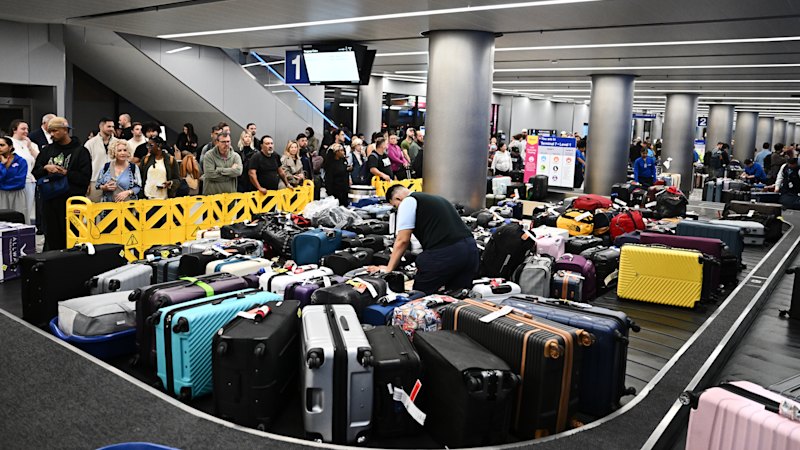
It was somewhat the opposite at airports across the United States on Friday afternoon – hundreds of thousands of people clutching phones, hastily revising plans, corralling bored children, waiting in line to rebook flights, searching for luggage, queueing at Starbucks or the airport bar.
US airspace handles about 45,000 flights a day, through some of the world’s busiest airports: Chicago’s O’Hare, Atlanta’s Hartsfield-Jackson, Texas’ Dallas-Fort Worth. It’s rarely glamorous, but when the system works, it is pretty impressive. When it fails, it’s miserable.
Such was the case when the US Federal Aviation Administration (FAA) ordered an exceedingly rare nationwide ground stop after technical problems plagued critical air traffic control systems. About 15,000 flights were either cancelled or delayed, affecting millions of passengers and their families.
At Ronald Reagan Washington National Airport, 31-year-old Madeline DeMaske was hoping to head home to Denver, Colorado after a whirlwind work trip to the nation’s capital. “Now I get one more day in DC,” she said. “Hopefully only one more day.”
DeMaske was already on board her plane, about to start taxiing, when the pilot and gate agent entered to tell passengers they were stuck on the tarmac. She waited at the terminal for hours, hearing rumours that things might change soon. “My flight was cancelled five minutes before [the flight ban] was lifted.”
Some gates inside the terminal were quiet, DeMaske said, but others were “very chaotic”, with long lines at the information desk. Other people said that while there was a scramble for phone charging stations, Washington’s city airport retained its reputation for being pretty calm and genial.
DeMaske rebooked on the same flight 24 hours later. She watched the price of hotels climb while she waited. “There’s definitely an Uber surcharge going on right now that’s pretty crazy,” she said. “This delay is going to cost me several hundred dollars.”
Rob Field, from Detroit, was still at his hotel when he heard there was going to be a delay, but he headed to the airport anyway. It was only once he arrived that he found out the full extent of the disruption.
“I’m going to go back to the hotel tonight, see where we’re at in the morning,” he said shortly before the stop order was lifted. “If they still don’t know, it’s an eight-hour drive; I’ll probably just drive.”
Carrie Trost and Corey Harlow were supposed to fly to Florida to watch the US men’s national soccer team play Haiti in Miami. They said they had received mixed messages about whether their flight had been cancelled or delayed until the morning. What would they do? “Go on the internet and keep our fingers crossed,” Trost said.
During their long waits, people had the time to think about the potential causes of the apparent system failure. While information was scant, and nothing was known for sure, they had their theories.
“They’re not going to tell us what it really is, if it’s a cyber type of thing – at least not right now,” Field said. He said he was also worried about AI. “Absolutely – you have to be … weird things are starting to happen.”
DeMaske noted the FAA had expanded the rollout of its new AI flight-tracking system this week, and that the agency’s existing infrastructure was quite dated.
“How are they mixing this very ancient technology with very new technology? You would think maybe it’s not meshing very well,” she said.
At a news conference at the White House, Homeland Security Secretary Markwayne Mullin said there was no connection to an outage of Microsoft systems the previous day, and no evidence a cyberattack was to blame.
Shortly after officials confirmed the ground stop had been lifted, an announcement came over the PA system at Reagan National: two Alaska Airlines flights would soon depart for the West Coast.
People were spotted running through the terminal with their luggage, trying to make a flight that was suddenly back on. But most flights were still showing as either cancelled or delayed for hours, some well into Saturday.

KioskNews shows a cleaned-up reading view extracted from the publisher’s page — the original always lives on their site, not ours.