Notes from Central Taiwan: Who gets to decide Taiwan’s future?
As Beijing presses Washington over arms sales, local elections in November could sharpen a debate over the nation’s own agency
By Michael Turton / Contributing reporter


The tussle between the Chinese Nationalist Party (KMT) and its pro-People’s Republic of China (PRC) allies and fellow travelers, and the pro-Taiwan side in politics is in part a struggle over defining the nation’s agency in international spaces. What kind of agency does Taiwan have?
The United Daily News (UDN) recently reported that former National Security Council secretary-general and longtime KMT stalwart Su Chi (蘇起), popularizer of the fake “1992 consensus,” contended that the US was both unable and unwilling to protect Taiwan. He also asserted that the threat from the PRC was rising and that the future depended on the actions of PRC dictator Xi Jinping (習近平). According to a Taipei Times report, Su said that Taiwan should consider political action to address cross-strait tensions, and not rely solely on outside powers.
Observe how Su positions Taiwan in this series of statements. The country has no say in its own fate, and is the helpless subject of the actions or inactions of others. Taiwan relies “solely” on outside powers, Su claimed, a quaint exaggeration that omits the reality of its military and diplomacy. The political measures Su is apparently referring to, that follow inexorably from those assertions of inagency, are that Taiwan should accommodate itself to PRC interests and acquiesce in its own subjugation, accepting the faux “1992 consensus,” conduct exchanges on PRC terms and “make a deal before it is too late” (read: surrender).” For such individuals, Taiwan is a region of the PRC and should not have any agency of its own.
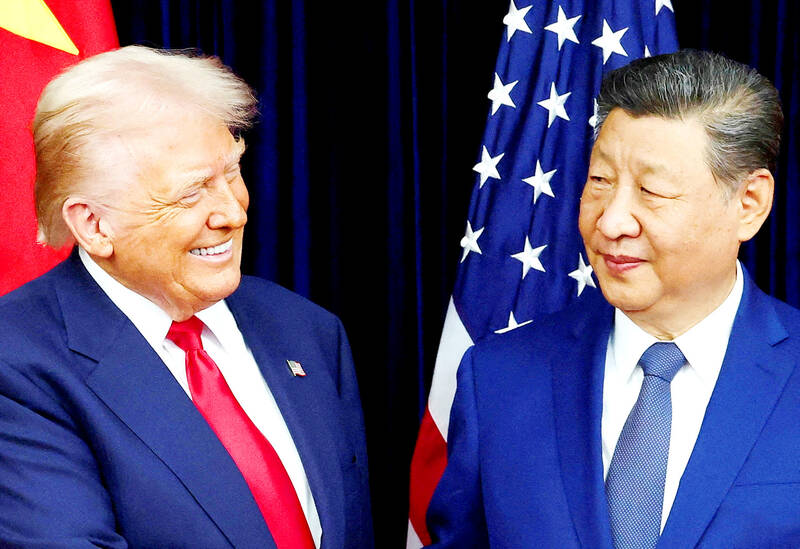
US President Donald Trump and Chinese President Xi Jinping in October last year react as they hold a bilateral meeting at Gimhae International Airport, on the sidelines of the Asia-Pacific Economic Cooperation (APEC) summit, in Busan, South Korea.
Photo: Reuters
Thus, an important thrust of the KMT anti-Taiwan propaganda campaign is denigrating Taiwan’s agency. The long history of US venality and unreliability helps give this campaign a veneer of rationality. So does Taiwan’s apparent smallness. What can little Taiwan do?
By contrast, the pro-Taiwan side affirms the country’s independent agency. Mainland Affairs Council (MAC) Deputy Minister Shen Yu-chung (沈有忠) said last week, partly in response to Su Chi, that the US remains committed to defending the First Island Chain. He took particular pains to show how Washington and Taipei are cooperating to “jointly managing risks” posed by Beijing. Taiwan is thus a partner, not a pawn. It follows from that logic that US-Taiwan cooperation, such as the 921 earthquake disaster cooperation that the American Institute in Taiwan (AIT) lauded last week, helps affirm Taiwan agency from the American side.
ARMS SALES
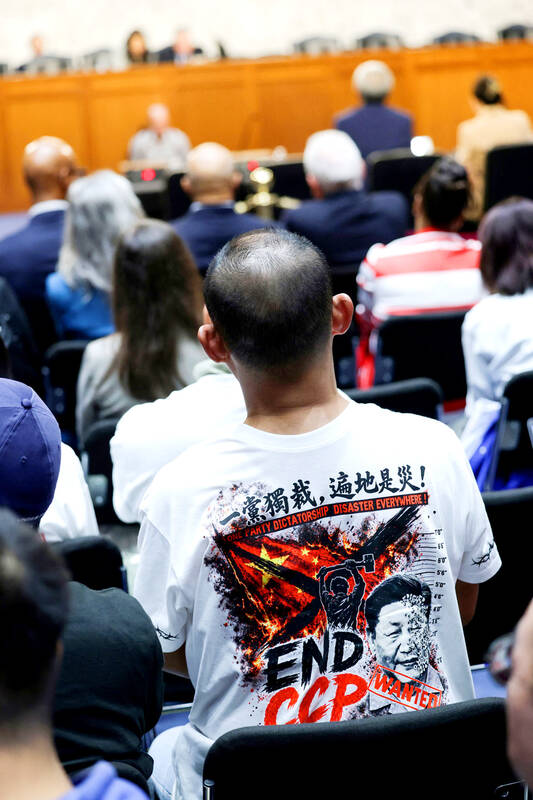
Members of the gallery on Tuesday listen as Christian Pastor Ezra Jin Mingri, founder of Zion Church who was released after more than 260 days in detention in China, addresses a Congressional-Executive Commission on China hearing on human rights issues in China on Capitol Hill in Washington, DC.
Photo: Reuters
Into this tussle fall US arms sales. The PRC demanded earlier this month that the US delay arms sales until after the November Asia-Pacific Economic Cooperation (APEC) Leaders’ summit in China’s Shenzhen and that the US not announce any sales before the meeting between the two nation’s leaders on the 24th of this month. Xi is also expected to visit Florida in December for a G20 Summit, held at a property of US President Donald Trump, of course.
Voters are being treated to another example of the canonical pattern in US-PRC relations in which the US trades something permanent (time, in relation to weapons sales) for something transient (meetings). The correct US position should have been, upon hearing the threat from the PRC, to announce that it was considering giving the weapons to Taipei for free. Instead, PRC “anger” once again determined US policy.
(The New York Times even shamefully quoted a “scholar” at a “Center for Taiwan Studies” at a PRC university saying that “demanding a continued delay in any arms sales may be the most critical issue,” as if such individuals were actual scholars and not state propagandists whose sole purpose is to parasitize the authority and credibility of critical scholarship in the name of PRC expansionism. There is no earthly reason to give PRC “scholars” space in major US papers of record. Just quote Xinhua.)
This swirl of weapons sales news and meetings between various governments will take place as voters consider their choices at the polls in November. Normally I would argue that local elections are not strongly influenced by international events. But in this case the KMT has worked hard, intentionally or not, to create that linkage by degrading domestic governance and focusing the media spotlight on its defense budget machinations for the last year.
POST-SUMMIT SPIN
After the summit this week, both the pro-PRC and pro-Taiwan sides will be attempting to sterilize the results. The pro-PRC side will shake its head and claim that the summit shows Taiwan has no agency of its own, and because of that it should “make a deal” with the PRC. The pro-Taiwan side will contend that nothing has really changed and Washington and Taipei are continuing to cooperate. No doubt underlings in the US government will attempt to walk back what the US president says, that too being a canonical experience of US Taiwan policy. That will help the pro-Taiwan side.
Two conclusions. First, voters will be watching, because the debate in the aftermath of the summit will spill into the lead up to the local elections, and candidates may be asked about it, especially candidates suspected of harboring presidential ambitions. It might be useful to the pro-Taiwan side to ask such candidates whether Taiwan should embrace the “1992 consensus.”
Moreover, this debate over Taiwan’s agency will be sustained throughout the election because the APEC summit is in November. That will help maintain the local-national linkage.
PRC ELECTION INTERFERENCE
Another factor linking the local elections to the national level will be increasing PRC interference in this election. While some PRC disinformation is slick, many of its activities are crude and obvious to voters. Government and private agencies will also be out front, identifying the PRC disinformation. Voters will get constant reminders that this local election is about China too.
Taken together, these issues imply that voter choices may indicate something about where they want Taiwan to go in the future, if one party or the other does surprisingly well. Such signaling may be unclear even where one party shines, since much depends on how local candidates perform.
Second, the US can play a constructive role simply by changing none of its traditional verbiage and by loudly and clearly clarifying that it has not changed anything. The AIT can support Taiwan simply by doing what it does, emphasizing Taiwan-US cooperation and weapons sales. Turning up the volume, though, would help.
Further, much PRC disinformation involves providing false information about the US. This basically hands AIT a license to forcefully denounce such shenanigans, benefiting the pro-Taiwan side.
It’s shaping up to be the most international local election ever. All of us who love Taiwan should not waste this opportunity to pin the negatives on the pro-PRC side.
Notes from Central Taiwan is a column written by long-term resident Michael Turton, who provides incisive commentary informed by three decades of living in and writing about his adoptive country. The views expressed here are his own.
KioskNews shows a cleaned-up reading view extracted from the publisher’s page — the original always lives on their site, not ours.