Support for Shen surpasses 52%, poll shows
By Lin Che-yuan and Sam Garcia / Staff reporter, with staff writer


Support for Democratic Progressive Party Legislator and Taipei mayoral candidate Puma Shen (沈伯洋) reached 52.6 percent, compared with 35.3 percent for Taipei Mayor Chiang Wan-an (蔣萬安) of the Chinese Nationalist Party (KMT), a poll released yesterday by the Strategy and Public Research Institute of Taiwan showed.
The poll was held after the candidates’ first debate on Saturday.
It showed support for Shen surpassing 50 percent for the first time, with the gap between the two widening to 17.3 percentage points.
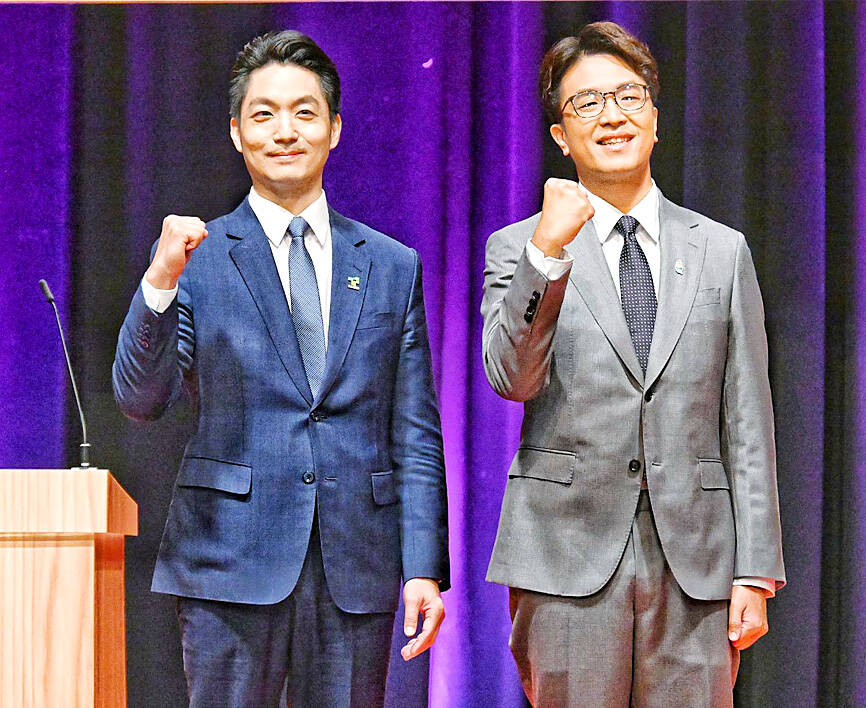
Taipei Mayor Chiang Wan-an of the Chinese Nationalist Party (KMT), left, and Democratic Progressive Party Legislator and Taipei mayoral candidate Puma Shen gesture before in a televised debate in Taipei on Saturday.
Photo: Fang Pin-chao, Taipei Times
A breakdown of voting intentions by district found that Shen led Chiang in 11 of Taipei’s 12 districts. His strongest support came from Datong District (大同), where he received 64 percent, while Chiang received 31.8 percent. Shen secured more than 50 percent support in eight districts: Datong, Zhongshan (中山), Songshan (松山), Daan (大安), Wanhua (萬華), Shilin (士林), Beitou (北投) and Neihu (內湖).
Asked who they expect to win the election, 47.9 percent of respondents said they think Shen would win, and 40.1 percent said they believe Chiang would.
As for who performed better in the debate, 41.2 percent chose Shen, 26.3 percent favored Chiang, and 20 percent said they did not watch.
Regarding Chiang’s performance as mayor, 48.3 percent said they were dissatisfied, 38.4 percent said they were satisfied and 10.1 percent expressed no opinion.
Asked which issue they most want the next mayor to prioritize, urban renewal topped the list at 24.3 percent, followed by transportation (15.2 percent), environmental hygiene (12 percent), education (11.9 percent), long-term care and healthcare (9.7 percent), housing (7.5 percent) and public safety (6.4 percent).
Another 6.2 percent had no opinion or cited other issues, while 6.9 percent declined to answer.
In response to media queries for comment about the poll, Shen said that while polls are one way of gauging public opinion, he remains cautious about the results.
Chiang separately said that all polls could serve as a reference, but the most important thing was the content of the debate, urging people to watch the entire debate.
The poll was commissioned by the institute and conducted by Woworld Marketing of Technology (窩窩科技) through artificial intelligence-assisted telephone calls on Saturday and yesterday.
The poll surveyed 1,436 Taipei residents aged 20 or older and had a margin of error of 2.9 percentage points.
KioskNews shows a cleaned-up reading view extracted from the publisher’s page — the original always lives on their site, not ours.