Switching to local anaesthetic before prostate cancer treatment at TTSH cuts costs, recovery time
SINGAPORE - Patients with prostate cancer at Tan Tock Seng Hospital (TTSH) can now benefit from from a pre-treatment procedure that harnesses localised numbing instead of traditional full-body anaesthesia.
This is less risky, costs less and allows them to recover faster, the doctors say.
The procedure involves inserting a soft gel-like synthetic material mostly made up of water between the prostate and rectum - a rectal spacer - so that healthy tissue is not harmed during radiation treatment.
About 80 to 100 TTSH patients are expected to be able to benefit from this switch each year, said Daniel Yong, head of the hospital’s urology department.
Benefits include a reduction in medical bills of about $400 for each patient, as the procedure only calls for local anaesthesia which is cheaper than full-body general anaesthesia. It can also be done in a specialist outpatient clinic rather than an operating theatre.
There are further cost savings as the anaesthesia can be administered by the urologist treating the patient, rather than a separate anaesthetist.
Patients with prostate cancer can also be treated faster as it takes about two to three weeks to book a consultation room in the outpatient clinic for the procedure, compared to three to four months’ waiting time for an available operating theatre, said Salada Rolando, a principal resident physician at the same department.
This in turn allows patients with more aggressive cancers or other conditions which require more urgent treatments to access an operating theatre.
Prostate cancer is the most common form of cancer affecting men worldwide, with about one in eight men affected during their lifetime.
In Singapore, 8,114 cases were recorded between 2019 and 2023, predominantly aged above 60, according to the latest Singapore Cancer Registry annual report 2023, published in January 2026.
TTSH said the latest development in its prostate cancer care is significant, considering many such patients are older and may face a higher risk of complications associated with general anaesthesia, such as affecting the blood pressure and heart rates of those with higher risks of strokes and heart attacks or certain respiratory conditions.
The insertion procedure is typically completed within 15 to 20 minutes after the patient is given local anaesthesia to numb the region surrounding the surgical area.
The patient is monitored for around one to two hours before discharge.
The gel increases the distance between these two body parts by about 1cm, reducing the rectum’s exposure to radiation once the patient starts on the radiotherapy of the prostate, said Salada.
Radiation exposure might lead to rectal bleeding, pain or a burning sensation, and diarrhoea.
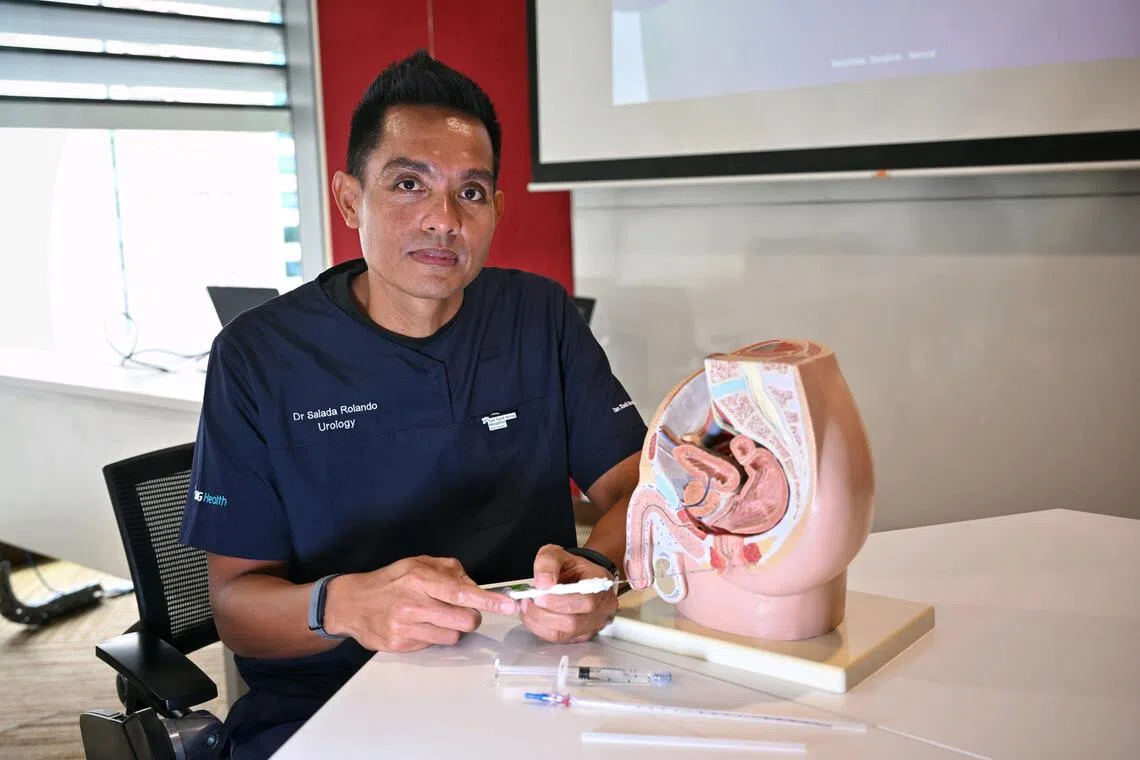
Salada Rolando has performed the pre-radiotherapy procedure on many patients with prostate cancer.
ST PHOTO: ARIFFIN JAMAR
The gel dissolves naturally in the body. It turns back into liquid about three to six months post-insertion, which is likely after treatment has ended as the entire course of radiotherapy for prostate cancer is typically completed within four to six weeks.
There is no known impact to the body when it absorbs the gel.
Overseas medical literature has shown that the rectal spacer insertion procedure is generally well-tolerated by patients, with common risks such as mild discomfort or bruising, more frequent urination or more cases of urgent need to urinate, and minimal bleeding.
TTSH’s shift to local anaesthesia was made in May, after more than a year of clinical evaluation by the hospital’s urology department, showing that the rectal spacer can be safely inserted under local anaesthesia.
There are plans for other public hospitals to also adopt a similar care approach, said Salada. An online search showed that there are private oncology clinics here which insert the spacer with local anaesthesia too.
Salada said about 50 patients had undergone the procedure with local anaesthesia. Twenty of them were aged 60 and above.
One of these patients was Er Lian Hong, 69. He was diagnosed with prostate cancer in May after a comprehensive health check revealed an enlarged prostate with signs of cancer, despite not showing specific symptoms.
He told The Straits Times that he opted for radiotherapy over an invasive surgery which would have meant he would be bedridden for two to three days, and would then have to carry a urination bag for about two weeks.
His spacer was inserted in August, allowing him to complete his radiotherapy within four weeks with minimal side effects.
Er said he has regained better control of his urinary function now, and has since returned to an active lifestyle, such as trekking up Bukit Timah Hill regularly.
KioskNews shows a cleaned-up reading view extracted from the publisher’s page — the original always lives on their site, not ours.