Glut! Farmers count losses as prices crash, customers happy
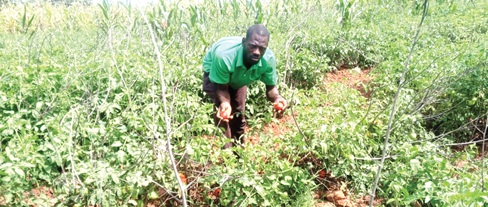
Farmers of vegetables in the Nabdam District of the Upper East Region are counting their losses as a sharp decline in the prices of tomatoes, pepper and okra threatens to undermine their incomes.
The prices of the vegetables have dropped significantly within the past month, following what farmers described as an increase in supply as more farmers bring their produce to the market.
Market survey
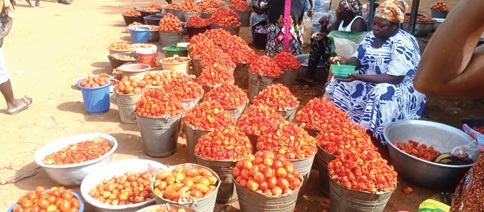
A market survey conducted by the Daily Graphic at the three major markets in Nabdam, including Pelungu, Kongo and Zanlerigu, showed that the price of a bucket of tomatoes had fallen from between GH¢120 and GH¢150 at the beginning of September this year to between GH¢60 and GH¢70 in early October.
Similarly, a basin of tomatoes, which previously sold for between GH¢300 and GH¢350, was now selling for between GH¢120 and GH¢150.
The prices of okra and fresh pepper had also declined sharply.
A bucket of okra, which previously sold for about GH¢120, was now going for GH¢80, while a bucket of fresh pepper was being sold between GH¢100 and GH¢120, as against the GH¢150 and GH¢200 recorded in September.
Farmers count losses
The development has brought some relief to consumers but has left farmers worried about recovering the huge investments they made in producing the vegetables.
Farmers attributed the situation to an increase in the supply of vegetables, saying the abundance of produce had weakened their bargaining power in the markets.
A tomato farmer, Mboleni Zoya, expressed frustration over the situation, saying the prevailing prices did not reflect the cost of producing the vegetables.
“We are not happy with the current prices, considering our expenses. However, with tomatoes being perishable, we are forced to sell at whatever price we can when there is abundance. This is the time most of us are harvesting because we all depend on the rain, and that is why you are seeing tomatoes all over with few buyers,” he said.
Another tomato and pepper farmer, Samson Wougnab, said the falling prices were discouraging, emphasising that farmers would struggle to break even if the trend continued.
“We were happy when a bucket was around GH¢150 or above because that would have helped us cover our expenditure, but now we are not even breaking even with the current prices.”
Buyers will intentionally come and wait until around 11 a.m. or 12 noon, and they come in with their own prices.
If you don't agree, you have to send it back home because they can't even finish buying it,” he said.
High production costs
The farmers said the sharp decline in prices was particularly worrying because the cost of production remained high.
They cited increasing expenditure on labour, seedlings, fertiliser and other farm inputs as some of the major costs affecting their profitability.
Mr Wougnab stated that, “During the beginning of the season, a bag of fertiliser was between GH¢450 and GH¢500, and a labourer was paid between GH¢70 and GH¢80.
Even putting my daily routine on the farm aside, imagine selling a bucket of tomatoes for GH¢60 or GH¢70, which is even in rare cases because sometimes you just have to give it out for something small. So, we are losing a lot.”
Mixed fortunes
While farmers complained about the situation, some food vendors and consumers welcomed the reduction in prices.
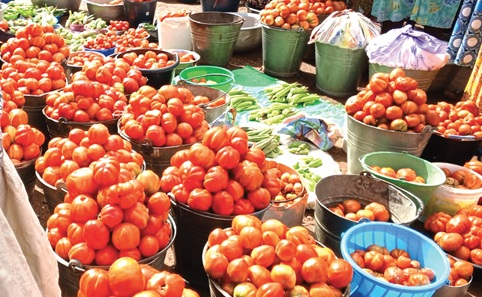
A food vendor, Ateni Ababila, said fluctuations in vegetable prices made it difficult for traders to predict their profit margins.
“For instance, buying a bucket of tomatoes for GH¢50 in Pelungu and transporting it to Bolgatanga at an additional GH¢10, only to sell it for less than GH¢80, means we end up with little or no profit. Sometimes, we are forced to sell it at a lower price because we cannot store it,” she said.
However, another food vendor at the Pelungu Market, Yenmah Mba, said the lower prices had improved her profit margins.
“The lower prices have led to substantial profits for me, and I hope this trend continues because this is normally the season for us to also enjoy. By the end of December, prices will rise, and by January, we won't get enough to buy in the district. So, let us enjoy it. Even if we get a bucket for GH¢40, we want it,” she said.
A customer, who is a teacher, also expressed satisfaction with the price reductions, saying they had made it possible for consumers to buy more vegetables with relatively little money.
“The reduced prices are fantastic. Now, a small amount of money can buy what I need, which is a significant improvement. It is time for us to also enjoy our stew at a lesser cost, but we are sorry for the farmers, though,” she said.
Call for support
The seasonal harvesting of vegetables and other crops in the Upper East Region usually increases from September and continues into the latter part of the year, resulting in increased supplies of some farm produce on local markets.
The Upper East Regional Director of Agriculture, Alhaji Fuseini Zakaria, said most of the farmers relied on rain for production.
“Over 90 per cent of the farmers rely on rain, so what it means is that they start planting at the same time, and that is the result we are seeing now.
If there is support for them to have mechanised boreholes, that will be appreciated because it tells you that when these farmers are given the needed support to produce year-round, we won't have problems with vegetables at any time in the season,” he said.
DISCLAIMER: The Views, Comments, Opinions, Contributions and Statements made by Readers and Contributors on this platform do not necessarily represent the views or policy of Multimedia Group Limited.
Tags:
DISCLAIMER: The Views, Comments, Opinions, Contributions and Statements made by Readers and Contributors on this platform do not necessarily represent the views or policy of Multimedia Group Limited.
KioskNews shows a cleaned-up reading view extracted from the publisher’s page — the original always lives on their site, not ours.