Printers’ group looks to future
By Hung Jui-chin and William Hetherington / Staff reporter, with staff writer


Once a major force for spreading knowledge, printing is now at a crossroads as digital reading reduces demand for traditional print. To adapt, one of Taiwan’s oldest printing associations is turning to artificial intelligence (AI), new markets and talent development.
Established 80 years ago, the Tainan City Printing Commercial Association is looking to the next 80 years with a focus on technology, talent and cultural preservation.
“AI adoption is only just beginning, and every industry is essentially starting from the same line,” the association’s honorary chairman Huang Chien-tung (黃建東) said on Sunday last week.
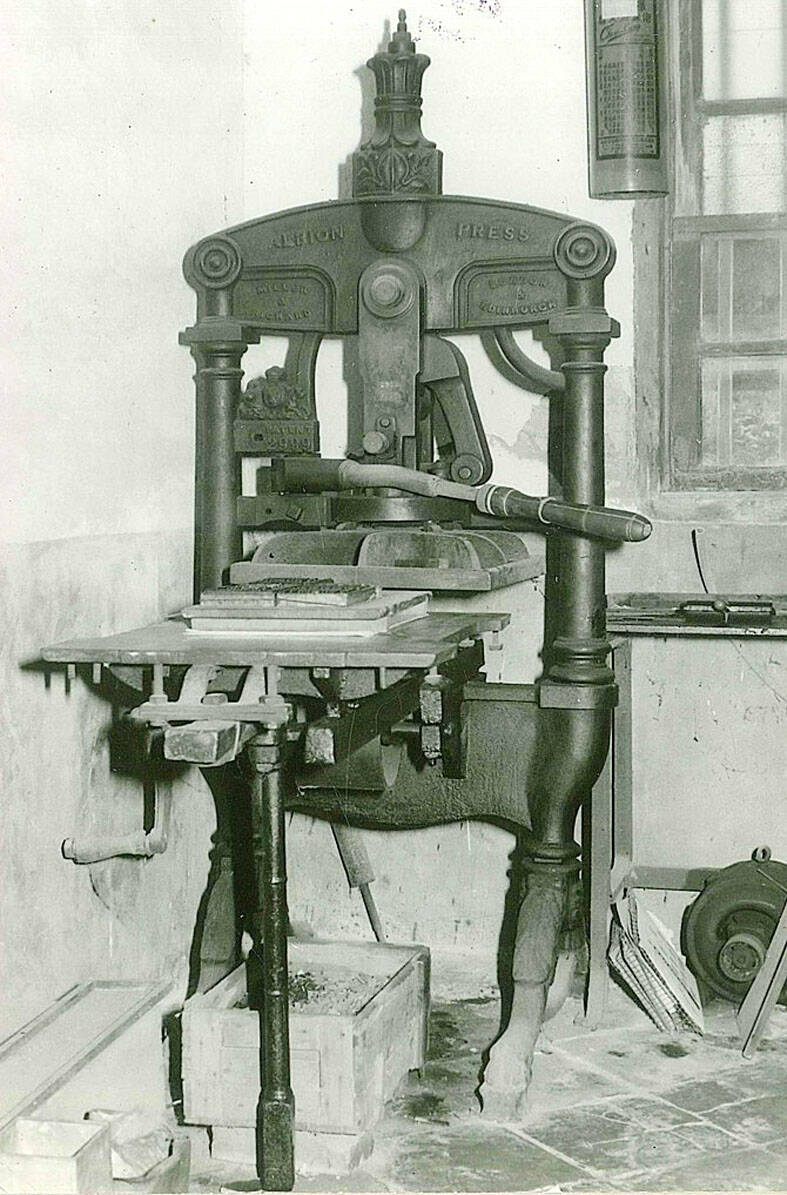
Taiwan’s first movable-type printing press is pictured in an undated photograph.
Photo courtesy of the Taiwan Church Press
The precision and commitment to quality developed by printing professionals provide a strong foundation for adopting AI, he said.
The association is promoting AI-powered design and intelligent production to address labor shortages, while developing AI training programs and seeking government support for digital transformation and talent development.
Pan Ching-chu (潘靜竹), head of the Fucheng Old Books Store, said Taiwan has about 10,000 publishers, but many new books have initial print runs of only 500 copies, compared with several thousand in the past. Rising production costs have pushed up book prices as demand falls, while large quantities of nearly new secondhand books are being sold for a fraction of their original prices.
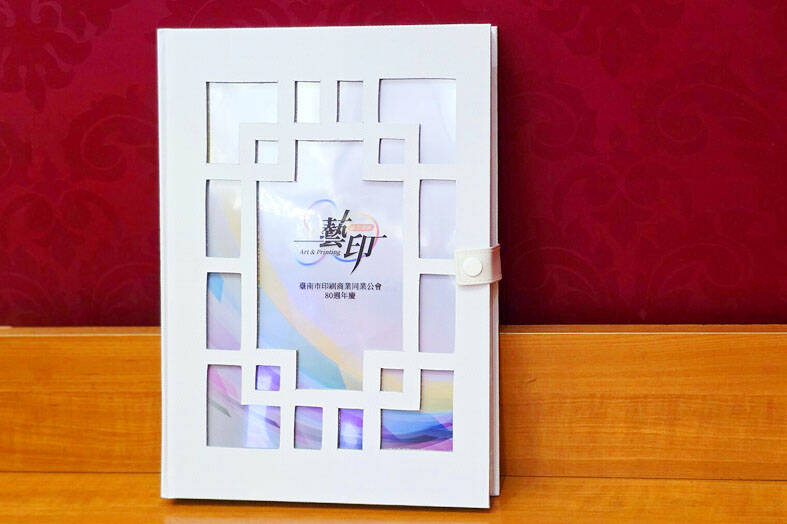
Cover of a publication by Tainan City Printing Commercial Association marking its 80th anniversary is pictured in an undated photograph.
Photo: Hung Jui-chin, Taipei Times
Still, Pan said printing remains essential for packaging, advertising and other commercial applications.
Huang Chin-yi (黃進益), a section chief at Academia Sinica’s Southern Branch Service Office, said books connect design, editing, paper, ink, machinery, binding, logistics and sales into a cultural and creative industry chain. Rather than mass production, print could increasingly focus on high-quality materials, sophisticated design and collectible value, he added.
The renewed popularity of independent publishing, zines, art books and photography books among younger creators also suggests that demand for print and its tangible qualities remains.
The association’s 80th-anniversary publication showcases that craftsmanship. Its cover combines Oxford paper, laser-foil stamping and die-cutting inspired by traditional Tainan window patterns, blending traditional motifs with modern printing techniques.
Printer Sun Wen-shan (孫文山) hopes Tainan can establish a printing-themed tourist factory combining cultural history, technology demonstrations and hands-on activities.
Companies are also demonstrating how the industry can adapt.
Chairman Lu Jung-ta (盧榮達) said that printing companies must understand how to adapt to markets and customer needs while maintaining expertise in design, production and service.
Chien Sheng Enterprise, the first printing company to establish a facility in the Tainan Technology Industrial Park, helped usher traditional printing into the technology sector through computerized equipment, digital typesetting and precision printing.
Manager Huang Chien-tung (黃建東) said that the global industry has moved beyond simple contract manufacturing toward digitalization and knowledge creation. With product life cycles shortening, companies must continually invest in research and development and incorporate new technologies to remain competitive, he added.
Chairman Cheng Chun-ming (鄭俊銘) said the company’s green transformation goes beyond upgrading equipment to incorporating sustainability into its products and operations.
Cheng also emphasized the importance of talent, saying that traditional industries face difficulties recruiting workers, and Taiwan has few printing-related programs. He said medium and senior-level professionals returning to the workforce, particularly those with management experience in the electronics industry, could become an important source of talent if given appropriate printing training.
From movable type to AI-powered manufacturing, Tainan’s printing industry is attempting to preserve its traditional expertise while adapting to a digital, increasingly automated and environmentally conscious economy.
KioskNews shows a cleaned-up reading view extracted from the publisher’s page — the original always lives on their site, not ours.