Transformative new robot that can fly, sail, and swim autonomously
Bio-inspired robots are a dime a dozen these days, with machines mimicking everything from bats and beetles to long-extinct sea creatures. But making the absolute most effective robot for certain niche scenarios like remote ocean monitoring during storms requires going one step beyond what nature offers.
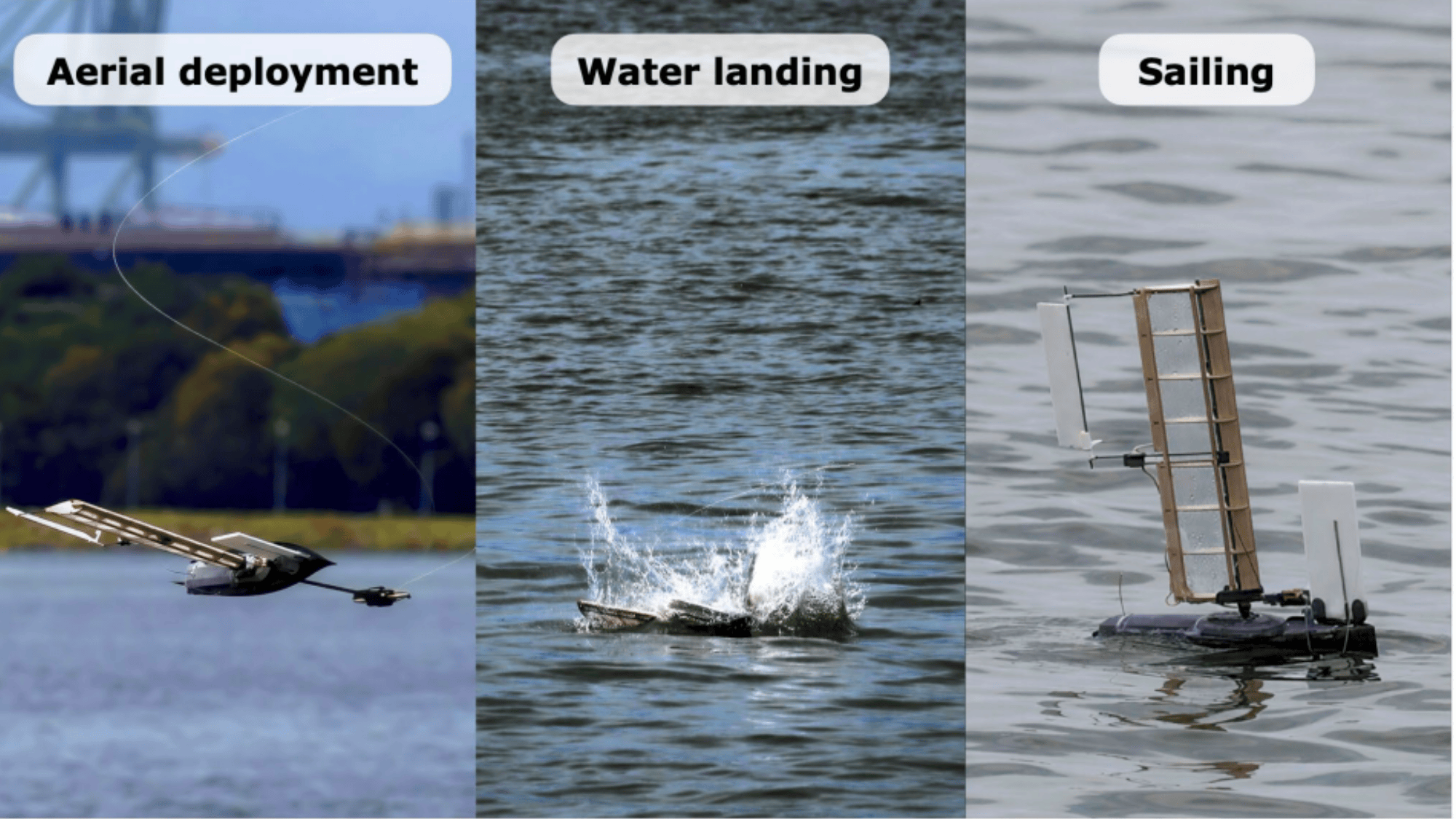
With this in mind, researchers from the Singapore University of Technology and Design recently engineered a kind of multi-formed chimera robot that can be dropped from high in the sky, spin its outstretched “wings” to slow itself down, land on water, and then seamlessly morph into a sailboat with a fish-like backup rudder. Once afloat, the sensing robot (part maple seed, part swan, part fish) can navigate autonomously for several hours. The result is a machine that uses biology less like a strict blueprint and more as a garage full of useful, interchangeable part, according to in a study published today in the journal Science Robotics, The team calls their creation ALBATROSS, short for Airborne Lander with Buoyant AuToROtating Sailing Sensor.
“Individual mechanisms can be borrowed, recombined, and engineered toward objectives evolution never faced,” engineers Raphael Zufferey and Andre Farinha write in a related editorial about their study. “Nature does not provide the complete solution but provides useful functional parts,” they add.

ALBATROSS In Action
ALBATROSS began with a simple realization: the perfect robot for remote aquatic sensing doesn’t really exist. Currently, getting accurate readings of marine habitats quickly during emergencies like underwater earthquakes, oil spills, or chemical leaks requires sending out a crewed vessel, then dropping in a robot or trying to get reasonably close with an aerial drone. Existing robots and drones are both only partially effective. A better method, the team noted, would be with something that can be dropped in from the air right at the source, and then navigate the area automatically. That kind of reconnaissance requires a machine that functions seamlessly in both air and water, but is also simple and cost-efficient enough that ocean research teams can realistically deploy it.
Like many roboticists before them, the team looked to nature as an inspiration. But unlike echolocating in the dark with sonar or running up hills, searching through human-made oil spills isn’t something any creature has naturally evolved to do. That’s where the idea of treating nature as a parts factor comes in. For the flying portion of the deployment, where the robot uses its wings to slow its descent, the team borrowed from the lowly maple seed. They then studied the anatomy of mute swans (Cygnus olor) for the sailing portion and various fish for its caudal fin-like back rudder. The rudder helps propel the robot forward when there isn’t much wind or when it needs to travel upwind.
What makes ABATROSS particularly noteworthy is its simplicity. The same rigid limbs it uses to twirl itself through the air double as sails once it’s in the water. Because those components are dual-use, the team didn’t have to add extra parts that could break or drive up development costs. The robot they ended up with weighs just a little over two pounds and navigated using only three actuators and three primary sensors.
The team tested ALBATROSS in repeated trials over two reservoirs in Singapore. In each trial, the robot was transported over the water, dangling from a remotely operated drone which hovered about 490 feet in the air before being released. The robot then used its spinning limbs to slow its descent from around 69 mph to about 15 mph, easing its landing.
According to the team, this acrobatic spinning, critical for safe aerial deployment, reduces the impact force 18-fold. Once it slows down, ALBATROSS rights itself almost immediately and seamlessly transforms into a form reminiscent of a toy sailboat.

ALBATROSS pool and river tests
Thanks to its simple but effective onboard sensors, the robot navigated the test area without constant human intervention, continuously recording environmental data, including humidity levels and temperature fluctuations. Those are exactly the kinds of measurements a sensing robot would need to collect in a real-world scenario. And what ALBATROSS lacks in mechanical complexity, it makes up for in energy efficiency. In one experiment lasting about three hours, the robot finished with roughly 50 percent of its main battery remaining.
“By integrating minimal actuation, bioinspired structures, and passive dynamics across aerial and marine operating regimes, this work extracts generalizable design principles for lightweight, aerially deployable sailing robots capable of robust, energy efficient marine sensing,” the authors write in the paper.
But don’t expect ALBATROSS to head into the eye of Hurricane Polo or any other major storm anytime soon. Its small, lightweight frame likely wouldn’t survive more than a few moments in violent ocean waves before being reduced to severed piles of scrap. However limited its practical applications may be for now, ALBATROSS’ biggest achievement may be in helping humans engineer expanding what it means to build a bioinspired robot, with the emphasis on inspired. In other words, when nature gives you lemons, maybe get creative and make totally non-naturally-occurring 90s-esque neon-pink lemonade instead of something rosey.
KioskNews shows a cleaned-up reading view extracted from the publisher’s page — the original always lives on their site, not ours.