Notes from Central Taiwan: The debt behind Taiwan’s local building boom
Self-liquidating loans help local governments finance major projects, but optimistic revenue forecasts risk leaving future administrations and taxpayers with the bill
By Michael Turton / Contributing reporter


As we watch this exciting local election reach its climax, we should be asking what all these politicians are getting themselves into. Debt, of course. Managing the nation’s local debt situation doesn’t get much publicity, but it is a major problem for local governments.
The United Daily News (UDN) reported in September that city councilors in Taoyuan have expressed concern about the debt being incurred by funding the city’s numerous large construction projects. These include the Aerotropolis complex, the MRT green line and moving the railway underground. According to UDN, total public debt reached approximately NT$34.6 billion at the end of last year, with interest payments jumping to roughly four times their 2020 level to nearly NT$1 billion last year. Another NT$267.5 billion in major policy projects remains to be allocated. Note too that Taoyuan has other liabilities, over NT$50 billion, including retirement pensions. However, the city’s finance bureau said that Taoyuan’s per capita debt of NT$14,700 is the lowest among the six major cities, and the debt is manageable.
SELF-LIQUIDATING DEBT

Visitors on Nov. 14 attend the Taoyuan Flower Festival in the city’s Dasi District. Taoyuan’s per capita debt of NT$14,700 is the lowest among the six major cities.
Photo: Hsieh Wu-hsiung, Taipei Times
Kaohsiung, according to a UDN report from August, is in a much different situation. According to the latest Ministry of Finance figures, it is the nation’s most indebted local government, although the city’s mayor, Chen Chi-mai (陳其邁), has overseen a drop in the city’s debt. However, this was accompanied by “self-liquidating” debt, in which the revenues from an asset offset the debt, removing the need for outside funding. The sharp rise in self-liquidating debt triggered an excessive debt warning from the Audit Department. The city finance bureau responded by saying that self-liquidating financing is used to accelerate construction of projects like light rail and the MRT. The costs are then repaid (“self-liquidated”) through ticket revenues, land development and incremental tax revenue, among a host of others. Such investments have generated NT$100 billion annually for the city, the bureau said.
Kaohsiung’s current debt per person, according to the city, is roughly NT$80,000, much higher than other local governments. Whoever wins in Kaohsiung is going to be constrained by the need to manage and reduce the city’s massive debts.
New Taipei City Mayor Hou You-yi (侯友宜) in September announced that the city’s debt had been reduced. Hou, said the city’s Directorate-General of Budget, Accounting and Statistics (DGBAS), had managed to increase spending on social projects and infrastructure despite the debt reduction. Of course, the cities receive a disproportionate share of central government development funding.

A light show along the Love River in Kaohsiung is pictured on Thursday last week. The city is the nation’s most indebted local government, although the city’s mayor, Chen Chi-mai, has overseen a drop in the city’s debt.
Photo: Lee Hui-chou, Taipei Times
Several of the local county governments struggle with long-term debt issues. The Miaoli county government in 2015 appealed to the central government for help with its NT$64.8 billion debt, which the Ministry of Finance rejected. Starved for funds, the county had been forced to lay off workers and slow construction projects. An Apple Daily piece at the time described the apparent extravagance of the previous county commissioner, Liu Cheng-hung (劉政鴻), who tripled the county’s debt, observing that the county government spent NT$218 million (US$7 million) on fireworks and concerts, but only NT$100 million (US$3.2 million) annually on nutritious school lunches during his tenure.
Today the Miaoli County debt is still high at NT$54 billion, according to an August UDN report. The Ministry of Finance lists it as having the highest debt ratio (defined as the outstanding balance of public debt with a maturity of one year or longer divided by total expenditures in the general budget and special budgets) among all city and county governments. The county has been in surplus every year since 2016, slowly beating the debt down.
Keelung too labors under debt, according to a report from our sister paper, the Liberty Times. Although the Finance Department announced in January that the city’s debt is only NT$4 billion, it estimates that the gap between revenue and expenditure will be NT$2.2 billion. That sum will have to be borrowed, raising the debt to NT$6.2 billion by the end of the year.
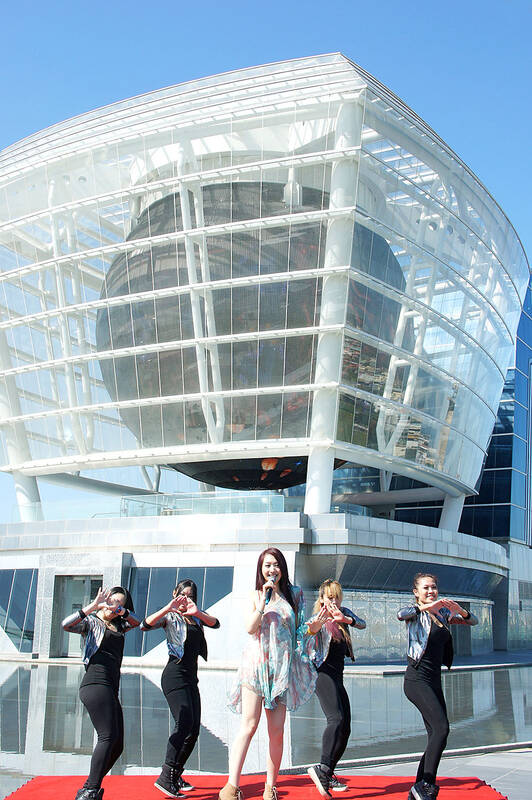
A pop group in June 2016 performs in front of the Taiwan Expo Pavilion in Hsinchu. The pavilion closed that year leaving the city government holding NT$1.1 billion in debt.
Photo: Hung Mei-hsiu, Taipei Times
MOF BAILOUT
Yilan County has wrestled with debt for years. For example, in 2010 it was struggling to pay wages and bonuses to its workers. Eventually it came under Ministry of Finance control because its debt exceeded legal limits. Although Yilan has paid off some of that debt since, Ministry of Finance figures show that its current overall debt ratio is 23.32 percent. It is second only to Miaoli in that respect.
By contrast, whoever wins in neighboring Hsinchu City is going to have what appears to be an excellent fiscal situation. The city government announced in July that after 30 years it had repaid all its outstanding public debt under the Public Debt law (it still has other liabilities) and debt per person was effectively zero.
The use of self-liquidating debt in Kaohsiung and elsewhere, regardless of the political party or the mayor, generates a problem of “hidden debt.” For example, a KMT city councilor in Kaohsiung estimated in a September interpellation that city liabilities exceeded NT$300 billion. But the city contended that the self-liquidating debt should not be included because it is repaid via revenues. As a Liberty Times piece from August observed, the increases in Kaohsiung’s self-liquidating debt are below similar increases in Taoyuan and New Taipei City over the last few years.
The self-liquidating calculation hinges on the ability of the asset to generate revenues while holding costs down. That is increasingly difficult. For example, Taoyuan’s social-housing plans expanded from 10 sites containing 4,075 homes in 2017 to 37 sites containing 9,982 homes last year. Estimated program costs rose from about NT$20.5 billion to more than NT$100.4 billion, while the projected self-liquidation ratio fell from 100.11 percent to 63.59 percent. Ballooning costs, labor shortages and delays and problems of construction projects, affect Taoyuan city’s social housing dreams.
Similarly, Hsinchu city borrowed NT$1.5 billion to fund the “Taiwan Expo Pavilion”, treating it as a self-liquidating debt since the pavilion would generate revenues. It was allegedly not managed well according to local media reports, and was closed in 2016, leaving the city holding NT$1.1 billion in debt.
APPEAL AND CONSEQUENCES OF SELF-LIQUIDATING DEBT
The reason self-liquidating debt is so tempting for big-city mayors is that it lies outside the debt limit regulations. Hence, the city mayor’s office can report that public debt is going down, while in fact it is rising, because it has been hidden as self-liquidating debt. The Audit Office in Kaohsiung warned the mayor on that exact point, noting that self-liquidating revenues had not matched expectations, meaning that debt had risen. The Kaohsiung City Finance Bureau responded with that bureaucratic classic: self-liquidating debts are handled in accordance with regulations. But of course, they are exempt from debt limit regulations.
As the population both ages and shrinks, abuse self-liquidating debt will become a critical issue and an irresistible temptation for local governments. Cost and revenue calculations for such debt will become increasingly distorted: costs will rise as labor shortages grow, while revenues will fall since the old consume less. Local government potentates need to be prevented from managing their debts by redefining them as self-liquidating through revisions to the relevant debt laws by the legislature.
After all, we are a decade away from the moment when more than half of the population aged 15–64 will be aged 45–64. What kind of politics will we have when half the workforce is either retired or thinking of it?
Notes from Central Taiwan is a column written by long-term resident Michael Turton, who provides incisive commentary informed by three decades of living in and writing about his adoptive country. The views expressed here are his own.
KioskNews shows a cleaned-up reading view extracted from the publisher’s page — the original always lives on their site, not ours.