UK diesel prices hit record high at 199.18p a litre; housebuilder stocks surge on new homes scheme – business live

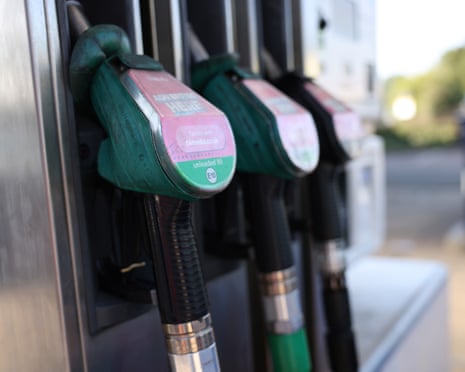
Diesel is now selling at its highest price ever: forecourts are charing 199.18p per litre on average in the UK, according to the RAC, surpassing the previous record set in June 2022 after Russia’s invasion of Uktraine.
Simon Williams, head of policy at the RAC, said the cost of filling up an average family car is now almost £110, which marks a £31 increase compared with at the start of the US-Iran conflict.
The diesel price has entered new uncharted territory. This spells pain not only at the pumps for drivers, but for everyone who buys goods or services that rely on diesel lorries and vans; undoubtedly these increased costs will be passed on to consumers.
Petrol prices are also rising, with a litre of unleaded now at 174.13p on average, 41p more than at the start of the war. Te cost of a full tank is now nearly £96. Williams said:
These extraordinarily high prices are another reminder of just how exposed the UK is to events occurring far away from its shores. Only a sustained lower oil price – over several weeks, not days – will lead to cheaper prices at the pumps.
Suggestions of a renewed deal to end the blockade of the Strait of Hormuz and get oil supplies moving freely again had offered a slight glimmer of hope for drivers.
The UK might have limited leverage when it comes to ending the US/Iran war and ultimately bringing oil prices down, but the government could take steps to ease the burden on drivers by lowering fuel duty further or reducing VAT.
As things stand, another 5p a litre will be loaded onto pump prices by the spring if the current fuel duty cut is fully reversed as planned. VAT receipts from fuel are also extremely high, so drivers will be watching this coming week’s Labour party conference, and October’s budget, very carefully indeed.”
Key events
UK diesel price hits all-time high at 199.18p per litre
Oil price rises again as Iran tensions continue
'Christmas come early' for UK housebuilders
Introduction: UK housebuilder stocks soar on new homes scheme
Dr Jonathan Owens, operations and supply chain expert at the University of Salford, says that businesses should be bracing for higher diesel prices.
Diesel prices are creeping upwards across UK forecourts, with prices in some locations considerably higher than the national average. Consider the impact on just one HGV (heavy goods vehicle).
Take a HGV travelling 80,000 miles annually, at eight miles per gallon, it would consume approximately 45,460 litres of diesel. At £2 per litre, that gives an annual fuel bill of approximately £90,900. If we jump to £3 per litre, that rises to approximately £136,400. In real terms, an increase of around £45,500 per HGV. If this is scaled across a fleet of 100 HGVs, we see an additional fuel bill approaching £4.55 million. And those costs do not simply remain with the haulier.
…The consequences could reach almost every part of UK economic life: supermarkets, manufacturing, construction, agriculture, e-commerce and countless other sectors that depend upon road freight.
Diesel is now selling at its highest price ever: forecourts are charing 199.18p per litre on average in the UK, according to the RAC, surpassing the previous record set in June 2022 after Russia’s invasion of Uktraine.
Simon Williams, head of policy at the RAC, said the cost of filling up an average family car is now almost £110, which marks a £31 increase compared with at the start of the US-Iran conflict.
The diesel price has entered new uncharted territory. This spells pain not only at the pumps for drivers, but for everyone who buys goods or services that rely on diesel lorries and vans; undoubtedly these increased costs will be passed on to consumers.
Petrol prices are also rising, with a litre of unleaded now at 174.13p on average, 41p more than at the start of the war. Te cost of a full tank is now nearly £96. Williams said:
These extraordinarily high prices are another reminder of just how exposed the UK is to events occurring far away from its shores. Only a sustained lower oil price – over several weeks, not days – will lead to cheaper prices at the pumps.
Suggestions of a renewed deal to end the blockade of the Strait of Hormuz and get oil supplies moving freely again had offered a slight glimmer of hope for drivers.
The UK might have limited leverage when it comes to ending the US/Iran war and ultimately bringing oil prices down, but the government could take steps to ease the burden on drivers by lowering fuel duty further or reducing VAT.
As things stand, another 5p a litre will be loaded onto pump prices by the spring if the current fuel duty cut is fully reversed as planned. VAT receipts from fuel are also extremely high, so drivers will be watching this coming week’s Labour party conference, and October’s budget, very carefully indeed.”
European gas prices are also rising this morning . The benchmark Dutch contract is up 2.9% to €74.185 per megawatt hour (MWh), while the the British front-month contract is up 2.7% to 184.64 pence per therm.
And in the world of energy – the UK’s grid operator has warned that electricity supply could be tight this evening.
The National Energy System Operator (Neso) said there could be a shortfall of 1.4 gigawatts starting at 4pm on Monday, before a spike in wind power then brings relief into the system, according to a notice to the market.
Neso wrote on social media that the notice was a “a routine and precautionary operational tool”.
There is no risk to customer electricity supplies and Great Britain’s electricity system remains secure.
Elsewhere this morning, oil is rising again as optimism fades on possible progress in talks between the US and Iran. Brent crude, the international benchmark for oil prices, rose by as much as 3.29% this morning to $107.75 a barrel.
Iran announced a peace proposal last week at the UN General Assembly in New York, saying it had been transmitted to the US via Qatari mediators. Donald Trump said on Saturday he rejected the plan, but told Axios in a phone interview on Sunday that he expected US negotiators to engage in more talks this week
Worries around continued conflict in the Middle East – and the impact it can have on global inflation – are growing in the bond market too. US treasury yields are up, with the 10-year up 3 basis points to 5.21%. So too are UK bond yields – the 10-year gilt is up 4 basis points to 5.403% this morning.
This does not set an ideal backdrop for UK chancellor John Healey, who will be giving his speech at the Labour party conference in Liverpool at noon today.
It is “Christmas come early” for UK housebuilders, says Anthony Codling, managing director at the broker RBC Capital Markets.
We believe that those with most exposure to the south and south east (Crest Nicholson) and the more liquid stocks (Barratt Redrow, Persimmon and Taylor Wimpey) will outperform, and those with the least exposure to open market homes (Vistry) and homes likely to be priced above the Your First Home price cap (Berkeley) to underperform on a relative basis.
That said, we believe this is the big catalyst the sector as a whole needed for a re-rating, and whilst most of us have 88 sleeps to Christmas, Christmas has come early for the UK housebuilders.
Shares in building material suppliers are also joining housebuilders in their market rally this morning – brick-maker Ibstock has jumped 21%, while Marshalls, which makes hard landscaping and building products, is up 12% this morning.
Construction material suppliers Forterra and Breedon are up 14% and 9% respectively. Topps Tiles is up 6%.
Adrian Kearsey, an analyst at the broker Panmure Liberum, notes there are still few details on how exactly the scheme will work. He wrote this morning:
Conversations with housebuilders over the weekend indicated that while they welcomed the news, they recognise the need to discuss the practicalities of implementation in the coming weeks.
He adds that the key winners are likely to be housebuilders with a lower price product, such as MJ Gleeson (which has shot up 19% this morning) and Persimmon (up 16%).
At this stage it is unclear what the income and property value caps are going to be. Even if they are relatively generous, it is likely that higher price point developers (such as Berkeley Group, not rated) benefit as much.
At this stage it is unclear what level of financial contribution the housebuilders will be required to make to participate in the scheme. If this hurdle is too high, then developer take up may be limited. Moreover, even a moderate contribution may preclude those housebuilders with stretched balance sheets (e.g. Crest Nicholson).
Good morning, and welcome to our rolling coverage of business, the financial markets and the world economy.
UK housebuilder stocks are flying this morning as investors rejoice at a new homes scheme for first-time buyers in England.
Shares in Barratt Redrow have surged 14%, making it the best performer across the FTSE 100. Housebuilders are dominating the FTSE 250 index too, with Vistry, Persimmon, Taylor Wimpey and Bellway all up between 14% and 16% this morning.
It comes after Andy Burnham unveiled plans over the weekend for a new help-to-buy scheme.
The programme, called “Your first home”, is intended to help buyers in England who have a regular income but have been unable to save for a large deposit or don’t have financial support from their family.
Under the scheme, first-time buyers will get a 20% equity loan to help them buy a new-build home, with an initial interest free period and a requirement of a minimum deposit of just 2.5%.
There will be household income caps and a deposit cap to exclude those on the biggest salaries and with big savings pots. There will also be price caps on the value of the properties.
Richard Hunter, head of markets at the broker Interactive Investor, said the new policy would be a welcome boost for the industry.
The housebuilding sector has been beleaguered by a raft of headwinds ranging from higher mortgage rates and strained affordability to a slow planning process for new homes and the announcements have provided a rare and overdue relief rally from investors.”
The agenda
-
7am BST: Aldi full-year results
-
11am BST: MPC member Dave Damsden speaks in London on quantitative tightening
KioskNews shows a cleaned-up reading view extracted from the publisher’s page — the original always lives on their site, not ours.