Yalta 2.0? Amid Shenzhen summit, revisiting the historic 1945 conference
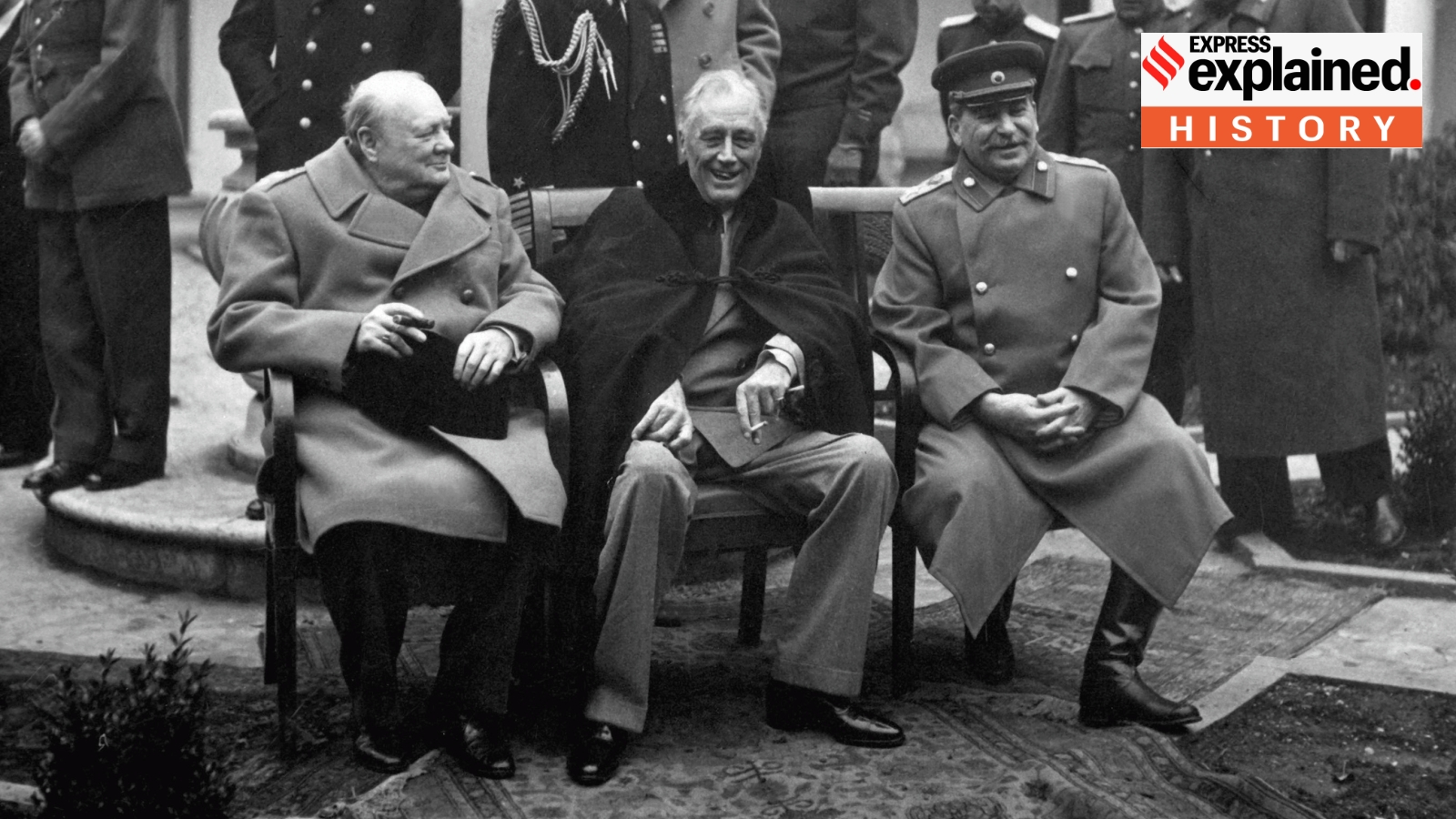
As leaders of the United States, China, and Russia — Donald Trump, Xi Jinping, and Vladimir Putin — convened in the Chinese city of Shenzhen for a trilateral summit to be held Thursday (November 19), some geopolitical observers likened it to a “Yalta 2.0” — a reference to the historic Yalta Conference of February 1945 where the eventual victors of World War II met to finalise a post-war settlement for Europe.
The summit comes at a critical juncture where the US and Russia are caught up in wars they started, while China, as a host, attempts to position itself as advocating a stable world order. Although the Kremlin was quick to dismiss any such comparisons to Yalta as “games of political scientists”, concerns over “great powers” dividing the world into “spheres of influence” have been raised by leaders such as Ukrainian President Volodymyr Zelenskyy, whose country has been fighting against a Russian invasion for close to five years now.
Even as the debate rages over the terms of engagement in Shenzhen, we revisit what ensued in the run-up to and during the Yalta Conference, and its consequences for the post-war geopolitical order.
What happened before Yalta?
World War II had broken out in September 1939 after Adolf Hitler-led Nazi Germany invaded Poland, which prompted the Allied forces — Great Britain and France — to declare war on Germany.
Over the course of the next year, Italy and Japan joined forces with Germany to form the Axis Powers and opened new battle fronts across Asia and parts of North Africa. Russia, in the meantime, had signed a non-aggression pact with Germany at the beginning of WWII but shifted sides in June 1941 after the latter invaded Soviet territory.
Although a swift military offensive by Hitler’s forces initially overwhelmed the Allies and brought most of Europe under German control, the tide began to turn with the US joining the Allies in December 1941 following Japan’s bombing of Pearl Harbor.
In November 1943, the leaders of the three Allied countries met in Tehran to coordinate the next phase of the war on both fronts: Europe and the Pacific. The conference saw the US and Britain commit to launching an invasion of Europe by mid-1944 — they did on June 6, 1944, also called D-Day — whereas Russia agreed in principle to join the fight against Japan after Germany was defeated.
Story continues below this ad
What happened at the Yalta Conference?
Much had changed in Europe by the time Roosevelt, Churchill, and Stalin again decided to convene in early 1945. While the US and Britain had liberated France and Belgium and had reached the western border of Germany, the Russians had already pushed the Germans out of Poland, Romania, and Bulgaria and were rapidly advancing towards Berlin from the east. With victory very much on the horizon, the “Big Three” met in February 1945 to discuss the issue on top of everyone’s mind: what a post-war world would look like.
In addition to the proximity of the Soviet forces to the German capital — about 40 miles at the time — the choice of Yalta in the Crimea peninsula on the Black Sea coast as the venue also handed Stalin a distinct advantage ahead of the conference. Stalin had himself proposed the resort city as the venue citing his doctors’ advice against him flying long distances.
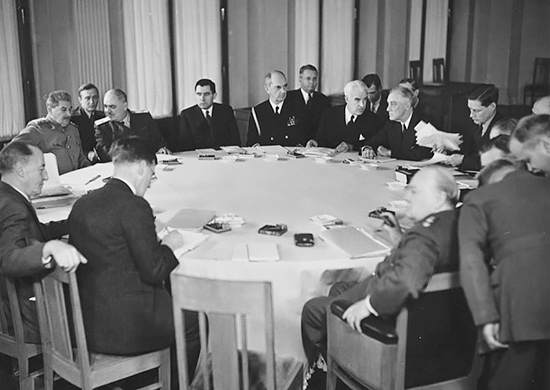 Leaders of the “Big Three” at the negotiating table at the Yalta conference. Photo: Wikimedia Commons
The following emerged out of the discussions at Yalta:
Germany divided: The three leaders agreed that after Germany’s surrender, the country would be divided into four post-war occupation zones, controlled by American, British, French, and Russian military personnel. Although not invited to Yalta, France was included in the scheme of governing post-war Germany after Stalin agreed on the condition that the French zone would be carved out of the British and US zones.
Story continues below this ad
The Allies also decided to assume some — but not sole — responsibility for post-war reparations (which was finalised in Potsdam later that year), besides ensuring Germany was completely demilitarised and “denazified”.
Eastern Europe: On the question of Poland, Stalin refused to yield much, pointing out how Germany had twice used the country as a corridor to attack Russia. Although he refused to relinquish control of Polish territory under Russian control, he decided to allow representatives from other parties into Poland’s provisional government, which was already dominated by communists.
He also promised to allow free elections not just in Poland but in all eastern European countries liberated from the Nazi occupation, in return for the US and Britain agreeing that these future governments in those countries be “friendly” to the Soviet Union — thus granting Stalin his “sphere of influence”.
United Nations: Stalin also agreed to the Soviet Union participating in the UN, envisioned as an international peacekeeping organisation at the time, on the condition that permanent members of the UN Security Council would hold the right to veto.
Story continues below this ad
Pacific front: Stalin also reiterated his promise from Tehran: that the Russians would join the war against Japan within “two or three months” after Germany’s surrender. In return, he wanted control of territories it had lost to Japan in the Russo-Japanese War (1904-05) such as southern Sakhalin and the Kuril Islands — the dispute over the latter continues to this day.
What happened after Yalta?
Although all outstanding questions would be resolved only in the Potsdam Conference in July-August 1945 after Germany’s unconditional surrender, the hopes raised by the bonhomie on display at Yalta soon fizzled out.
Starting with Poland, the Soviet Union went back on its promises to allow free elections in the liberated eastern European countries, setting the stage for Soviet domination across the region. Roosevelt, who was seriously ill during the Yalta Conference and died two months later, received a great amount of criticism back home for the concessions he made to Stalin — his successor, Harry S Truman, would adopt a far more cautious approach to negotiations with the Soviet Union while finalising the terms of the Potsdam Agreement.
“In dealing with Russian leaders, Roosevelt, like many US presidents after him, appeared to believe that gestures of good will and efforts to take account of legitimate Russian interests, would be enough to convince Russia to take a more tolerant approach to its neighbors. Roosevelt seemed to hope that the momentum of wartime alliance, and the prospect of post-war entente and US support, would appeal to Stalin as much as it appealed to him. If so, Roosevelt would not be the last president to project his open mind to Russian leaders who did not share it,” wrote former US ambassador Daniel Fried in a 2020 piece for the American think tank Atlantic Council.
Story continues below this ad
The end of one conflict would only be succeeded by the start of another — one that would turn out to be colder and much longer. Come March 1946, Churchill (by then no longer Prime Minister) would sum up this breakdown of camaraderie in a memorable line. “An iron curtain has descended across the continent,” he said, thereby confirming the division of not just Europe but the world into two “spheres of influence” for decades to come.
KioskNews shows a cleaned-up reading view extracted from the publisher’s page — the original always lives on their site, not ours.